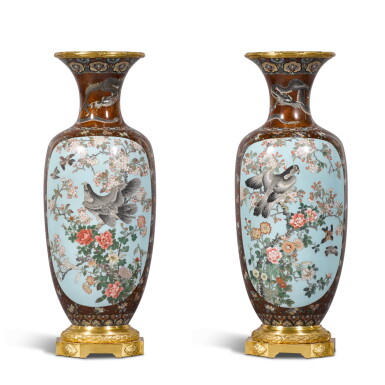
A pair of Japanese cloisonné enamel vases, late 19th century
Lot Closed
May 17, 12:15 PM GMT
Estimate
10,000 - 15,000 GBP
Lot Details
Description
A pair of Japanese cloisonné enamel vases, late 19th century
with Louis XVI style gilt-bronze mounts to the spout and base, each tall tapering vase with everted neck, the body with a main panel decorated in coloured enamels on a light blue ground depicting a bird on flowering branches, among an aventurine coloured ground
67.5cm. high, 23cm. wide; 2ft. 2 1/4 in., 9in.
The present pair of vases reveals the influence of Japan on French decorative arts and furniture pieces in the second half of the 19th century, brought by the opening of Japan to the West and that nation's participation in the 1867 Paris Exposition Universelle. The style and quality would have surely positioned these vases at the height of the Parisian taste. At the time, designers such as Edouard Lièvre and firms such as L'Escalier de Cristal were important figures for 'Japonisme' and the decorative arts, with the design vocabulary often including elephants, dragons, cranes, stylized foliage, blossoming branches, the lotus flower and intricate intertwined lines.
Here Japanese vases from the Meiji period, late 19th century were mounted with sleek Louis XVI style gilt-bronze mounts. A similar Japanese cloisonné enamel vase was sold at Sotheby's, London, 3 November 2021, lot 67 and another example sold at Christie's, London, 18 November 2014, lot 129. Interestingly, similar mounts to the base of the present are found of a pair of glass vases by the Escalier de Cristal offered at Christie’s, London, 22 March – 5 April 2022, lot 139.
L'Escalier de Cristal was first established in 1802 by Madame Désarnaud. She exhibited at the Exposition Nationale in the Louvre in 1819. The business was based in the Palais Royal and it was the first manufacturer to mount crystal objects with gilt-bronze. L' Escalier supplied lamps, vases, clocks and other objets d'art to most of the aristocratic European families. The firm was appointed fournisseur breveté du Roi in 1819 as well as to the Duc de Berry and the garde meuble de la Couronne. In 1872, the business was acquired by Emile Pannier and moved from their Palais Royal Galleries to Nouvel Opera region at the corner of rue Scribe and rue Auber. In 1885, George and Henry Pannier succeeded their father and gradually developed a company which became noted for the quality of its production. The company supplied furniture and all manners of luxurious objects often having manufacturers supplying individual components which were then assembled to the firm's own design. The firm boasted such distinguished designers as Lièvre and Viardot and soon developed a recognizable style, often looking to the Orient for inspiration. The firm's work can be found in public collections such as the Musée du Louvre and the Musée d' Orsay, Paris.
You May Also Like