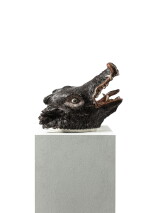
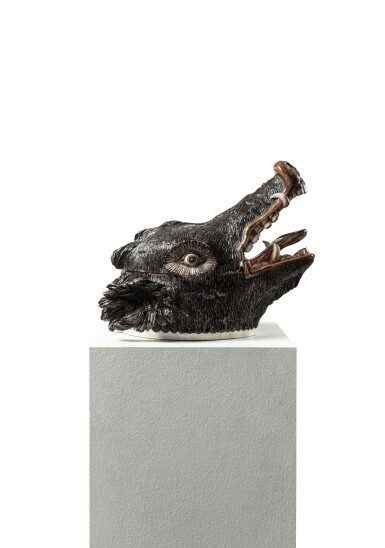
A Continental faience Boar tureen and cover, perhaps Lunéville, mid-18th century
Estimate
10,000 - 15,000 EUR
We may charge or debit your saved payment method subject to the terms set out in our Conditions of Business for Buyers.
Read more.Lot Details
Description
naturalistically modelled and painted, with dark brown fur and eyes picked out in blue, its snout hollow and pierced
Approximate length 13 3/8 in., Height 11 in. ; Longueur approx. 34 cm, Haut. 28 cm
J. & G. Laue Kunsthandlung, Munich;
Acquired from the above in 1999.
Naturalistically modeled as a boar’s head, this exceptional tureen epitomizes the technical mastery of 18th century European faience. Whether fashioned in faience or Chinese porcelain for the export market, boar’s head tureens ranked among the most coveted centerpieces of 18th-century aristocratic dining, lending theatricality and refinement to the banquet table. Their effect was heightened when filled with steaming soup or stew, as vapors rising from the nostrils created the illusion of a living animal, delighting guests with a touch of spectacle.
The popularity of animal-form tureens flourished across Europe in the mid-18th century, with notable examples produced in faience and soft-paste porcelain at manufactories including Strasbourg, Höchst and Chelsea. The Chelsea factory sale catalogue of 18 March 1755, for example, lists “a very curious tureen in the form of a boar’s head.”, and a surviving example is in the de Young, Legion of Honor Museum, San Francisco, acc. no. 1945.581a-b. Such European models almost certainly informed Chinese export production.
A particularly close example of this model, attributed to Lunéville, is in the Musée de la chasse et de la nature, Paris, inv. no. 005 99; and another, with a shaped stand is in the Musée des beaux-arts, Reims, inv. no. 892.4.312.0.