Property from a European Private Collection
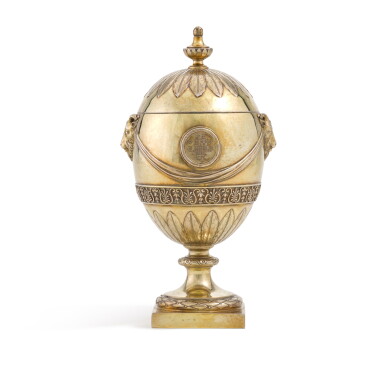
A George III silver-gilt vase, Thomas Heming, London, 1775
Lot Closed
November 9, 03:18 PM GMT
Estimate
4,000 - 6,000 GBP
Lot Details
Description
Property from a European Private Collection
A George III silver-gilt vase, Thomas Heming, London, 1775
Ovoid-form, on a square pedestal base, the lower part of the body with stiff-leaf ornament below a frieze of honeysuckle, the upper part with two goat masks linked by drapery swags, and with two plaques engraved with arms, the rim of the cover engraved with a Latin inscription
24cm., 9 ½in. high
704gr., 22 ½oz.
The inscription reads: ‘Extremum munus morientis amici, Caroli Carlile’ (‘The last/final gift of a dying friend, Charles [?of] Carlisle.’)
The arms are those of the See of Rochester impaling Thomas for John Thomas (1712 – 22 August 1793), who was consecrated Bishop of Rochester on 13 November 1774. He born in Carlisle, the eldest son of John Thomas (1684?-1747), a minor Canon of Carlisle Cathedral and from 1721 until his death, Vicar of Brampton, Cumberland. Both father and son were educated at Carlisle Grammar School, and Queen’s College, Oxford, from where the son matriculated in December 1730.
One of Thomas’s earliest duties was as private tutor to the younger son of Sir William Clayton, his future brother-in-law. He was ordained as a priest in September 1737, becoming Rector of Bletchingley, Surrey the following January. He remained there until moving to Rochester in 1774. Meanwhile he was appointed chaplain-in-ordinary to George II and Canon of Westminster in April 1754. In 1768 he became Dean of Westminster and Chancellor of the Order of the Bath.
Bishop Thomas, a well-known philanthropist, was married twice: first in 1742, at the Chapel Royal, Whitehall, to Anne (1716?-1772), sister of Sir William Clayton and widow of Sir Charles Blackwell, 2nd Bt.; and second in 1775 in Westminster Abbey to Elizabeth, daughter of Charles Baldwin of Munslow, Shropshire and widow of Sir Joseph Yates, a judge. He died after a brief illness and was buried at Bletchingley. His memorial plaque with portrait bust survives in Westminster Abbey.
His will, signed on 20 September 1791 and proved on 8 August 1793, included the following: ‘I give and bequeath to the surrounding Deans and Prebends my large Silver Gilt Chased Cup and Cover as a Poculum Charitalie or Grace Cup to be used at their Election and Audit Dinners of the two small Gilt and Chased I give one to my dear wife and other to my Nephew.’ (National Archives, Kew, PROB 11/1236) He also left a large collection of coins, medals, prints and paintings.
You May Also Like