Property of a Private Collection
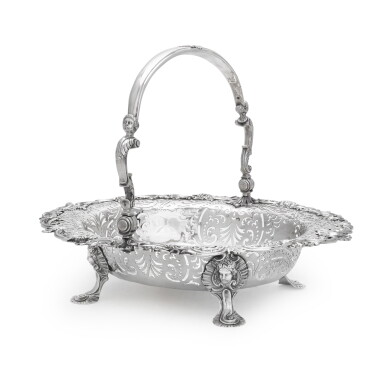
A George II silver basket, Edward Aldridge, London, 1745
Lot Closed
November 9, 02:03 PM GMT
Estimate
3,000 - 5,000 GBP
Lot Details
Description
Property of a Private Collection
A George II silver basket, Edward Aldridge, London, 1745
Shaped-oval form with a swing handle and pierced body, engraved with a coat-of-arms,
36cm., 14 ¼in. long
The arms are those of Austen, baronets of Hall Place, Bexley, Kent, impaling Lambert for Sir Sheffield Austen, 5th Bt. (baptised 25 October 1698 – died January 1756) who succeeded to the title upon the death of his brother, Sir Robert Austen, 4th Bt. (1697-1743).
‘Dublin, Jan 10. [1756] . . .
‘A few days since died in Britain-street, Sir Sheffield Austen, Bart.’ (Read’s Weekly Journal, or British-Gazeteer, London, Saturday, 24 January 1756, p. 2a)
‘HALL-PLACE is an antient and stately mansion, which stands in the northern part of this parish [of Bexley], next Crayford. . . . [The estate was eventually conveyed] to Robert Austen, esq. [1580?-1666] who was made a baronet on July 10 [1660], in the 12th year of king Charles II and was sheriff of this county that and the next year, bearing for his arms, or, a chevron gules between three bears paws erased sable. . . . Sir Robert Austen died in 1666, and was succeeded in this seat by his eldest son, Sir John Austen, [2nd] bart. who resided here, as did his eldest son Sir Robert Austen, [3rd] bart. who married Elizabeth, daughter and coheir of George Stawel, esq. of Somersetshire, by whom he left three sons, Robert, Sheffield, and John, and several daughters, and died in 1706.
‘Sir Robert Austen, [4th] bart. the eldest son, succeeded his father and resided at Hall-place. He was sheriff in 1724, and married Rachel, daughter of Sir Francis Dashwood, bart. of West Wicomb, by whom he had no issue. He died at Bath in 1743, and was buried at Church Dane, in Gloucestershire, where there is a memorial for him. He was succeeded by his next brother, Sir Sheffield Austen, [5th] bart. who resided in Ireland; and, on his death without issue, (his younger brother John being deceased some time before, likewise without issue) the title, together with the fee of this seat, came to Edward Austen, esq. of Boxley Abbey, the grandson of Robert, second son of Sir Robert Austen, the first baronet, as before-mentioned; and on his death likewise without issue in 1760, they descended together to his younger brother, Sir Robert Austen, [7th] bart of Tenterden, who dying in 1772 without issue, the title of baronet became extinct, and he being only tenant for life, the fee of this seat and estate, by the will of Sir Robert Austen, [4th] bart. who died in 1743, became vested in Francis lord Le Despencer. After the death of Sir Robert Austen last-mentioned, this estate had been put under the direction of the court of chancery, on account of the great debts and legacies which he had left charged on it by his will, and there being large jointures on it besides, which amounted together to the full annual receipts, it is hard to say, whether the succeeding baronets, after his death, ever had possession of it, the see of it they were certainly entitled to, but none of them resided here.
‘Francis, lord Le Despencer becoming thus proprietor of the fee of this estate, died possessed of it in 1781, and by his will devised it to Francis Dashwood, esq. who resided at it for a few years afterwards, and he still remains the owner of it, but the mansion has been for some time occupied as a school for young gentlemen.’
(Edward Hasted, The History and Topographical Survey of the County of Kent, London, 1797, vol. II, pp. 173-176)
‘DEAD. Thursday died, Mrs. Ann Austen, Sister to the late Sir Sheffield Austen, Bart. late of Hall Place in Kent.’ (The Whitehall Evening Post; Or, London Intelligencer, London, Thursday to Saturday, 10-12 August 1758, p. 2b)
You May Also Like