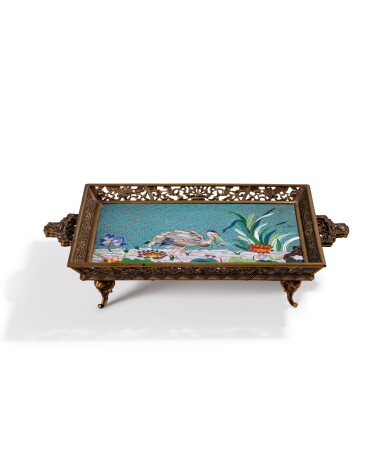
A gilt-bronze and cloisonne enamel "japoniste" tray, attributed to Edouard Lièvre, late 19th century | Plateau japonisant en bronze doré et émaux cloisonnés attribués à Edouard Lièvre, fin du XIXe siècle
Lot Closed
November 19, 03:51 PM GMT
Estimate
4,000 - 6,000 EUR
Lot Details
Description
A gilt-bronze and cloisonne enamel "japoniste" tray, attributed to Edouard Lièvre, late 19th century
the top with a crane and flowers, the pierce frieze with two handles, on four elephant heads
Height. 3½in, width 17 in, 9½in, Haut 9 cm, larg. 43 cm, prof. 24,2
__________________________________________________________________________
Plateau japonisant en bronze doré et émaux cloisonnés attribués à Edouard Lièvre, fin du XIXe siècle
le plateau orné d'une grue et de fleurs, la galerie ajourée munie de poignées ornées de têtes de dragon, reposant sur quatre têtes d'éléphant
See Roberto Polo, Un créateur inspiré, Connaissance des Arts, pp. 28, 31, 34, for illustrations of Lièvre elephant head cast mounts.
__________________________________________________________________
Voir R. Polo, Un créateur inspiré, Connaissance des Arts, pp. 28, 31, 34, pour des illustrations de tête d'éléphant par Lièvre.
The elephant heads, the use of cloisonne enamel and the "japonisme" style of our tray is typical to Edouard Lièvre's work.
Born in Nancy, Lièvre trained as a painter under the French academic painter Thomas Couture before turning his attention to decorative art design. His earliest important work datable with certainty is the grand vase persan designed for the Christofle firm in 1874, and exhibited by the latter at the Paris Expositions of 1878 and also in 1889 and 1900. Lièvre also designed for the illustrious bronzier Ferdinand Barbedienne. Among Lièvre's important clients were actress Sarah Bernhardt, courtesan Louise-Emilie Valtesse de la Bigne, and Albert Vieillard, director of Bordeaux's ceramics factory and an early Japonisme enthusiast.
Following Lièvre's death, his estate was sold in two auctions in 1887 and 1890. These auction were commended by the press: "It has been a long time since art lovers had the opportunity to see at auction a remarkable collection such as the work of the recently deceased master. His creations will make history..." (see Connaissance des Arts, No. 228, Un créateur inspiré by Roberto Polo, p. 8). It is believed that most of the collection was sold to George and Henri Pannier, owners of the elegant shop, l'Escalier de Cristal. The Pannier brothers produced altered versions of Lièvre's designs, including seven variants of Vieillard's Cabinet Japonais, one of which was sold to Grand Duke Vladimir of Russia and is now in the Hermitage, St. Petersburg.
You May Also Like