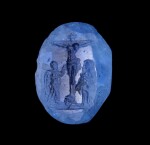

Italian, Milan, second half 16th century | A Rare Sapphire engraved with the Crucifixion
Lot Closed
July 15, 12:10 PM GMT
Estimate
18,000 - 25,000 GBP
Lot Details
Description
Italian, Milan, second half 16th century
A Rare Sapphire engraved with the Crucifixion
sapphire, with a resin impression of the intaglio
intaglio: 12.8mm., 1/2 in.
impression: 18mm., 3/4 in.
Renaissance engraved sapphires are rare. Sapphires are exceptionally difficult to engrave, and, in the 16th century, they were the preserve only of the highest ranking members of the clergy or princes.
The present sapphire is intricately engraved with the Cristo Morto on the Cross and flanked by a veiled representation of the Virgin and St John the Evangelist, who raises his arm in a gesture of pained exhortation. The whole is further enlivened by faceted framing of the scene and the faceted reverse. The model is ultimately grounded in Byzantine prototypes, such as a 6th/7th-century gem listed by Papanikola-Bakirtzi (op. cit., p. 485, no. 659). Note also to Middle Byzantine gems published by Spier (op. cit., pp. 114-126, nos. 14, 17). Contemporary 16th-century parallels are seen in a cameo from the Milton Weil collection (Kris, op. cit., p. 14, pl. II); Dalton (op. cit., p. 81, no. 567, pl. XX); and Kagan and Neverov (op. cit., p. 154, no. 198/14). The muscular body of Christ bears some similarities with Corpora by the Roman Counter Reformation sculptor Guglielmo Della Porta (1500-1577), conceived in the 1560s and 1570s; compare with the Corpus in the Geistliche Schatzkammer, Vienna (illustrated by Coppel, op. cit., fig. 22). The present sapphire is likely to have been engraved in Milan, however, which was the major centre of hardstone and gem cutting in the 16th century.
Precious sapphires set within rings were worn only by the highest ranking members of the church in 16th-century Italy. Sapphires symbolised pious chastity and so they were particularly appropriate for Archbishops and Popes. The Dutch theologian Gerrit Janszoon Vossius (1577-1649) wrote that a 'sapphire worn in a ring or in any other manner is able to quench concupiscence, and for that reason is proper to be worn by the priesthood and by all persons vowed to perpetual chastity.' In Raphael's celebrated Portrait of Pope Julius II (National Gallery, London, inv. no. NG27) the proper wears a sapphire ring on his proper left hand.
Given the dating of the present sapphire it seems likely that it may have been made for San Carlo Borromeo who was Archbishop of Milan and one of the highest ranking members of the Catholic Church; his uncle was Pope Pius IV. Scarisbrick records the existence of San Carlo Borromeo's episcopal ring in the Treasury of Milan Cathedral, 'which is set with a sapphire in a plain pie-dish style bezel' (op. cit.). This sapphire appears in a number of portraits of Borromeo, including in a portrait of the Saint in the Poveri Vergognosi, Bologna, and a painting by Ottavio Bizzozerro (1600-1699) in Ca' Granda - Ospedale Maggiore Policlinico, Milan (circa 1680-1690; inv. no. 000009). The ring also appears in a 17th-century portrait of San Carlo sold Sotheby's London 8 April 2003, lot 216. However, given his wealth, Borromeo would almost certainly have commissioned more than one engraved gem. In consideration of the date of the engraving, the material and the subject, the present sapphire would have been both appropriate and worthy of his ownership.
San Carlo Borromeo was born into the prominent Lombard Borromeo family. His mother, Margherita, was a Medici, and his father was Count of Arona. He studied civil and canon law at Padua University, and received his doctorate in 1559. With the election of his uncle Cardinal Giovanni Angelo Medici as Pope Pius IV in 1559, he went to Rome and was appointed Protonary Apostolic. Shortly thereafter he was made Cardinal, and organised the third and final session of the Council of Trent (1562-1563). With the death of his brother Federico in 1562, his family urged him to leave the church and marry in order to ensure the family line. However, he refused and adopted a stricter Catholic life. On 7 December 1563 Borromeo was consecrated bishop in the Sistine Chapel by Cardinal Giovanni Serbelloni, and was appointed Archbishop of Milan on 12 May 1564. A noted reformer, Borromeo spent much of the rest of his life ensuring that the Archdiocese of Milan adhered strictly to church teaching. He established many seminaries, colleges and other institutions and, when famine hit Milan in 1567, he personally paid for the feeding of 60,000-70,000 daily. Borromeo has particular significance for English Catholics since he met with many prominent Catholics who had been forced to flee Elizabeth I's England. These included Saint Edmund Campion and Saint Ralph Sherwin, who visited him in Milan in 1580.
RELATED LITERATURE
O. M. Dalton, Catalogue of the Engraved Gems of the Post-Classical Periods…British Museum, London, 1915; E. Kris, Catalogue of the Postclassical Cameos in the Milton Weil Collection, Vienna, 1932; D. Scarisbrick, Rings: Symbols of wealth, power and affection, London, 1993; J. Kagan and O. Neverov, Splendeurs des Collections de Catherine II de Russie, Paris, 2000; D. Papanikola-Bakirtzi, Everyday Life in Byzantium; Athens, 2002; J. Spier, 'Middle Byzantine (10th-13th century AD) stamp seals in semi-precious stone' in C. Entwistle, Through a Glass Brightly; Studies in Byzantine and Medieval Art and Archaeology Presented to David Buckton, London, 2003
You May Also Like


