
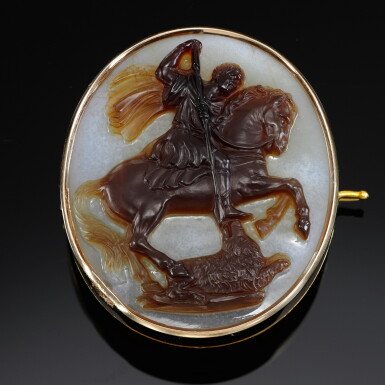
Italian, possibly 12th century, or later | Cameo with Meleager spearing the Erymanthian Boar
Lot Closed
July 15, 12:09 PM GMT
Estimate
1,500 - 2,000 GBP
Lot Details
Description
Italian, possibly 12th century, or later
Cameo with Meleager spearing the Erymanthian Boar
chalcedony, within a brooch mount
the mount marked for St Petersberg, circa 1880: Z and 56 and ZM and with two further indicernable marks;
with an early 20th-century leather bound box labelled A. D. IVANOFF À ST PETERSBOURG
intaglio: 33mm.,1 1/4 in
Whilst the composition is evident in St George and the Dragon gems since the medieval and Renaissance periods and often copied into the 19th Century, this intriguing cameo maybe an early example. The stone itself, which is detachable from the frame, on the reverse exhibits a finish and wear suggesting a pre-19th Century date. The choice of stone and its contrasting brown and white layers is particularly consistent with the group of gems associated with the Hohenstaufen court. Compare in particular the Samson slaying the Lion cameo in the Kunsthistorisches Museum (inv. no. IX 1949), with a similar use of stone, the treatment of the tunic and cloak and the distinctive rotated head of the lion to the depiction in this cameo. A cameo of a hare captured by an eagle on a similarly two-tone stone in the Hermitage also exhibits a pray with the head similarly rotated (Hermitage, inv. no. K2141). Another comparable gem is of a hunter and lion in the Museo Archeologico Nationale Di Napoli (inv. no. 25890) catalogued by Giuliano as Hohenstaufen period with the hunter believed to represent Frederick II Hohenstaufen. Also notable is the sculptural representation of St. George and the Dragon in the portico San Giorgio, Florence dated to c.1324 referenced by Wentzel in connection with the aforementioned Naples gem which he thought also likely to be medieval (op.cit., p. 265, no.58, fig. 40).
The unusual subject matter also suggests an earlier dating. The boar was highly revered in the medieval period due to its ferocity (see Thiébaux, op. cit., pp. 281-299). The highly challenging and skilled task of capturing the boar, celebrated in medieval literature, appears to be expressed in the cameo. During the medieval period the boar was viewed as an anti-Christ and representation of sin, the victory over which may well have appealed to a ruler such as Frederick II Hohenstaufen whose other gems conveyed similar symbolism, see for example the Samson and Lion cameo (Scarisbrick, op. cit., no. 108, p. 103). Finally, as the case with many of the Hohenstaufen gems, the cameo reflects an admiration for ancient works of art, which served as a models for gem designs, note a Roman relief of a boar hunter on a Sarcophagus in Belluno, Italy (Getty Images), and a cameo of Alexander the Great as Meleager, 1st C AD in the Hermitage (inv. no. 12407).
RELATED LITERATURE
H. Wentzel, 'Mittelalterliche Gemmen in den Sammlungen Italiens', Mitteilungen des Kunsthistorischen Institutes in Florenz, Jul., 1956, 7. Bd., H. 3/4, p. 265, no.58, fig. 40; M. Thiébaux, 'The Mouth of the Boar as a Symbol in Medieval Literature', Romance Philology, February 1969, Vol. 22, No. 3 , pp. 281-299; D. Scarisbrick, J. Boardman and C. Wagner, The Guy Ladriere Collection of Gems and Rings, London, 2018, p. 103, no. 108


