
Property from a Private Collection, New York
Yuri Pavlovich Annenkov
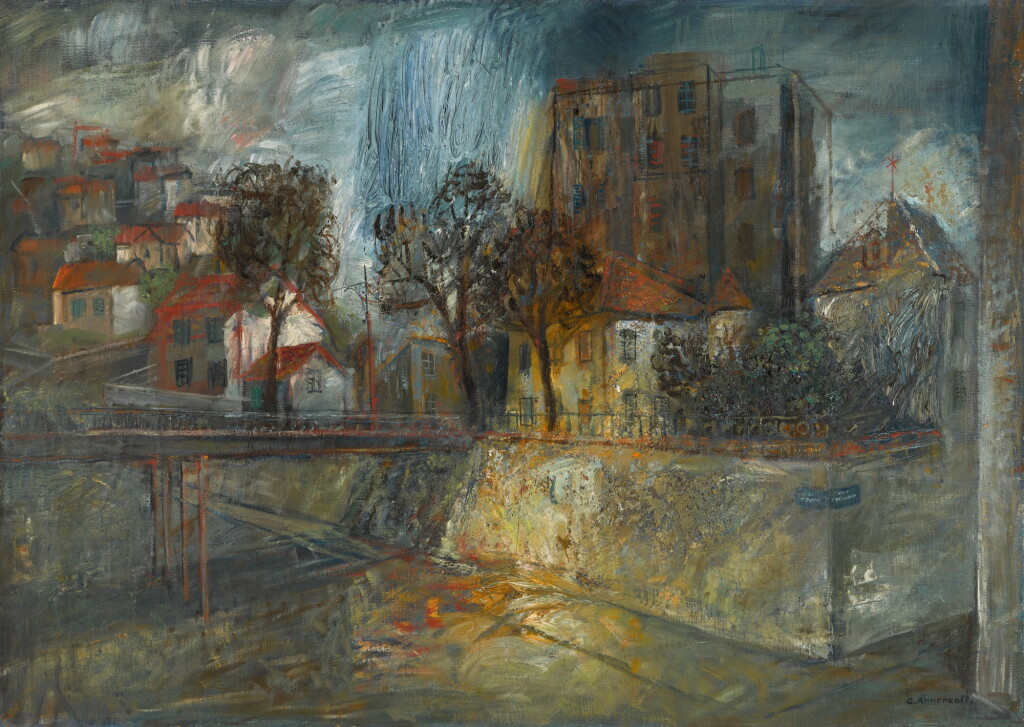
Banlieue de Paris
Auction Closed
November 30, 02:40 PM GMT
Estimate
50,000 - 70,000 GBP
Lot Details
Description
Property from a Private Collection, New York
Yuri Pavlovich Annenkov
1889 - 1974
Banlieue de Paris
signed in Latin l.r.
oil on canvas
Canvas: 65.5 by 92cm, 25¾ by 36¼in.
Framed: 81 by 108cm, 32 by 42½in.
Executed in 1928-1929
Acquired at the above sale by the present owner
Banlieue de Paris dates to 1928-29 and is an example of what can be referred to as Yuri Annenkov’s first French period. After his arrival in Paris, Annenkov started painting landscapes, still lifes, portraits and nudes in his distinctive figurative style. Deviating subtly from a realist framework, these works are abundant in artistic experimentation and formal discoveries. This atmospheric painting conveys the gloomy ambience of the suburbs of Paris, which the artist often visited while working on the illustrations for Louis Chéronnet’s Paris Extra-Muros (Paris: Au Sans Pareil, 1929, with a foreword by Jules Romain).
The following year an exhibition dedicated to Annenkov was held at Galerie Bing, accompanied by an illustrated monograph by Pierre Courthion, who rightly noted: ‘The suburbs were the true school of life for Yuri Annenkov; by observing them, the painter learned to differentiate between materials, to disregard the superficial feats which make up bad paintings, and to create by focusing on the everyday in order to seek out the eternal and get to the heart of the matter.’
Annenkov employs a great economy of means and a muted palette to depict the Paris suburbs. The painting is an imagined landscape, designed and reassembled through the painter’s selective eye. A footbridge connects both banks lined with spindly trees. Beneath a tormented sky a ghost-like building stands high surrounded by small houses.
The colour range is purposefully limited, only occasionally intercepted by flashes of colour. While the sky is lead-grey, the palette is dominated by a combination of earthy, greenish and yellowish hues, with only the white walls and the reddish-brown roofs adding a touch of colour and lightening up the overall atmosphere of sadness. The outlines have been quickly sketched out, using vigorous, dynamic strokes and scratches, applied with extreme virtuosity using the brush and the palette knife.
Devoid of any human presence, with houses depicted with closed shutters, Annenkov’s suburban landscape appears like an island, cut off from the rest of the world. This is how the painter must have felt, suffering from anxiety during the early days of his exile. The present work is stylistically comparable to other works from the same series, in particular Deux Maisons (1928), Fortifications and L’Hospice rouge (1929), reproduced by Pierre Courthion in his 1930 monograph on Annenkov.
We are grateful to the expert Vladimir Hofmann, the artist’s former student and author of his catalogue raisonné, for providing this catalogue note.