
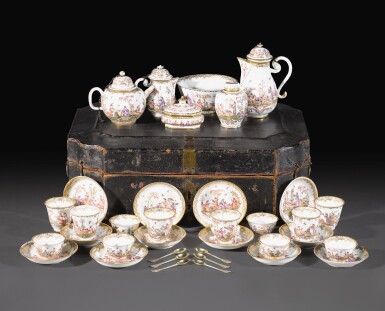
A Meissen presentation service decorated in Augsburg, the porcelain circa 1725, the decoration circa 1731
Auction Closed
December 10, 04:34 PM GMT
Estimate
100,000 - 150,000 GBP
Lot Details
Description
A Meissen presentation service decorated in Augsburg, the porcelain circa 1725, the decoration circa 1731
Painted in the Auffenwerth workshop with chinoiserie scenes in the Höroldt style with figures at various pursuits, taking tea and smoking, among furniture and plants, within gitterwerk borders, comprising:
A baluster coffee-pot and cover with chain
A globular teapot and cover with chain
A baluster milk-jug and cover with chain
An octagonal sugar box and cover
An ovoid tea caddy and cover
A flared circular basin
Six beakers and saucers and six teabowls and saucers
Some pieces with blue crossed swords marks
with six silver-gilt teaspoons by Elias Adam, Augsburg, circa 1731/33, the original leather covered travelling case (Futteral) with brass hasp lock, hinges and handle
with Elfriede Langeloh Antiquitäten, Weinheim
Ducret, S., `Anna Elisabeth Wald, eine geborene Aufenwerth', Keramos, Heft 50, 1970, pp. 3-9.
Ducret, S. Meissner Porzellan bemalt in Augsburg, 1718 bis um 1750, Vol. I, 1971, pp. 42-43 and 79, pl. 381-385; Vol. II, 1972, p. 15, pl. 94 and col. pl. V.
Clarke, T.H., Eine Meissen-Entdeckung - Sabina Auffenwerth in Augsburg, in Keramos, April 1973, pp. 17-40
This present service is testimony to the skill and exuberance of the hausmalern, a term literally translated as “home painters”. These independent enamellers and decorators are important figures in the production of luxury objects because they form a bridge linking a variety of materials and craftsmen and women who utilised faience, porcelain, glass and metalwork to create exceptional objects in the baroque period. Hausmaler decorators congregated in cities and regions such as Nuremberg, Augsburg, Silesian and Bohemia throughout the late 17th and early 18th century which coincides with a number of technical innovations, in particular the development of porcelain in Saxony in the first decades of the 18th century. In the early years of the Meissen factory the relationship with the independent decorators of Augsburg, traditionally the centre for the manufacture of silver, is particularly important. The leading workshops were those of the Seuter and Auffenwerth families and it is in the second of these celebrated workshops the hausmaler (or more accurately hausmalerin) who decorated the present service is to be found.
Johann Auffenwerth (1662-1728) was a gold painter and signed works by him on Meissen porcelain are recorded including coloured chinoiserie decoration in the style of J. G. Höroldt and Du Paquier (1). He had eight children and it is his daughters, Anna Elisabeth and Sabina who are of particular relevance. Anna Elisabeth, his second child, was baptized on the 3rd February 1696 at the Protestant church of St Ulrich, she worked as a decorator and in 1722 married the Nuremberg goldsmith, Jakob Wald. Her younger sister was born a decade of so later, married Isaac Heinrich Hosennestel, a goldsmith, silversmith and Kaffeeschenk or Kaffetier on 3rd December 1731. Both sisters painted porcelain in the chinoiserie style, and their work is very similar in style and both were fond of signing their work with monograms (2). Dr. Siegfried Ducret, the renowned ceramic scholar, attributed the painting of the current service to Anna Elisabeth Wald (3). However, since the publication of this attribution, a chionoiserie service known as the Hosennestel Service, (4) emerged which illuminates the role of Sabina as a decorator. The surviving pieces from the Hosennestel service comprised: a coffee-pot and cover, a teapot and cover with bird spout, a milk jug and cover, a hexagonal baluster tea-caddy and cover, a slop basin, four two-handled beakers, a teabowl and three saucers as well as a replacement teabowl and two later two-handled beakers. Many of the pieces were marked in gilt with the mirrored monogram AW (Auffem Werth) with flourishes and the flanking initials `S` for Sabina Auffenwerth and the coffee-pot and cover was initialed SA and IH, for Sabina Auffenwerth and her husband Isaac Hosennestel, hidden amongst the flowers below the spout. In his articles on the service T.H. Clarke summerises that both sisters had learnt their craft from their father, perhaps at his workshop near the Göggingen Tor and appear to have occupied the studio of the painter Kühndelt in the Schonauergasser (5) where they continued working after the death of their father in 1728, not unreasonably he suggests the sisters were friendly rivals, one might even go further to suggest they were collaborators. Although there appears to be little contemporary documentary evidence around Anna Elisabeth, two tankards by her are preserved, both named and dated 1748 (6), one in the City Art Collection, Augsburg, the other, on Künesberg fayence, is in the Bayerisches Nationalmuseum. Her younger sister is recorded by a contemporary commentator (7) in 1765 as having been a highly skilled and revered decorator, stating that Sabina no longer painted Saxon porcelain, and indeed the same commentator records in 1779 (three years before Sabina’s death) “Frau Hosennestal” was a skilled decorator (8).
(1) Pazaurek, G. E., Deutsche Fayence – und Porzellan - Hausmaler Leipzig, 1925, Vol. I, no. 103, p. 129.
(2) Clarke, T.H., “A Meissen Discovery – Sabina Aufenwerth at Ausburg”, The Connoisseur, October, 1972, p. 96, nos. 2-5.
(3) Pauls-Eisenbeiss, E., op.cit., Vol. I, p. 384
(4) Sold in these Rooms, the property of Mrs. Mary Lees Johnstone, 7th November 1972, lots 125-133, discussed Clarke, T.H., “A Meissen Discovery – Sabina Aufenwerth at Ausburg”, The Connoisseur, October, 1972, pp. 94-99; translated and expanded, Clarke, T.H., “Eine Meissen-Entdeckung – Sabina Auffenwerth in Augsburg”, Keramos, heft 60, April 1973, pp. 17-39.
(5) Ducret, S. Meissner Porzellan bemalt in Augsburg 1718 bis um 1750, Braunschweig, 1971, Vol. II, p. 15.
(6) Pauls-Eisenbeiss, E., op.cit., Vol. I, p. 384.
(7) Clarke, T.H., “A Meissen Discovery – Sabina Aufenwerth at Ausburg”, The Connoisseur, October, 1972, pp. 98-99 where the author refers to Ducret who cites Paul von Stetten, Erläuterungen, Augsberg, 1765.
(8) Clarke, T.H., “A Meissen Discovery – Sabina Aufenwerth at Ausburg”, The Connoisseur, October, 1972, pp. 98-99 where the author cites Paul von Stetten, Kunst-Gewerb-und Handereks Geschichte der Reichstadt Augsburg, 1779.