
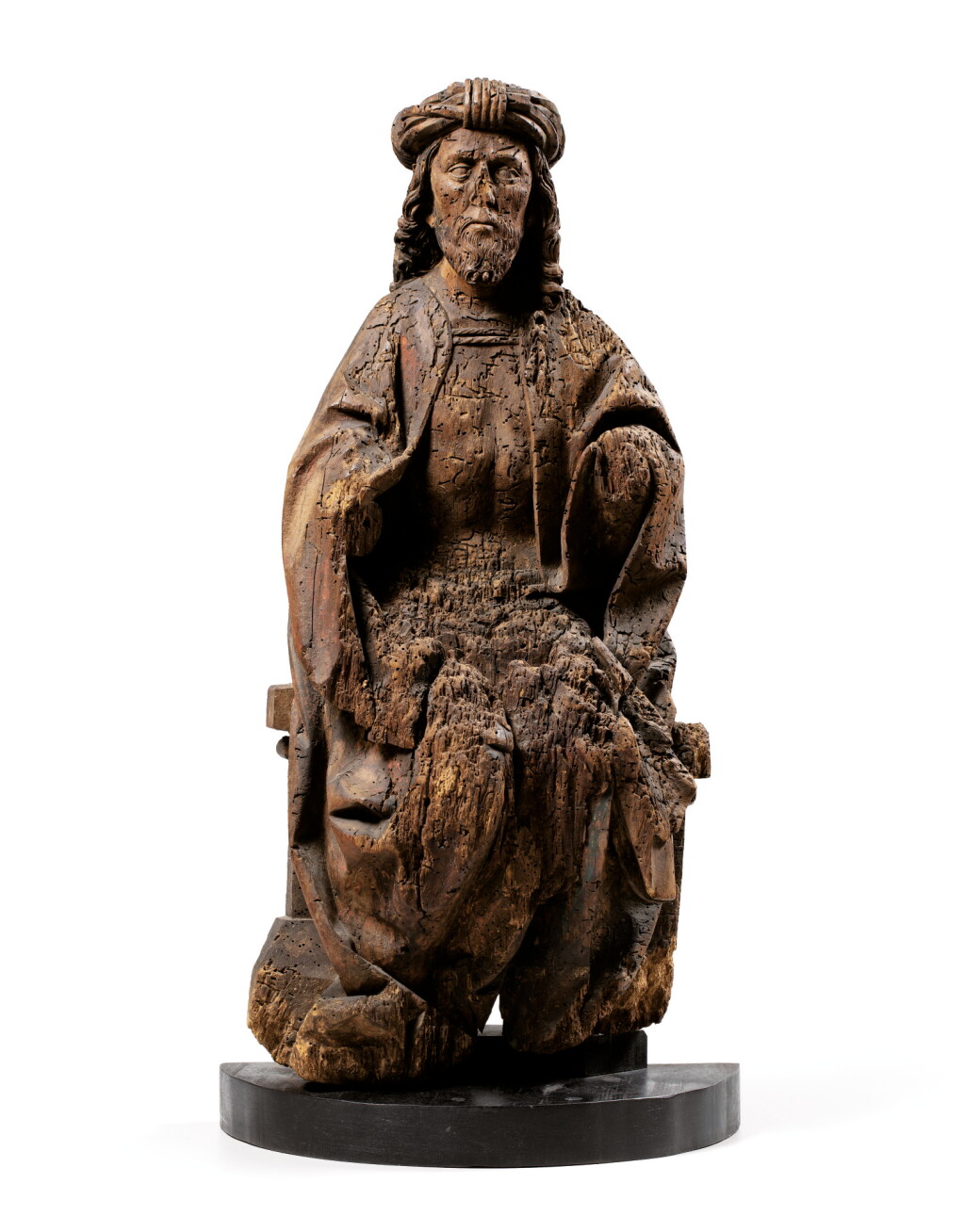
SOUTHERN GERMANY, FRANCONIA, CIRCA 1500 | MAN OF SORROWS
Lot Closed
June 30, 03:06 PM GMT
Estimate
5,000 - 7,000 EUR
Lot Details
Description
SOUTHERN GERMANY, FRANCONIA, CIRCA 1500,
MAN OF SORROWS
limewood with remains of polychromy, on a modern painted wood base
H. 70,5 cm ; 27 ¾ in.
__________________________________________________________________
ALLEMAGNE DU SUD, FRANCONIE, VERS 1500
CHRIST DE DOULEURS
tilleul avec des restes de polychromie ; sur un socle moderne en bois
H. 70,5 cm ; 27 ¾ in.
Due to the various measures taken to deal with the Covid-19 epidemic, property collection and shipment of this lot will be delayed until the offices where it is located are able to reopen. Please refer to the “auction details” tab. Thank you for your understanding
Please contact FRpostsaleservices@sothebys.com for any shipping inquiries.
[En raison des circonstances actuelles liées au COVID-19, la livraison de ce lot ne pourra intervenir qu’après la réouverture des locaux de Sotheby’s dans lesquels il se trouve. Nous vous remercions de votre compréhension et nous vous invitons à consulter l’onglet « auction details ».
Pour toute demande concernant le transport, veuillez contacter FRpostsaleservices@sothebys.com.]
Related Literature
J. Chapuis, Tilman Riemenschneider, Master sculptor of the late Middle Ages, exh. cat., National Gallery of art (Washington), Metropolitan museum of art (New York), 1999-2000, pp. 323-325.
__________________________________________________________________
Référence bibliographique
J. Chapuis, Tilman Riemenschneider, Master sculptor of the late Middle Ages, cat. exp., National Gallery of art (Washington), Metropolitan museum of art (New York), 1999-2000, pp. 323-325.
Following a traditional iconography that invites contemplation of suffering and death, the Man of Sorrows sits on a throne facing forwards, displaying the wounds of the Passion to the faithful. The treatment of the face in this high-relief is influenced by the art of Tilman Riemenschneider (1460-1531), one of the great protagonists of German sculpture at the juncture between Late Gothic and the Renaissance. Active in the Würzburg region at the end of the fifteenth century, his art is recognisable from the physiognomy and expressive facial features of his sculptures.
The work presented here has a similar physiognomy, with a coiling beard, wavy hair, as well as a stylized crown of thorns as a Man of Sorrows, in limestone, in the Bavarian National Museum in Munich (inv. no. MA 1004), all indications of an influence of Riemenschneider's.
__________________________________________________________________
Selon une iconographie traditionnelle qui invite à méditer sur la souffrance et la mort, le Christ de douleur se tient droit sur un trône, montrant aux fidèles les plaies de sa Passion. Le traitement du visage est influencé par l’art de Tilman Riemenschneider (1460-1531), un des grands représentants de la sculpture allemande à la jonction entre le Gothique tardif et la Renaissance. Actif dans la région de Würzburg et Ulm à la fin du XVe siècle, son art est reconnaissable à la physionomie et aux visages expressifs de ses sculptures.
On retrouve une physionomie similaire à la barbe entortillée, à la chevelure ondulée, ainsi que la même couronne d’épines stylisée que dans un Christ de douleur en calcaire au musée national Bavarois de Munich (inv. n° MA 1004) témoignant d'une influence de Riemenschneider.