
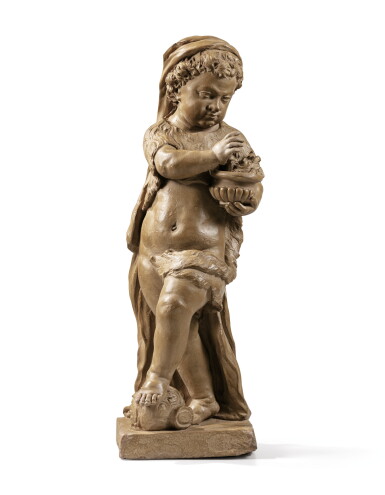
CIRCLE OF JAN PIETER VAN BAURSCHEIT, THE YOUNGER | ALLEGORY OF WINTER
Lot Closed
June 30, 03:26 PM GMT
Estimate
6,000 - 8,000 EUR
Lot Details
Description
SOUTHERN NETHERLANDS, CIRCA 1733
CIRCLE OF JAN PIETER VAN BAURSCHEIT, THE YOUNGER (1699-1768)
ALLEGORY OF WINTER
terracotta statue
H. 78 cm, 30⅔ in.
__________________________________________________________________
PAYS-BAS DU SUD, VERS 1733
ENTOURAGE DE JAN PIETER VAN BAURSCHEIT, DIT LE JEUNE (1699-1768)
ALLÉGORIE DE L'HIVER
statue en terre cuite
H. 78 cm, 30⅔ in.
Due to the various measures taken to deal with the Covid-19 epidemic, property collection and shipment of this lot will be delayed until the offices where it is located are able to reopen. Please refer to the “auction details” tab. Thank you for your understanding
Please contact FRpostsaleservices@sothebys.com for any shipping inquiries.
[En raison des circonstances actuelles liées au COVID-19, la livraison de ce lot ne pourra intervenir qu’après la réouverture des locaux de Sotheby’s dans lesquels il se trouve. Nous vous remercions de votre compréhension et nous vous invitons à consulter l’onglet « auction details ».
Pour toute demande concernant le transport, veuillez contacter FRpostsaleservices@sothebys.com.]
Related Literature
P. Philipot, D. Coekelberghs, P. Loze, D. Vautier, L'architecture religieuse et la sculpture baroques dans les Pays-Bas méridionaux et la principauté de Liège, 1600-1770, Sprimont, 2003, pp. 1007-1013.
__________________________________________________________________
Référence bibliographique
P. Philipot, D. Coekelberghs, P. Loze, D. Vautier, L’architecture religieuse et la sculpture baroques dans les Pays-Bas méridionaux et la principauté de Liège, 1600-1770, Sprimont, 2003, pp. 1007-1013.
Alongside the religious pieces they produced, the artists Jan Pieter Baurscheit l'Ancien (1669-1728) and his son Baurscheit dit le Jeune (1699-1768) made secular works, particularly of children, which were very popular in the middle class homes in the province of Anvers (Antwerp). Generally made in stone or marble and displayed as ornamental sculptures in gardens, some were also made from terracotta. Several themes became very popular such as the representation of the 'Quatre Saisons' (Four Seasons), or of the different Continents or even of the 'Cinq Senses' (Five Senses), a notable example being the beautiful terracotta series of the Quatre Saisons attributed to Baurscheit le Jeune (Sotheby's London, 6 December 2011, Lot 79). The use of clay and the malleability it offered, gave the artist the possibility of personalizing each figure with the addition of certain details and attributes.
The putto symbolizing l'Hiver or Winter that we are offering is dressed in falling drapery covering part of his head, an animal skin wrapped around his shoulders and waist. He is standing with a foot resting on a cabbage (or an artichoke), holding a brazier in his left hand to keep warm. This figure can be compared to a drawing by Baurscheit l'Ancien kept at the Musée Plantin-Moretus in Anvers (Fig. 1, Antwerp; inv.no.PK.OT.00703) illustrating the Four Seasons where the figure of Winter compares well to our terracotta.
Fig. 1, Jan Pieter Baurscheit the Elder (1695-1728), Design of four putto, Antwerp, Plantin-Moretus museum. @ Collectie Stad Antwerpen, Museum Plantin-Moretus
__________________________________________________________________
En parallèle à leur production religieuse, les artistes Jan Pieter Baurscheit l’Ancien (1669-1728) et son fils Baurscheit dit le Jeune (1699-1768), sont à l’origine de sculptures profanes, notamment d'enfants, ou putti, qui connaîtront un immense succès dans les maisons bourgeoises de la province anversoise. Généralement exécutées en pierre ou en marbre pour servir à l’ornementation des jardins, certaines oeuvres étaient réalisées en terre cuite. Plusieurs thèmes connurent une grande popularité comme la représentation des Quatre parties du monde, les Cinq Senses, ou encore les Quatres Saisons, comme notamment la belle série en terre cuite attribuée à Baurscheit le Jeune (Sotheby’s Londres, 6 décembre 2011, Lot 79). L’usage de la terre offre à l’artiste par sa malléabilité, de modeler chaque figure individuellement par l’ajout de détails et d’attributs.
Le putto symbolisant l’Hiver que nous proposons est vêtu d’un drapé retombant et couvrant une partie de sa tête, une peau de bête sur ses épaules qui enveloppe ses hanches. Le pied posé sur un chou (ou un artichaut), il se réchauffe auprès d'un brasero. Notre figure peut être rapprochée d’un dessin de Baurscheit l’Ancien au musée Plantin-Moretus d’Anvers (Fig. 1, inv. n° PK.OT.00703) illustrant les Quatre Saisons dont l’Hiver présente une composition tout à fait comparable à notre terre cuite.
Fig. 1, Jan Pieter Baurscheit l'Ancien (1695-1728), Dessin pour quatre statues de putto, Anvers, Musée Plantin-Moretus.@ Collectie Stad Antwerpen, Museum Plantin-Moretus