
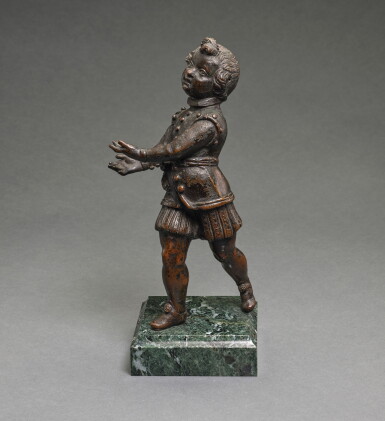
Probably Southern German, Augsburg, late 16th/ early 17th century | Striding Page Boy
Lot Closed
December 5, 03:50 PM GMT
Estimate
20,000 - 30,000 GBP
Lot Details
Description
Probably Southern German, Augsburg, late 16th/ early 17th century
Striding Page Boy
bronze, on a veined green marble base
bronze: 28.5cm., 11¼in.
base: 4cm., 1½in.
private collection, London
This unusual and charming figure of a page boy has formerly been attributed to Hendrick de Keyser based on its similarities with a bronze of a Striding Nobleman that had previously itself been attributed to the Dutch sculptor. Both figures are dressed in the fashion of the late 16th-century Spanish court. The boy wears a waisted tunic buttoned at the front and full bag-like breeches known as trunk hose, stockings and shoes with a buckle on the bridge. Scholten (op. cit.) has convincingly argued against the attribution to de Keyser for the Striding Nobleman in favour of a Southern German or Venetian origin. Scholten draws interesting parallels with figures made in southern Germany for large clocks, automatons or moving fountains. In addition to the costume, the striding composition and general facture are comparable between these two figures. Further comparisons with the pose can be observed with North Italian bronzes, such as the Boy with a Shell (inv. no. 2287) and the Putto with a Shell (inv. no. 8723) both in the Bode Museum, Berlin.
RELATED LITERATURE
F. Scholten and M. Verber, From Vulcan’s Forge. Bronzes from the Rijksmuseum, Amsterdam 145-1800, exh. cat., Daniel Katz Ltd., London, 2005, pp. 126-129, no. 39