The Breuer at 60: Six Decades of Art, Architecture, and Innovation
The Breuer at 60: Six Decades of Art, Architecture, and Innovation
By
Bryan Martin| Sep 11, 2026
This year marks the 60th anniversary of the Breuer, now the New York headquarters of Sotheby's. To mark the occasion, we're looking back at the seminal moments that defined the Breuer's history.
This year marks the 60th anniversary of the Breuer, now the New York headquarters of Sotheby's. To mark the occasion, we're looking back at the seminal moments that defined the Breuer's history.
I
n 1963, Marcel Breuer was commissioned to design the Whitney Museum of American Art’s new building. That same year, the architect gave a lecture at the University of Michigan. In it, he noted: “The great architectural virtue of reinforced concrete is that it can be molded to express its builder's thoughts precisely.” Three years later, the Breuer building at 945 Madison Avenue would do just this, demonstrating its designer’s thoughts as well as his singular talent for vividly envisioning concrete in space.
The rough bush-hammered concrete, bluestone floors, teak and bronze railings, sunken sculpture court, and massive trapezoidal windows would go on to become defining elements of the New York arts and culture world.
2026 marks the 60th anniversary of the Breuer, now the New York headquarters of Sotheby's. And, fittingly, this month the Breuer will host Independent 20th Century which will bring together curated exhibitions of art created between 1900 and 2000. Tickets are available to all. In the meantime, take a look at lauded moments in the Breuer's history that defined it as an essential incubator for art in the 20th and 21st centuries.
1960s: Jackie at the Ribbon Cutting
The grand opening of the Breuer building in 1966 as the Whitney Museum of American Art was a major occasion, attended by the likes of Jackie Kennedy, who was right there at the ribbon-cutting alongside Marcel Breuer. Though the building was initially met with apprehension by the Upper East Side’s more conservative residents who disliked the incongruity of a modernist structure in a neighborhood of brownstones, many notable voices praised the building. As Pulitzer Prize-winning architecture critic Ada Louise Huxtable wrote in The New York Times, “In addition to a museum, the Whitney wanted, and got, a landmark; a distinctive, recognizable structure on the New York scene.”
On September 26, 1966, the museum opened on the corner of East 75th Street and Madison Avenue, becoming Breuer’s only built work in Manhattan. Jackie Kennedy attended the ribbon-cutting ceremony. Photo via Bettmann / Getty Images
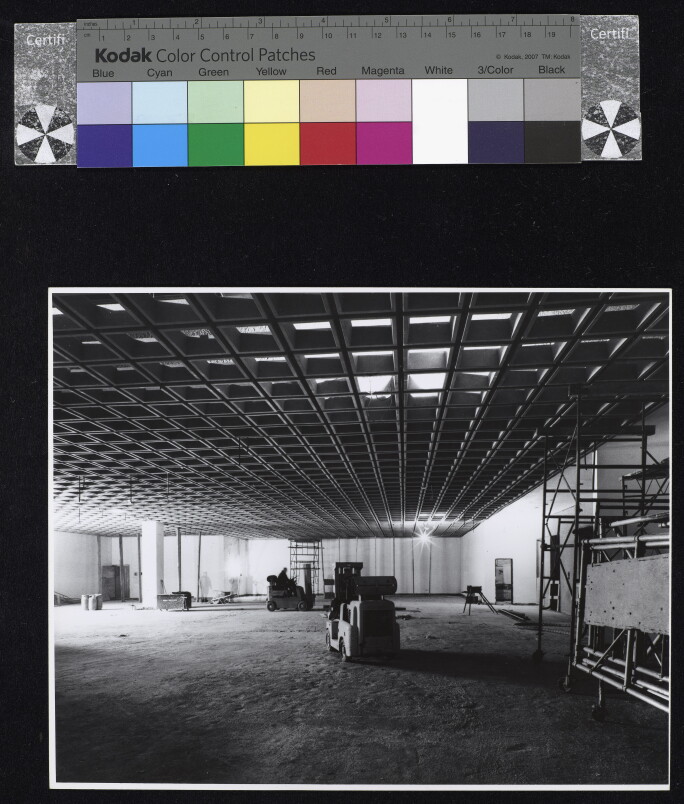
The design of the Breuer galleries allowed remarkable flexibility for rotating exhibitions, with high ceilings, open freight elevators, columnless spaces, adjustable lighting, and stone floors. The combination of form and function, along with the museum itself serving as a beautiful work of art, made its opening particularly attractive to art world insiders.
1970s: The New Biennial
While the building itself was becoming an icon, the exhibitions held inside were critical. The Whitney Museum had, until the 1970s, implemented an annual exhibition format alternating each year between painting and sculpture. But artistic mediums had become much more fluid with the advent of video and film art, conceptual art, mixed media, and other ways of making that defied convention.
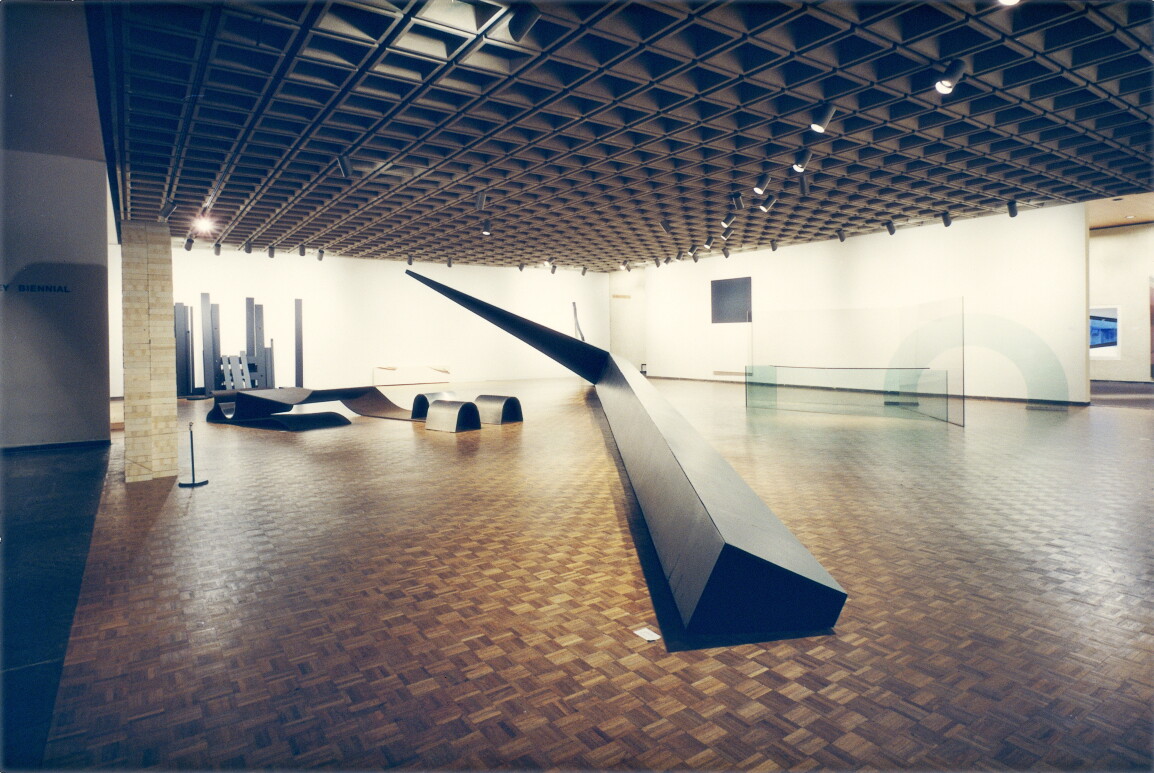
Installation view of 1973 Biennial Exhibition of Contemporary Art (Whitney Museum of American Art, New York, January 10-March 18, 1973). Photograph by Sandak, Inc. Photo Scala, Florence/Whitney Museum / Scala
In response to this, the Whitney evolved the annual into its biennial model in 1973, which helped reshape the field of American art and had major international implications. With over 200 artists on view, legendary names like Jasper Johns, Louise Bourgeois, Frank Bowling, Donald Judd, and John Baldessari were displayed together. The pioneering show set the tone for the building’s capacity to exhibit some of the most important art of its time.
Many iconic performances also occurred during the 1970s in the Breuer building. Trisha Brown’s Walking on The Wall performance, featured the choreographer’s dancers suspended in the air, walking across gallery walls. Duke Ellington performed in the building in 1972, a recital that was later turned into an album Duke Ellington Live at the Whitney.
1980s: The City in the Staircase
While the Breuer building proved perfect for the Whitney’s multi-floor biennial surveys and performances, it was also a nimble space that allowed for excellent single-artist presentations. Nam June Paik’s memorable 1982 solo exhibition was an early standout of the decade. As the first major retrospective of the South Korean experimental electronic artist, it affirmed the importance of video and electronic art as an integral artistic practice through Paik’s imaginative suite of wires, flashing lights, manipulated images, and luminous glass monitors.
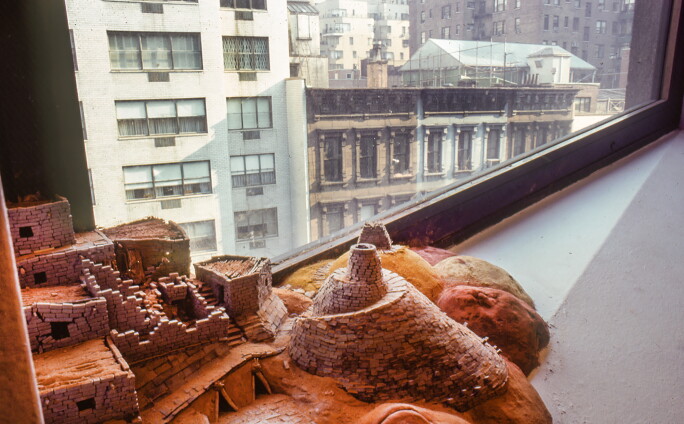
Charles Simonds, Dwelling. Whitney Museum, New York, 1975.
Other notable solo presentations included seminal American artists like Thomas Hart Benton and Marsden Hartley. The museum also gave space for shows for the two most famous photographers to come out of that decade, Cindy Sherman and Robert Mapplethorpe. In 1981, the sculptor Charles Simonds installed his iconic clay sculpture, Dwellings, in the Breuer’s stairwell—this installation remains in place today.
1990s: The Political Shift
In 1992, the Whitney hosted Jean-Michel Basquiat’s first posthumous career retrospective. The exhibition was a major success, with over 100 works on view, solidifying Basquiat as one of the most famous and prolific artists of the end of the century. The artist would later make a notable return to the building at Sotheby’s in 2025, when his painting, Crowns (Peso Neto), 1981, which had been included in his first solo exhibition in the United States, sold for $48.3 million at auction.
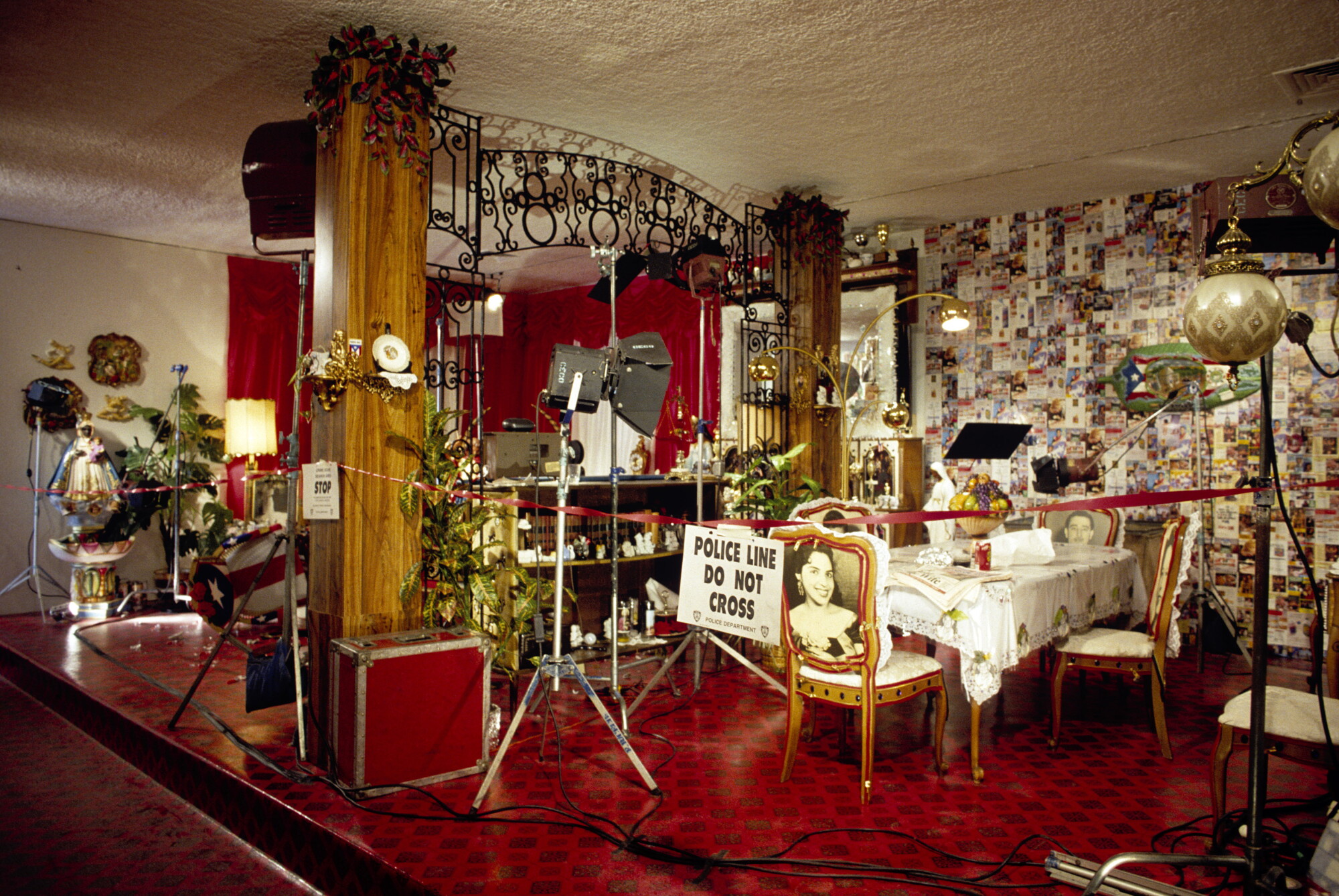
One year later, the 1993 Whitney Biennial stood out as a major departure from those of the 1980s. The climate around the arts was shifting significantly: The National Endowment for the Arts’s funding was being threatened in an attempt to censor American artists. In response, the curatorial team displayed artworks that questioned inequality not just in the United States but globally. Curated by Thelma Golden, John G. Hanhardt, Lisa Phillips, and Elisabeth Sussman, the Biennial tackled issues of gender, sexuality, race, and identity, resulting in an unforgettable moment in twentieth century art.
Installation view of 1993 Biennial Exhibition (Whitney Museum of American Art, February 24–June 20, 1993). Pepón Osorio, The Scene of the Crime (Whose Crime?), 1993.
Photograph by Geoffrey Clements. Photo Scala, Florence/Whitney Museum / Scala
2000s: Technology As Art
The turn of the millennium brought changes that defined the programming at The Whitney in the 2000s. In 2001, the museum organized BitStreams, a multimedia survey that examined how nascent digital technology was shaping and would continue to shape art. While most of the technology is outdated, the exhibition was one of the earliest museum shows in the United States to consider new ways of making now embedded in artmaking—all within a mid-twentieth-century modernist building that could never have anticipated displaying digital art.
2010s: The Ultimate Koons Retrospective
In 2014, The Whitney held its last exhibition in the space, a retrospective of Jeff Koons’s work, before moving downtown to its current home in the Meatpacking District. As the most comprehensive retrospective of the famed artist’s career, the exhibition filled the galleries with Koons’s iconic glass balloon animals, slick parodies of advertisements, and kitschy large-scale sculptures of tchotchkes. Visitors encountered the artist’s work against the stark Brutalist architecture, creating space to appreciate an oeuvre often obscured by market hype.
Installation view of Jeff Koons: A Retrospective. (Whitney Museum of American Art, New York, June 27 – October 19, 2014). Jeff Koons, Balloon Dog (Yellow), 1994-2000. Photography by Ronald Amstutz.
After leasing and carefully restoring the building, the Metropolitan Museum of Art used the space to exhibit its modern and contemporary program, with important exhibitions by artists such as Kerry James Marshall and Gerhard Richter. During the COVID-19 pandemic, The Met handed the lease to The Frick to use while it renovated its iconic mansion-museum five blocks south. A temporary occupant, the historic Frick collection worked remarkably well within Breuer's modernist architecture, seamlessly juxtaposing styles across hundreds of years.
2020s: The Future Is Sotheby's
The lobby lights after Herzog & de Meuron's meticulous restoration. Photo by Stefan Ruiz.
In 2023, Sotheby’s bought the building from the Whitney and, after additional restoration by the architectural firm Herzog & de Meuron, opened it to the public in 2025. This included refinishing and replacing the iconic rows of lamps in the building's lobby, steam-cleaning the concrete walls, and polishing the stone floors. More significantly—and for the first time in the building’s history—Sotheby's made visiting the galleries free, ensuring that the public can engage with some of the best art displays New York City has to offer.
Another major achievement accompanied the building’s transition into this new chapter. In its fifty-plus-year history, it had not previously received landmark designation. On May 20, 2025, the New York City Landmarks Preservation Commission designated the building as both an individual and interior landmark, with the cooperation and endorsement of Sotheby’s.
Now 60 years into the building’s life, Marcel Breuer’s inverted ziggurat and concrete interior have the protected status they warrant. The preservation act culminates decades of rich art history and ensures that a beloved space will continue to do what it does best for years to come: facilitate our collective appreciation and love of art. Next up Independent 20th Century. And after that, well, you’ll have to sign up for Sotheby’s emails to stay in the know.
The Breuer opens in 2025 under Sotheby's ownership. Photo by Stefan Ruiz.
About the Author
Bryan Martin
Bryan Martin is a writer based in New York. He works as an editor at The Metropolitan Museum of Art and earned his MA in art history from City College.