How Monet Continues to Inspire This Jewelry Designer 100 Years Later
How Monet Continues to Inspire This Jewelry Designer 100 Years Later
By Sotheby's| Sep 17, 2026
Feng J was born to paint, but found her way to another art form—jewelry design—after life's twists and turns. In October, Sotheby's in Paris will host Le Temps Retrouvé: The Schlumberger Collection, featuring two previously unseen paintings by Claude Monet. To mark the sale, Feng J's jewels—inspired by the paintings—will go on display in Paris and Hong Kong. Read her story of inspiration and finding her medium.
As told to Lili Goksenin.
Feng J was born to paint, but found her way to another art form—jewelry design—after life's twists and turns. In October, Sotheby's in Paris will host Le Temps Retrouvé: The Schlumberger Collection, featuring two previously unseen paintings by Claude Monet. To mark the sale, Feng J's jewels—inspired by the paintings—will go on display in Paris and Hong Kong. Read her story of inspiration and finding her medium.
As told to Lili Goksenin.
I
always wanted to be a painter—jewelry design only came at the conclusion of a long, searching journey. I grew up in a family steeped in traditional Chinese art: my great‑grandfather was a court painter in the Qing dynasty, and from a young age I studied ink painting and calligraphy.
When I entered the China Academy of Art in Hangzhou—alma mater of the artists Zao Wou‑Ki, Wu Guanzhong, Lin Fengmian and Chu Teh‑Chun—I found myself increasingly drawn to abstraction, but I completed a degree in Furniture and Product Design, studying under Pritzker Prize–winning architect Wang Shu.
After that, I dreamed of designing sports cars so I applied to the ArtCenter College of Design in Pasadena, California. When my student visa was rejected, I pivoted and enrolled at the London College of Fashion (UAL), where I majored in Fashion Accessories. That was the moment I discovered jewelry, and by the time I returned to China, my path was clear.
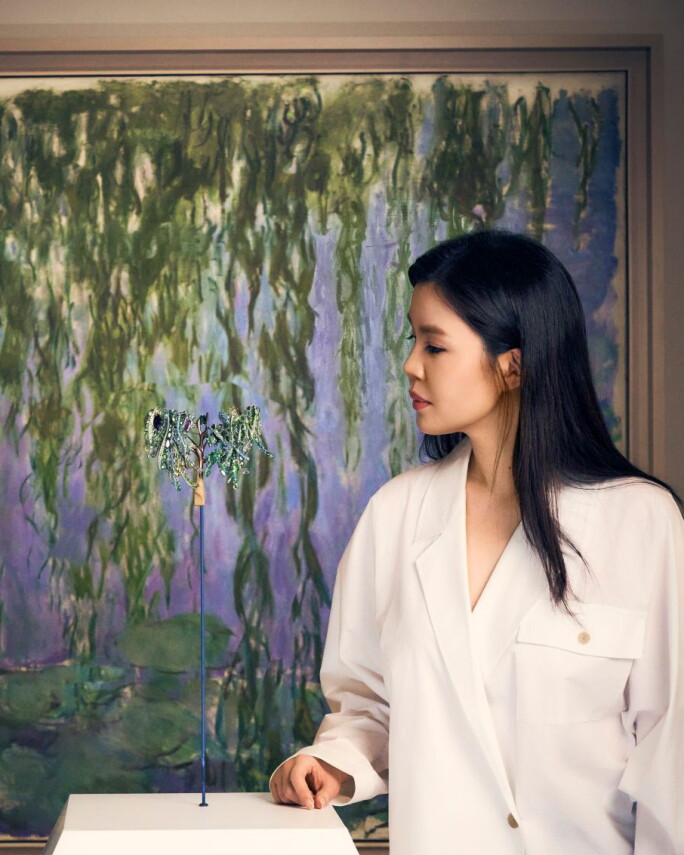
The designer stands next to her Dragonfly with Willow Branches brooch.
I went on to study gemology at GIA Shanghai and spent my free time visiting gem fairs and trading centers across Asia. Around that time, a relative asked me to design a piece for her: an orchid brooch. The same year, I joined a group of young designers invited by Poly Auction (Hong Kong) to create jewels incorporating jade. When my piece sold, I gained the confidence to develop my own style and techniques.
After a few more years of practice, I took courage in both hands and founded my own maison, Feng J – Joaillerie d’Art, in Paris in 2016.
"I remember discovering Monet at school—it really was a revelation."
My work is inspired by painting and nature—the light, colors, plants, even insects. This comes directly from my Chinese heritage, and it’s shaped the way I see the world. Painting, especially, is at the origin of everything I create. I sketch all the time, and every piece begins with a drawing and a gouache. The process keeps me connected to my roots and reminds me that jewelry, for me, is simply another way of painting.
I remember discovering Monet at school—it really was a revelation. Looking back, I think there a few reasons why that encounter left such a lasting imprint on me, and, more generally, why Monet is so deeply revered in China.
The first is his focus on nature, light, atmosphere, and contemplation. Those ideas resonate profoundly with Chinese artistic traditions and aesthetics, and they influenced generations of Chinese artists, even contemporary painters such as Lin Fengmian, Liu Haisu, Li Keran, Wu Guanzhong, Chen Yifei, Pan Shengqian, etc. The list is long.
There’s something almost uncanny about the similarities between the places that inspired Monet and the landscapes of Hangzhou, where I grew up. When you walk along the shores of West Lake, you can almost imagine yourself in Monet’s garden, surrounded by weeping willows and waterlilies. That connection felt very natural to me.
"The most important thing that Monet taught me was what art can be."
But the most important thing that Monet taught me was what art can be, and what an artist should dare to do. Seeing how his technique evolved toward abstraction at the end of his life gave me the confidence to search for my own language in high jewellery. It showed me that you can break with, or reinvent, centuries‑old traditions if that’s what it takes to express your vision.
Images from left to right: From Left: Libellule aux rameaux de saule (Dragonfly with Willow Branches) and The Ginkgo Leaf of Dawn brooches. .
Before I made the pieces in for this collection, I visited the Musée des Impressionnismes Giverny, where I discovered Nymphéas avec rameaux de saule, the monumental canvas Monet painted during the First World War. What immediately caught my eye wasn’t the waterlilies—it was the branches of the weeping willow, and the extraordinary modernity of the painting. There’s an almost abstract dimension to it that feels incredibly contemporary.
I’ve always been drawn to abstraction, so Monet’s patterns spoke to me instantly. They inspired the dragonfly I later created—Libellule de Giverny— the wings of which echo the incandescent branches of Monet’s “trees of fire.” It was my way of translating his gesture, his rhythm, into the language of high jewelry.
Many of the other pieces in the exhibition are inspired by Monet’s treatment of light and his extraordinary pastel palette. They also feature the mounting technique I invented—the Floating Set— and gems cut in the Double Rose Cut, an antique cut I rediscovered to give full expression to my pictorial vocabulary.
A guache rendering of the Gingko brooch design.
Like Impressionist brushstrokes, I use gemstones and diamonds as pigments, layering them and alternating angles to create plays of color and light. It’s my way of translating Monet’s atmosphere and luminosity into the language of high jewelry.
Usually, my pieces take months of trial and error—and quite a few breakages along the way. The Floating Setting technique is challenging, time‑consuming and wonderfully unpredictable. You can’t design these compositions with any real precision in advance; each one has to be arranged entirely by hand, every stone meticulously positioned.
I always begin by working out the positioning of the stones, and then I sit side by side with the setter as the piece is being crafted. That dialogue between the idea and the hand is essential— it’s where the piece finds its balance.
As for the gemstones, over the years I’ve built what I call my “color bank” or “color library”: gems organized by tones, nuances, hues and saturations, all divided into color families. For example, my palette of greens includes emeralds, tsavorites, green sapphires and green tourmalines. The spectrum of reds, pinks and oranges ranges from rubies and spinels to the rare peach‑hued padparadscha sapphire. I’ve always seen jewelry a form of art: it brings together sculpture, painting, even design. So, when Sotheby’s suggested exhibiting my new pieces in dialogue with never‑before‑seen late works by Monet, it genuinely felt like a dream come true.
What I hope this exhibition does is open a door for painting collectors, or anyone who loves art, to see high jewelry as something more than purely ornamental. For me, it’s another medium of expression— a way to paint with light, color, and materials. And showing my pieces next to Monet’s late works makes that connection visible in a very immediate, emotional way.
These pieces (and others) will be available for viewing alongside the two Monet paintings on the following dates:
Sotheby’s Paris (17-18 September) 83 rue du Faubourg Saint-Honoré, 75008 Paris, France 17 September | 2:00-6 PM 18 September | 10:00 AM–6:00 PM
Sotheby’s Hong Kong (22-27 September) Landmark Chater, 8 Connaught Road Central, Central Monday–Saturday | 11:00AM–7:00PM Sunday | 11:00AM–6:00PM