
The Painting That Made Roy Lichtenstein
A new biography of the painter, out in November, recounts the eureka moment when he abandoned abstraction and embraced his destiny as a pop art star.

A t first, Roy Lichtenstein was taken aback by what he had done. Then he was spellbound. It was June 1961, and the painter, a 37-year-old assistant professor of art at Douglass College, was in the upstairs bedroom that served as a studio in his suburban home in Highland Park, New Jersey.
For many months, he had been producing paintings composed in the shadow of abstract expressionism. The canvases consisted of stripes—broad, wavelike ribbons of bright and lusciously swiped pigment. Vertical bands of three or four harmoniously chosen colors were usually balanced by horizontal ones in the same hues. The canvases were deliberate and accomplished, but they could not have existed without the example of Willem de Kooning or Franz Kline. Indeed, by the late 1950s, abstract expressionism had devolved into a semi-academic exercise as flotillas of artists around the United States emulated its mannerisms of angst and edginess, purveyed through slashing brushstrokes. The New York dealers that Lichtenstein hoped would show his work did not warm to yet another version of diluted de Kooning. In truth, he had not been in a serious gallery since 1957, and unsold pictures were piling up around him. He supported his wife, Isabel Lichtenstein, and young sons, David and Mitchell, by teaching, and he could not afford to jeopardize his job. Fortunately, Lichtenstein had a way with his students, who described him as “wide open,” “fun to be with,” “down to earth,” and “a natty dresser,” but it was not enough. A paramount reason for his joining the faculty at Douglass, the women’s branch of Rutgers University in central New Jersey, was its proximity to the New York City art scene. As a colleague said, he was “hell-bent on getting recognized” there.

Lichtenstein had been preoccupied with reaching the top since the mid-1950s, but nothing he did had attracted enough notice. Then one June day in 1961, Lichtenstein paid unusual attention to a book that his sons had. It was titled “Walt Disney’s Donald Duck, Lost and Found.” On the cover, Donald Duck and Mickey Mouse are on a raft, making for the shore. Because the book was a Disney product, readers discovered that “shore” inevitably meant the “Tom Sawyer Island” attraction at Disneyland. Lichtenstein was struck by an inside-the-book illustration of Donald and Mickey fishing in a cove. Donald, perched on the end of the dock, has hooked the edge of his own sailor jersey in the act of casting, and he is pulling himself skyward as he struggles to land a fish. Mickey, standing behind him, covers his mouth to suppress a guffaw as Donald quacks, “Look, Mickey, I’ve hooked a big one.”
Unlike the slapstick setup, with its potential for disaster and confusion, the illustration is artistically sophisticated. Readers see a variety of colors—reds, yellows, blues, oranges, browns, greens, blacks and whites. Donald and Mickey are in the foreground, but the planks of the dock recede behind them, leading the eye to three people in the distance walking by some trees. The composition is not simple, primitive or reductive. Cartoon characters and human beings coexist in a peaceable and nicely planned universe. The economies and shortcuts typical of comic strips are absent. Instead, the illustration is a model of the lavish and genteel visual touches that make for an alluring picture book that parents will buy for their children.


This was not Lichtenstein’s first professional encounter with Mickey and Donald. In early 1958, while teaching in upstate New York, he produced several paintings inhabited by a smiling Mickey Mouse, a yawping Donald and a particularly insouciant Bugs Bunny. But these refugees from the lowly comic books were too unrehabilitated for art, and Lichtenstein sought to legitimize them by embedding them in rough, swirling backgrounds once again indebted to de Kooning. Lichtenstein was not ready for the implications of such recombinant contrasts—they must have struck him as art Frankensteins. He destroyed the canvases but kept several drawings as mementoes. Form and content had not coalesced, and in the parochial artistic and political environment of Oswego, New York, where he lived and worked, there was little encouragement for him to take a creative leap. On the verge of a walloping discovery, he turned away.
Three years later, Lichtenstein could saturate himself in the New York art world, which consisted not only of the elders of abstract expressionism, but also the emergent risk-takers who personified alternatives to it. Rutgers and Douglass were essential to Lichtenstein’s burgeoning artistic emancipation too, because the university was a cradle of freethinkers. Allan Kaprow, the father of “happenings,” which dispensed with the canvas and turned the work of art into a participatory event, taught at Rutgers and galvanized everyone around him. Lucas Samaras and Robert Whitman had been undergraduates there. Nascent Fluxus artists Robert Watts and Geoffrey Hendricks taught at Douglass, and George Segal was an important presence in both places. Moreover, as Kaprow said of the entire group, “We were also active in the New York studio and gallery world.” Their alchemy made New Brunswick a place of creative vitality, where all varieties of aural and visual experiences from everyday life had the potential to be the new stuff of art. This shift in Lichtenstein’s milieu, from isolation to a high-functioning artists’ community, sparked a shift in style. Lichtenstein admitted that his metamorphosis from prosaic abstract painter into someone who blatantly questioned the nature of art with pictures that “had every quality that abstract expressionism eschewed” had the appearance of a miraculous event, and he credited Douglass for it. “I am sure that if I had stayed in Oswego,” he further stated, “nothing would have happened.”
When Lichtenstein noticed the little tableau of Mickey and Donald, he hooked the big idea of a lifetime. He decided to render the silly scene, but not in an artistic way. He would forgo the application of abstract expressionist frosting to use the language of the day—the same flat style found in comic strips, a byproduct of the cheap printing processes of newspaper reproduction. In fact, Lichtenstein did not copy the composition or palette of the Disney original; he cropped it to strip out everything but the foreground action, and he changed the rainbow of colors to a set of tightly limited choices—the primaries of red, blue and yellow, plus white. Along with black, this was the cost-saving palette of comic strips and bubble-gum wrappers rather than higher-echelon children’s publications. Lichtenstein made his alleged facsimile cruder, ruder and more aggressive than the source that inspired him. He wanted to remind people of a real comic book panel, so he adopted a graphic style and dropped the hallmarks of 1950s painting, like modulations of thick and thin paint and calligraphic lines. “I just thought, ‘Gee, suppose I paint this without the painterliness,’” Lichtenstein remembered. “I realized that this was a marked change from prevailing taste, because, although almost anything seemed to be fair subject matter for art … commercial art and particularly cartooning were not considered to be one of those possibilities.” The notion of presenting a cartoon image so it looked like a cartoon was more than outrageous: it was subversive. This canvas, which Lichtenstein later called his “first painting with no expressionism in it,” was titled “Look Mickey.”

The results stunned Lichtenstein. As someone with more than 20 years of training and preparation to be an artist—he had a BFA and an MFA from Ohio State University (OSU), and he had been making art since his adolescent years—he had never considered commercial art or illustration on the same plane as high art. The paintings of Jackson Pollock, de Kooning and Kline were sanctified totems; this rebellion against the artists he venerated was almost psychologically unbearable for him. Veering so dramatically from being an abstractionist striving for seriousness and depth to a representational painter whose work was riddled with satire and irony was by no means easy. Up to that moment, Lichtenstein had accepted the notion that figurative painting was retrogressive and commercial art was contemptible. Harold Rosenberg, the critic who coined the term “action painting” and was closely identified with the New York School, dismissed Lichtenstein as “an abstract expressionist suddenly retooled to blow up comic strips.” Rosenberg incorrectly suspected that Lichtenstein’s stylistic transformation was motivated by expediency, but he was accurate in defining his aesthetic heritage and the wrench the artist had given to it. Yet unlike in 1958, Lichtenstein’s fresh new strength was his willingness to abandon the direction he was taking. This time he was dominating his material, as opposed to seeing this unruly new development as a distraction from a perceived goal. “Look Mickey” negated everything he knew. The first cartoon paintings were “what people thought of as non-art,” Lichtenstein said. “But it was just an impulse—based on something, obviously, or I would have thrown it away, I guess. The rationales came in later.” Yet there was no question about what had happened—Lichtenstein had finally invented himself.

Lichtenstein displayed “Look Mickey” in his studio for about a week, intending to return to abstraction. But this disreputable new canvas was so compelling that before long he knew there was no going back. “I did it as sort of a tryout to see what it would look like,” he remembered. “I put it up in my studio, and everything else looked like mush.” Lichtenstein burst forth with paintings taken from comic books and advertisements—including “Popeye,” “Wimpy (Tweet),” “Washing Machine,” “The Engagement Ring,” and “Girl with Ball”—without hesitation. They depicted things that Americans lived with—trash cans, transistor radios, spare tires, laundry soap—but, wrote the art historian Robert Rosenblum, “had always been kept far away from the sacred spaces where art was to be worshipped.” Trying to articulate an underlying principle for his breakthrough, Lichtenstein explained, “I usually say that my ability was above my awareness. I think that’s something that happens with inspiration. I mean, that defines inspiration in a way, where, generally speaking, your awareness is above your ability. You can conceive of playing the piano, but you know you’re not Mozart. But once in a while you become kind of a crazed genius for a second, and you invent something beyond what you’re really aware of. It’s not quite that simple, because you have to … be aware—because you would throw it away, obviously. So you have to recognize that you’ve done something.”
Throughout the summer, Lichtenstein stayed up in his studio, painting and laughing out loud, reveling in the flash of his own Mozartian moment. He finished close to a dozen paintings executed in a deadpan simulation of cartoon-style reproduction. He had asked every friend, every relative, every artist, every neighbor who dropped by for their opinion. Some of Lichtenstein’s first viewers smiled their acceptance or laughed too. Others tried to hide their puzzlement and horror or reached for understanding, but his unease had vanished. For these paintings, Lichtenstein would not countenance marking time in the second- or third-tier galleries that had previously been venues for his work. Allan Kaprow made an appointment for him at the Leo Castelli Gallery, the premier showcase for groundbreaking contemporary art in New York, in the early autumn of 1961. Lichtenstein had been going to Castelli’s gallery since the late 1950s and longed to be a part of it, but that would have been in the realm of fantasy. A few weeks after he brought in the canvases for Castelli to see, the dealer agreed to represent him and scheduled a solo show for February of 1962. Critical response was mixed, ranging from astonished delight to equally astonished indignation, but there was blanket press coverage and the show sold out. The media and the market anointed Lichtenstein and pop art as desirable. Lichtenstein’s career as a modern artist was streaking toward a stratosphere of success so spectacular that not even a futurist could have predicted it.
O n January 31, 1964, two years after his electrifying debut at Castelli and less than three years after the creation of “Look Mickey,” Roy Lichtenstein was inescapable. He was such a red-hot subject that Life magazine ran a story about him headlined “Is He the Worst Artist in the U.S.?” Lichtenstein’s crime, as Life and other critics saw it, was that he had sullied the good name of art. He had pressed forward with his practice of taking dozens of images from comic books, advertisements and other plebeian sources that he went on to enlarge and transfer to canvas. He had shown them in galleries and even in eager museums—and enough influential people had bought them. By monumentalizing ordinary objects, from hot dogs to soda siphons, and imbuing them with an iconic status, Lichtenstein celebrated and debunked the glorious dumbness of American things in a startling new manner. But the artist’s most heretical act—and supreme brainstorm—was the method he still dared to use: imitating the cheapest processes of commercial printing. His trademark device was the Ben Day dot, the minute mechanical patterning used in newspaper illustrations and comic strips to convey texture and gradations of color. In Lichtenstein’s hands, the dots were weaponized to attack every reigning convention that cloaked high art in solemnity and angst. As he would explain it, “The use of dots to produce half-tones or 50% red or 50% blue changed what is in art an aesthetic problem into a seemingly insensitive mathematical problem. So if somehow I could produce a work that had unity of both drawing and tonality, but was done in a style which signaled the exact opposite of that, it would be just what I was looking for.” Lichtenstein, said curator Diane Waldman, “claimed for the Ben Day dot a role that only a short time earlier had belonged to the drip.” Infusing crude form and crass content with an unprecedented punch of irony, Lichtenstein struck at the heart of deeply held aesthetic pieties—what makes good taste “good” and bad taste “bad,” and who gets to decide? If someone’s art does not look “original,” then what does it mean to be an artist? Life’s headline writers were confident that they knew the answers to those questions already, but for Lichtenstein, earning an article like that was a triumph in itself.
“I just thought, ‘Gee, suppose I paint this without the painterliness.’ I realized that this was a marked change from prevailing taste, because, although almost anything seemed to be fair subject matter for art … commercial art and particularly cartooning were not considered to be one of those possibilities.”
Roy Lichtenstein was one of the artists responsible for an earthquake that shook the landscape of modern art so dramatically that its tremors became an international phenomenon. After his recognition in the early 1960s, he became one of the leading artists of the second half of the 20th century. Lichtenstein is synonymous with pop art, the movement he helped invent, and, as we have seen, his first fully achieved works were paintings based on imagery that had no business being associated with fine art.
Yet precisely because he did create something that did not look like the heroic high art of the day, and then stripped that art of its godlike status, Lichtenstein took his place among the new avant-garde. When Lichtenstein began his first pop pictures during that summer of 1961, it was at the same time as the emergence of Andy Warhol, James Rosenquist and Tom Wesselmann, who had recently found signature styles of their own. Sculptor Claes Oldenburg first made his mark in New York with a show in 1959, and in 1960 painter Jim Dine was constructing autobiographical environments and theater pieces that were raw affronts to traditional sculpture and performance. All these artists were following in the wake of Robert Rauschenberg and Jasper Johns, who dispensed with abstraction in the early 1950s. Taken together, they constituted a generational revolt. Inevitably, there were naysayers—to the veteran critic Max Kozloff, Lichtenstein was one of the “new vulgarians,” and Clement Greenberg, the champion of Jackson Pollock and a lion among American critics, wrote off pop as a novelty that lacked staying power—it was too frivolous to qualify as art. The New York Times’s Brian O’Doherty gloomily noted that Lichtenstein had added “an unworthy graft to the body of art, and there seems to be nothing one can do to stop it.” Yet writers, curators, collectors and artists hungry for change saw the insurgents as invigorating the energies of the 1960s, which ranged from the Kennedy administration and the Beatles to the Civil Rights Movement, the sexual revolution and the Vietnam War. The artists of the ’60s, approaching middle age, became unwitting symbols and prophets of a youth-oriented decade to come. Richard Hamilton, creator of the first purposely pop work of art in 1956, forecast the cheeky excitements to come a year later, listing the salient characteristics of pop art as: “popular, transient, expendable, low-cost, mass-produced, young, witty, sexy, gimmicky, glamorous and Big business.”
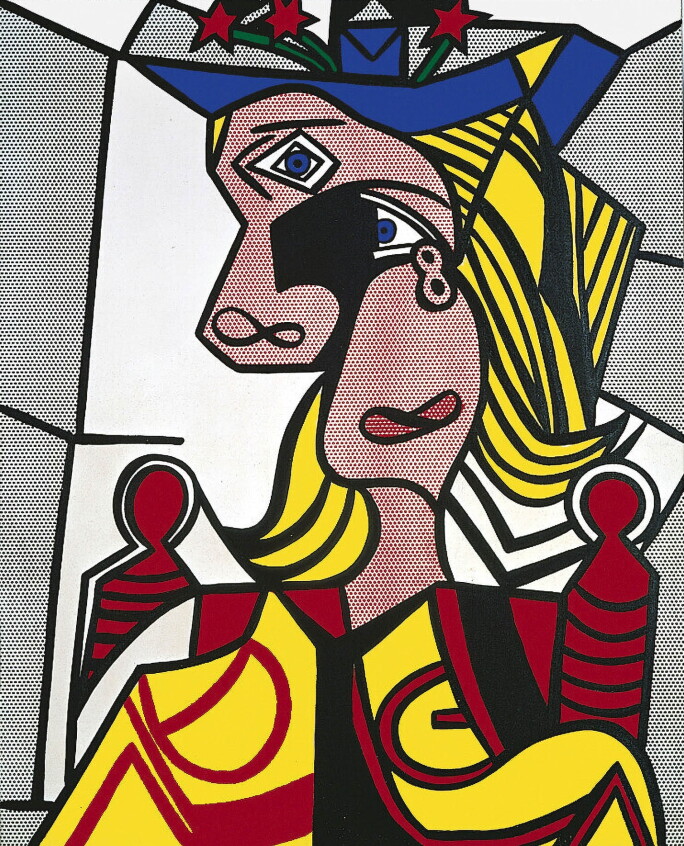
Lichtenstein’s iconic cartoon images only lasted five years. He went on to create an oeuvre of more than 5,000 paintings, drawings, prints, sculptures and other objects acclaimed for their wit and invention. He remained committed to experimentation throughout his career, intent on changing the way we think about art, always pushing himself toward more complex pictorial statements. Lichtenstein did not rest with his acclaimed paintings and sculptures of pop objects and narratives. He created provocative reinterpretations of the art of his personal gods—Picasso, Cézanne, Monet and Mondrian—and expert meldings of surrealism, expressionism and purism. These works proclaim Lichtenstein’s ongoing fascination with both art history and the nuts-and-bolts components of painting: he left no aspect of art practice untouched. He produced intimate and casual sketches that offer clues to his inner life, and grandly scaled public sculptures and mural commissions. There are perfect encapsulations of the zeitgeist, tapping into political and social issues, and there are forays into esoteric subjects and styles and unusual materials. There are canvases of enormous pictorial intricacy undreamed by an earlier artistic self, and souvenirs of Lichtenstein’s youth, well before he found the idiom that propelled him into history.
Today, nearly 65 years after the debut of the pictures that made him notorious and more than a quarter-century after his death in 1997, Roy Lichtenstein has not faded away. Museums around the world still compete to acquire and show his work, and commercial galleries to sell it. Scholars and critics have never stopped studying or writing about him, and streams of catalogues, monographs, articles and reviews flood his ever-expanding bibliography.

Market valuations are a notoriously imperfect guide to the lasting worth of a work of art, and Lichtenstein himself avoided dwelling on his good fortune—his sales and commissions ultimately made him a multimillionaire. He was uncomfortable in judging his art by price or equating it with money. Nevertheless, financial imperatives have to be acknowledged. The appetite for Lichtensteins has been enthusiastic and unstoppable since late 1961. In 1962, Lichtenstein painted “Masterpiece,” a cartoon narrative that turned out to be an uncannily prescient forecast of his own future. When he created it, Lichtenstein was poking fun at himself and all other artists who fantasize about fame and fortune: a young blonde speaks in a dialogue balloon to the black-haired, granite-jawed comic-strip hero at her side. She gushes, “Why, Brad darling, this painting is a masterpiece! My, soon you’ll have all of New York clamoring for your work!” The comic format is a perfect match for the message—the artist is the archetype of the nerdy kid who discovers that he is a wizard. Through the superpower of his talent, the obscure outsider triumphs in the battle for success. For Lichtenstein, the superhero metaphor turned into a reality that surpassed his imagination. He had dreamed the impossible, and it had come true. As for “Masterpiece” itself, in 2017 it was privately sold to Steven A. Cohen, a hedge fund manager and soon-to-be owner of the New York Mets, for $165 million. “Nurse,” from 1964, is a theatrical close-up of a nurse in a state of alarm. Shock and doubt play across her face; no clues are given for her freeze-framed terror. The canvas established an auction record for the artist in 2015 when it sold for more than $95 million. Lichtenstein obviously did not live to see these surreal prices, but the hundreds of thousands of dollars that he could receive for a picture must have appeared at least as bizarre to someone of his age and experience. Born in 1923, he grew up in New York City during the Depression, where he saw hoboes camped along the Hudson River and watched his father press money into the hands of the men selling apples on the streets. Nor was he so far removed in spirit from the long decade of 1949 to 1961, when he strained to make a living, and was lucky to make $35 to $50 from selling a picture.

Lichtenstein’s sensibility and focus were responsible for the expansiveness of his oeuvre, his alertness to the moment, his democratic outlook and his energy in tackling myriad genres, methods and materials. In 2007, New York Times critic Roberta Smith, who would not have known about Lichtenstein’s unpublished remark about Mozart, compared him to the nonpareil musical genius on her own. “Despite other candidates, Roy Lichtenstein’s elegant, buoyant canvases may be as close as 20th-century painting gets to Mozart,” she wrote. “There is a boundless optimism to his work, expressed in its unwavering celebration of popular culture; its cool, straightforward craftsmanship; and its intricate, eye-popping, often witty perfection.”
From the first, Lichtenstein believed that art is not based on nature. Instead, it is built on other art, which guides what we see and what we think we see, and this tenet remained the crux of all his work. Both Picasso and Paul Klee, another artist Lichtenstein admired and learned from, stated that nature was an obstacle that artists should do without. In his extremely hard-used copy of an exhibition catalogue on Picasso that he bought in 1941 and held on to for the rest of his life, Lichtenstein bracketed in pencil several of Picasso’s statements, including this one: “They speak of naturalism in opposition to modern painting. I would like to know if anyone has ever seen a natural work of art. Nature and art, being two different things, cannot be the same thing. Through art we express our conception of what nature is not.” Lichtenstein’s habit of rifling through the canon of art history and restating it in his own work is a trope of modern art and establishes Lichtenstein irrevocably in that camp no matter the look or subject of his work. As Robert Motherwell so trenchantly observed, “Every intelligent painter carries the whole culture of modern painting in his head. It is his real subject, of which anything he paints is both an homage and a critique, and anything he says is a gloss.” A century after his birth, Lichtenstein’s achievement can best be described as indispensable: American painting would not be the same without him.
Excerpted from “Becoming Roy Lichtenstein: The Path to Pop,” by Avis Berman, New York: Abbeville Press, 2026. Text by Avis Berman © 2026. All Rights Reserved.

