Important Design25 November 2025 • 2:30 PM CET • Paris
With over 200 lots combining Art Deco, post-war design, and contemporary creations, the sale establishes a lively dialogue between the masters of the past and the voices of the present.
The sale will open with a chapter celebrating the centenary of the Paris 1925 International Exhibition of Decorative Arts, presented by the Anne-Sophie Duval gallery and Liaigre. This cross-selection of some fifty creations reveals the close links between the great figures of Art Deco, and the creations of Christian Liaigre.
The sale will continue with a journey through design from the 20th century to the present day, revealing several major creations in the history of design, some of which are being offered at auction for the first time.
Contemporary design will also be in the spotlight with a section dedicated to the work of Richard Peduzzi. Through a selection of furniture, rugs, and lighting, the sale showcases the unique artistic vision of this internationally renowned scenographer, painter, and designer.
This season, Sotheby’s invites him to turn his discerning eye to the decorative arts, entrusting him as curator of the Important Design sale in Paris.
The famous questionnaire most notably answered by chronicler of the human condition, Marcel Proust, in the late 19th century, has come to serve as a fascinating insight into the minds of cultural figures throughout history. Pierre Hardy, guest curator of the Important Design sale in Paris, shared his answers to the famous questions.
This chapter, which opens our sale, pays tribute to two major figures in the history of 20th-century decorative arts in France: Anne-Sophie Duval, a pioneer in the rediscovery of the great Art Deco designers and founder of the eponymous gallery, established in 1972 at 5 quai Malaquais in Paris, now run by her daughter Julie Blum, who continues the gallery's historical legacy with a vision that also looks toward more contemporary creations. Christian Liaigre, interior architect and designer, who made his mark on the international decoration scene in the mid-1980s, embodying a sober style with perfect proportions in line with the best examples of the first half of the 20th century. A demanding vision that continues to be kept alive by Liaigre. Through the dialogue between nearly fifty works by the great names of Art Deco and the creations of Christian Liaigre, this chapter of the sale outlines a conception of interior architecture synonymous with timeless elegance, revealed in the photographs staged by Vincent-Emmanuel Rouxel during a photo shoot at the Anne-Sophie Duval gallery.
This year, the celebration of the 100th anniversary of the International Exhibition of Modern Decorative and Industrial Arts, originally held in Paris in 1925, is an opportunity for new insight into this event and to ask ourselves how it has influenced our time.
When my mother opened her Art Deco gallery in 1972 on Quai Malaquais in Paris, this “in between World Wars” period had almost faded from our memories. With passion, she contributed to the rediscovery of iconic works by Chareau, Frank, Groult, Rateau, and many other creators whose talent was less known.
The eclectic selection presented for the Sotheby’s Design 2025 sale focuses on pieces which are characteristic of the gallery’s taste: Jean-Michel Frank’s refined and minimalist furniture, such as his well-known cubic armchair, lacquered coffee tables by Jean Dunand or Katsu Hamanaka, who reinvented this archaic material to adapt to modern living, an engraved glass screen by Czaky for Jacques Doucet’s studio’s staircase, medieval and surrealist-inspired chairs by Serge Roche and Gilbert Poillerat, a dressing table ornemented by Paul Iribewith a young girl holding a rose, an ingenious parchement bed with rotating bedside table by Pierre Chareau, side tables with delicate marquetry by Georges de Feure, transparent glass columns by Syrie Maugham, and modernist metal napkins rings by Pierre Legrain.
But what is most surprising is that this period is still inspiring contemporary design. To illustrate its influence, we invited Maison Liaigre to select pieces that echo Art Deco, pointing out that despite its extreme brevity, Art Deco radicalism, both modern and classic, has never stopped influencing us.
– By Julie Blum, Director of the Anne-Sophie Duval Gallery
Cross-Functional Roles. Work Objects, Life Objects
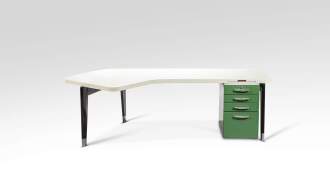
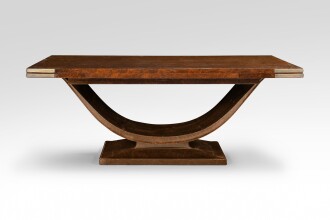
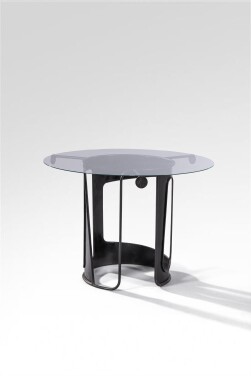
A natural extension of our movements, tables and desks punctuate our daily activities. They have always attracted the attention of designers, who are fascinated by their function as much as their form. The pieces presented here illustrate both the excellence of traditional craftsmanship and the boldness of innovations driven by the avant-garde vision of their creators.
Let's start in the 1920s. The world was buzzing with boldness, Pierre Chareau refined his lines, playing with wrought iron with precision, where rigor became lightness, while Pierre Legrain played the role of furniture architect, his geometric shapes balanced with elegance. Ruhlmann and Printz translated classicism in the style of the 20th century—supple, refined, with rigorous design. Printz called on Dunand to adorn a table with luminous lacquer.
A little further down the line, the momentum becomes more pronounced. René Drouet twists iron into spirals. Jean Prouvé invents new structures, rigorous and ingenious, where folded sheet metal becomes constructive poetry. Following in his footsteps, Mathieu Matégot cuts steel like a sculptor shapes light.
And time continues to pass. Shigeru Uchida creates a dialogue between the restraint of lacquered wood and the joy of a vibrant palette. Marc Newson, meanwhile, starts with a constraint—a need for functionality—and uses it to create a powerful work: beneath the glass, the structure is revealed, red lacquer contrasting with polished aluminum. Today, the field of design is being explored by creators from diverse backgrounds, opening up new perspectives. For example, scenographer Richard Peduzzi has designed an oak written desk whose structural rigor and perfection of design are in line with the research carried out by Gerrit Rietveld in the last century.
This is how this journey unfolds: a century of creations where each table, each desk, tells the same story in its own way—that of human endeavor relentlessly seeking to give form to the beauty of everyday life.
Richard Peduzzi A Creator at the Crossroads of the Arts
« Drawing a chair or a stage set means confronting space and form »
From the very beginning, Richard Peduzzi has explored space, material, form, light, and color—creating a dialogue between the arts. As a scenographer, painter, and designer, he brings a transversal and sensitive approach to each of his projects.
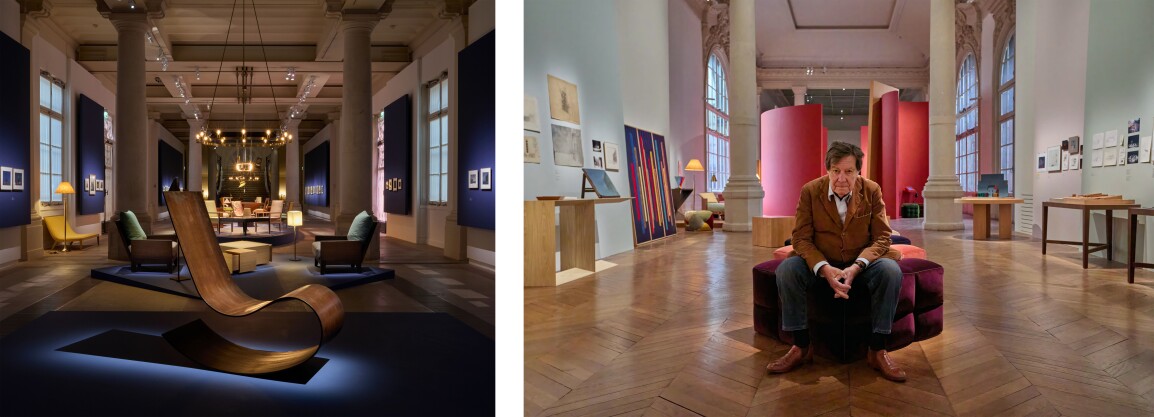
"Nearly one hundred pieces of furniture by Richard Peduzzi, created between 1988 and 2013, now enrich the collections of the Mobilier National” says Hervé Lemoine, President of the Mobilier National and Manufactures Nationales. In October 2024, the Mobilier National pays tribute to him at the Galerie des Gobelins with the exhibition Perspective: Furniture, Sets, Drawings. Several of the works featured in that exhibition are now included in our Important Design sale (lots 187 to 207).
This selection includes some of his most iconic works, such as the Rocking Chair (lot 193). Originally made of cherry wood, this unique piece crafted in patinated iron for the Perspective exhibition unfolds like a ribbon of steel. “As with my scenography, I like to carve into space, to sculpt emptiness, with the idea that a chair is a temple” confides Richard Peduzzi.
Another striking creation is the Pyramid table (lot 192), based on the prototype designed by ARC in 1992. A true technical feat, it features a pyramidal base topped by an inverted pyramid, open on two sides and serving as a tabletop, creating perfect balance.
Always in motion, Richard Peduzzi created in 2024 a series of tapestries produced by Carpet Society. Three of these pieces are featured in our sale (lots 199, 202, and 207), including the Wozzeck rug (lot 207). Its pattern is inspired from the set design for Alban Berg’s opera, staged by Patrice Chéreau in 1992.
Between theater, design, and architecture, the richness and diversity of the works presented in our sale testify to a creator in constant pursuit of harmony and emotional truth.
Caption: (left) Exposition Richard Peduzzi. Perspective. Mobilier, décors, dessins, 2024, Galerie des Gobelins, Paris. (right) Richard Peduzzi, dans l’exposition Richard Peduzzi. Perspective. Mobilier, décors, dessins, 2024, Galerie des Gobelins, Paris.