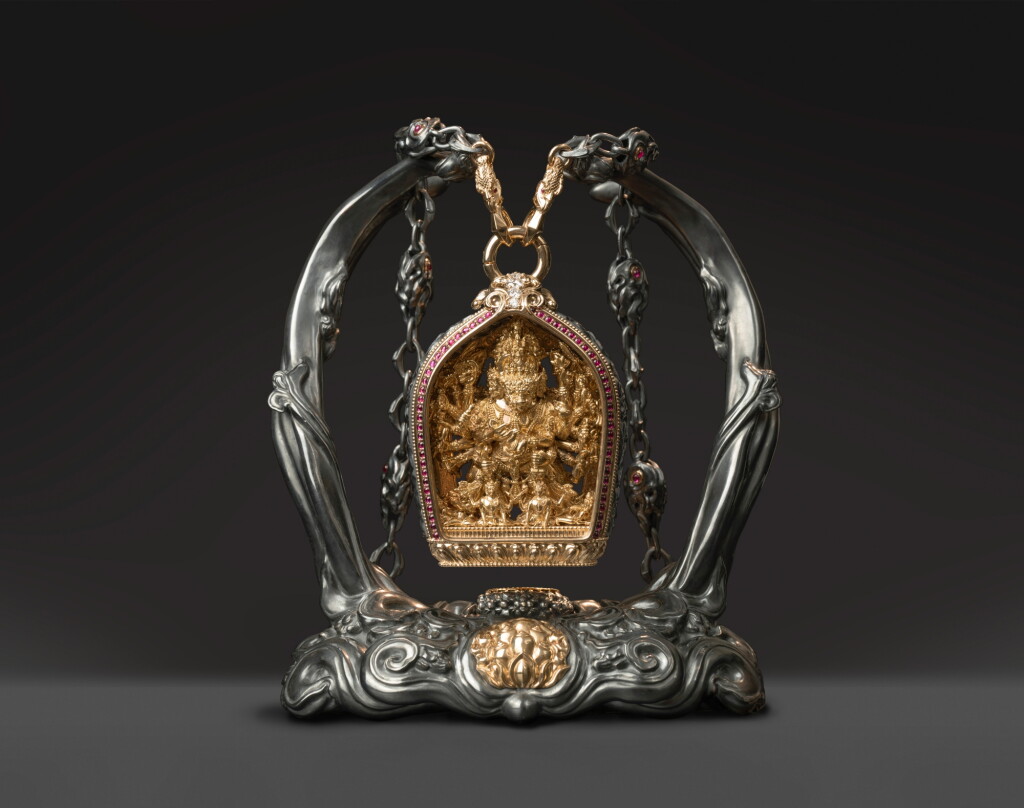
Mei Hua | Microcarvings ‘Vajrabhairava’, Piece Unique Gold, Ruby, Diamond and Lapis Lazuli Pendent Necklace with Silver and Gold Stand | 梅花 | 微雕 '大德威金剛' 全球唯一 18K及22K黃金 配 82顆紅寶石、鑽石及青金石 項鏈及金銀精雕台座
No reserve
Auction Closed
October 6, 09:28 AM GMT
Estimate
380,000 - 480,000 HKD
Lot Details
Description
Mei Hua | Microcarvings ‘Vajrabhairava’, Piece Unique Gold, Ruby, Diamond and Lapis Lazuli Pendent Necklace with Silver and Gold Stand
梅花 | 微雕 '大德威金剛' 全球唯一 18K及22K黃金 配 82顆紅寶石、鑽石及青金石 項鏈及金銀精雕台座
The pendant designed as a mandorla encasing a seated ' Vajrabhairava ' Buddha, highlighted with cabochon rubies, suspended from a necklace decorated with flame motifs, vajra and lapis lazuli beads, to the hand-forged blackened silver pedestal, necklace length approximately 580mm, pendant is detachable.
Miniature Bejewelled Gold Sculpture of the Vajrabhairava Buddha
Vajrabhairava is one of the highly revered, principle deities in the Anuttarayoga Tantra class popular within the Gelug school of Tibetan Buddhism. Also known as Yamantaka, Vajrabhairava is the wrathful manifestation of Manjushri, the Bodhisattva of Discriminating Wisdom. In Tibetan Buddhism, Vajrabhairava is referred to as ‘vjigs byed,’ which originally means ‘to terrify’ or ‘to be capable of terrifying,’ symbolising the ability to subdue all demonic obstacles with a fierce and wrathful posture.
The present lot is a miniature gold sculpture of Vajrabhairava bearing an imposing and magnificent appearance. While the sculpture is made of 22 karat yellow gold, the ornamental outer frame, lotus throne, and other decorative details are fashioned out of 18 karat yellow gold. The combination of these two karat finishes enhances the overall richness and depth of the work. The hardness of the 18 karat yellow gold outer frame protects the intricate details of the work from wear and tear. The total weight of the piece is approximately 200 grams. The front of the ornamental frame, adorned with intertwined vine patterns, is set with fifty-eight natural rubies and four natural diamonds. The beaded chain, engraved with flame patterns, is inset with twenty natural rubies. The spacers between the beads are made of 18 karat yellow gold and adorned with lapis lazuli of the highest quality in the shape of a vajra-handled vajra pestle. The hanging loop of the frame is in the shape of a Capricorn’s head, embedded with four natural rubies. The end of the chain is adorned with a gold and silver-carved lotus mirror. At the centre of the mirror is a custom-made magnifying glass that allows closer examination of the work’s exquisite details. The statue is accompanied by a nimbus hand forged silver pedestal adorned with auspicious clouds, intertwined vines, and lotus patterns. The pedestal is inset with a cintamani (wish-fulfilling jewel) made of 18 karat yellow gold, further highlighting the majestic presence and solemnity of Vajrabhairava.
The Vajrabhairava sculpture required nearly 3000 hours to produce and is an important representative work of the master sculptor Mei Hua. Standing at a height of only 48mm, the work is adorned with magnificent details, exquisite craftsmanship, an intricate design, complex structure, harmonious proportions, and natural fluidity, exuding a vibrant and ethereal aura. The powerful presence and profound religious significance of this statue truly inspires awe.
Vajrabhairava manifests in various forms. The most commonly seen are of the principal deity with nine heads, thirty-four arms, and embracing consorts. The present sculpture portrays a majestic form of Vajrabhairava, appearing as a revered and formidable figure.
The nine heads represent the nine methods of subduing the Lord of Death according to the Tantric scriptures and the nine methods of teachings of the Buddha. The central buffalo head of this Vajrabhairava represents Yama, the Lord of Death, and the two buffalo horns are symbolic of the Two Truths, representing the essence of the secret teachings of transformation and luminosity. The three eyes symbolise the ability to see everything within a distance of three thousand leagues. On the right side, the three heads symbolise the three virtues of anger, power, and serenity, while on the left side, they represent purity, death, and anger. The head above the central face portrays a man-eating rakshasa known as ‘Sambara’. Above this, the highest head represents Manjushri, symbolising wisdom, compassion, and peace. Except for the central Bodhisattva face adorned with a jewelled crown, the other eight faces wear crowns adorned with five skull ornaments, representing the protectors.
Each of Vajrabhairava’s thirty-four arms holds a different ritual implement in its hand. The primary arms in front of the chest hold a vajra, a flaying knife, and a skull cup. The remaining hands extend outwards in a fan shape on both sides of the body. The right hands, from top to bottom, hold: a khatvanga (staff with a skull top), a white conch, a pestle, a curved knife, a spear, a crescent-shaped axe, a sword, arrows, a curved knife, a club, a bone staff, a Dharma wheel, a vajra pestle, a vajra hammer, a dagger, and a hand drum. The left hands, from top to bottom, hold: an elephant hide, the head of a deity, a vine shield, the fresh left leg, a long rope, a bow, human intestines, a bell, a left leg, a mourning cloth, a trident, a furnace, a skull cup, a left arm, a military banner, and a black cloth.
The sixteen legs of Vajrabhairava tramples upon the sixteen-faced iron citadel of Yama, symbolising the sixteen manifestations of emptiness. The eight right legs are bent, pressing down on the eight guardians of the heavens, symbolised by man, water buffalo, yellow cow, deer, snake, dog, sheep, and fox. The eight left legs are extended, pressing down on the eight female guardians of light, represented by the garuda, owl, crow, parrot, eagle, duck, rooster, and goose, symbolising the eight liberated states of purity.
It is extremely rare to find a Vajrabhairava sculpture of this compact size beholding such exquisite craftsmanship. The smallest areas of the sculptures, such as the jewellery, animals, and Vishnu, measure only 0.5mm2. Even when viewed under magnification several times their original size, the details remain beautiful and superb. This Vajrabhairava sculpture incorporates elements from various artistic styles including Ming Dynasty (1368 – 1644) Buddhist sculptures. Exemplary of Mei Hua’s masterful skill and elegrance in micro-carving, the sculpture is exceptional for its exquisite details and meticulous craftsmanship. It is exceptionally rare among Tibetan Buddhist sculptures worldwide and can be regarded as a masterpiece of fine art.
黃金藏傳大威德金剛佛龕掛墜
大威德金剛是藏傳佛教無上瑜伽續部的重要本尊之一,被認為是文殊菩薩的忿怒相化身,備受藏傳佛教各派和信徒的信奉,其地位非同一般。 在藏傳佛教中,大威德金剛被稱之為“vjigs byed”,原為“作怖”、“能怖”之意,即以威猛兇暴的姿勢懾伏一切魔障。
此尊黃金大威德金剛造像,造型威武華麗,整尊造像均為22k黃金制。 纏枝紋外框、蓮花寶座及其他金飾部件為18k黃金,兩種成色黃金的搭配使整體層次更加豐富,其外框18k黃金的硬度更有益於作品精妙的細節不易磨損。 整件作品金重約200克,纏枝紋飾外框正面鑲嵌58顆天然紅寶石和4顆天然鑽石。 火焰紋錾刻珠鏈鑲嵌20顆天然紅寶石,隔珠為18k金配頂級青金石降魔杵造型,佛框掛環為摩羯獸頭並鑲嵌4顆天然紅寶石,珠鏈末端配金銀雕蓮花寶鏡,寶鏡中心定製光學放大鏡片,可用於欣賞作品精美的細節。 本尊造像配有純手工打造925銀祥雲纏枝蓮紋須彌座,座正面鑲嵌18k金摩尼如意寶珠,整體造型流暢沉穩,更加襯托出造像之威武莊嚴。
本品錾刻耗時近3000個小時,是雕刻師梅花的重要代表作品。 此尊全金造像身高僅48毫米,此像裝飾華麗,工藝精美,造型繁縟,結構複雜,比例合度,舒展自然,氣韻生動,其威猛的氣勢和宗教的空靈感令人歎為觀止。
大威德金剛造型眾多,目前存世較為常見的多為主尊九面、三十四臂、十六足且懷抱明妃的形象,而本尊造像為單尊出現的獨雄形象。
本尊怖畏金剛九頭,代表九種鎮壓閻王的契經。 三目,意為三千里眼,無所不見。 居中牛頭,表閻羅王,長兩水牛角,表示兩真二諦; 右三頭,象徵著憤怒、權勢、安靜三德能 ; 左三頭,表示清凈、死亡、憤怒 ; 居中再上為吃人夜叉相,名「參怖」; 最高一頭為文殊本像,象徵著慈善和平。 除最上的菩薩面頭戴珠寶花冠外,其餘八面都帶五骷髏冠 (護法裝)。 主面牛臉和兩個牛角,代表幻身與明光的教法,這是密續教法的精髓。 九面代表佛陀的九類教法。
三十四臂,各手均持有法器,主臂胸前各持鉞刀和顱碗,其餘各手呈扇形伸向身體兩側; 右手由上而下分別持: 高揚、白筒、杵、勾刀、標槍、月斧、劍、箭、勾刀、棒、人骨杖、法輪、金剛杵、椎、匕首、手鼓 ; 左手自上而下分別持: 象皮、天王頭、藤牌、鮮左腿、長繩、弓、人腸、鈴、鮮左臂、喪布、三尖矛、爐、顱器、人左臂、軍旗、黑布。
十六條腿 ,壓閻王十六面鐵城,亦象徵十六空相。 右八腿屈,壓八天王,象徵物為男人、水牛、黃牛、鹿、蛇、狗、綿羊及狐,表示是八成就 ; 左八腿伸,壓八女明王,象徵物為鷲、梟、鴉、鸚鵡、鷹、鴨、公雞及雁表示八自在清淨。
此尊造像工藝之精美,尺寸之小巧實屬罕見,其中瓔珞、鳥獸和毗濕奴等造型的最小面積僅為0.5平方毫米,而且造型在放大數十倍尺寸下觀看依然精美絕倫。 此像造型風格在立足於明代宮廷佛造像藝術的基礎上,又融合了多種藝術元素,無論從造型、裝飾還是工藝上看,都顯示了極高的藝術品質,同時也展現了雕刻師微雕藝術與技術的精湛與優美。
此尊黃金大威德金剛造像體量之精巧,造型之繁複,裝飾之華麗,工藝之講究,在世界藏傳佛教造像中極為罕見,當屬精品佳作。
You May Also Like