
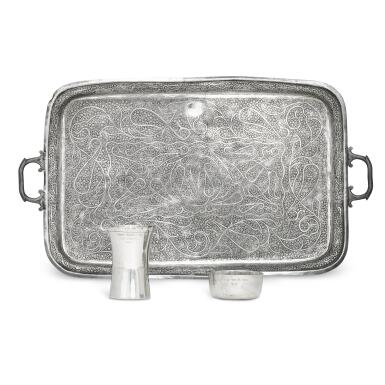
Mohandas K. Gandhi | Silver tray, cup, and bowl, said to have been used by Gandhi when visiting his friend Dr Pranjivan Mehta
Lot Closed
July 11, 01:07 PM GMT
Estimate
30,000 - 50,000 GBP
Lot Details
Description
Mohandas K. Gandhi
Three pieces of silver tableware said to have been retained for the use of Gandhi by Dr Pranjivan Mehta, comprising:
i) Tray, 570 x 330mm, rectangular form with two scroll handles, the surface with chased decoration of Kashmiri design, dents, 5 mm break at edge
ii) Beaker, 110 x 75 x 75mm, flaring form with simple engraved linear ornament, engraved in Gujarati (“ratilal pranjivan mehta / sa.1997 / to. 18(?)”) [Ratilal Pranjvan Mehta/ year 1997 Samvat date (corresponding to 1940 AD), weight 18(?)”], dented
iii) Tumbler cup, 40 x 80 x 80mm, plain form, engraved in Gujarati (“r. pr. mehta. sa. 1997 / to. 89(?)”)
AN EXCEPTIONAL GROUP OF ASSOCIATION ITEMS FROM THE FAMILY OF ONE OF GANDHI'S OLDEST FRIENDS.
According to family tradition, these items were customarily placed next to Gandhi’s bed for his personal use whenever he visited Pranjivan Mehta at his home in Rangoon. Mehta was one of his Gandhi’s oldest and closest friends and political allies; when he died in August 1932, Gandhi, then imprisoned in Yerwada jail, wrote that “I had no greater friend than Doctor in this whole world” (letter to Manilal Jhaveri, 4 August 1932).
Mehta (1864-1932) was born into a prosperous Jain family. He studied medicine in India and Europe, then moved to London to study law. On 29 September 1888 he met a strong-minded and highly intelligent law student newly arrived from India, and in the days and weeks that followed introduced Gandhi to life in Britain. On Gandhi’s return to India in 1891, he stayed with Mehta in Bombay, and during this time Mehta introduced Gandhi to Shrimad Rajchandra, who was married to his niece; the Jain philosopher came to have a profound influence on Gandhi’s intellectual and spiritual development. Gandhi credited Mehta with introducing him to the writings of Leo Tolstoy and his philosophy of non-resistance, and in later years Mehta became a committed believer in Gandhi’s struggle for Swaraj. In 1899 Mehta moved to Burma and joined the family diamond business of Magnanlal Pranjivan & Co., so the two men had only occasional opportunities to meet, but they retained a deep friendship. Time spent together in London in the summer of 1909 had a major impact on both men. Gandhi was driven to write Hind Swaraj following their time together, whilst Mehta described to G.K. Gokhale the extraordinary man Gandhi had become (six years before Tagore titled him Mahatma): “He is now leading almost an ascetic sort of life–not the life of an ordinary ascetic that we usually see but that of a great Mahatma and the one idea that engrosses his mind is his motherland.” (8 November 1909). Mehta not only provided liberal financial support to Gandhi and his campaigns but also became politically active himself, although his burgeoning political career was cut short by a stroke in 1920.
Gandhi made three visits to Mehta in Burma and had fond memories of Mehta’s hospitality: “Doctor’s liberality knew no bounds. His house was like a dharmasala. No deserving poor ever returned empty-handed from him” (letter to Narandas Gandhi, 2 August 1932). The first visit was in January/February 1902, when Gandhi was back in India after his first stay in South Africa; the second visit was in March 1915, just after his final return to India, and the final visit was in March 1929 when Gandhi was at the height of his fame and influence. Mehta became one of the first people to hear of Gandhi’s plans for Salt Satyagraha during this final visit, and Mehta secured Gandhi’s permission to join him on this pilgrimage although ill-health prevented him from doing so. It is on these occasions when Gandhi would have used this silverware. The beaker will have been used for fruit juice or goat’s milk, and the cup for nuts or raw vegetables.
Members of the Mehta family continued to visit and correspond with Gandhi in the years that followed the death of “the Doctor” (as Gandhi referred to him). Gandhi continued to take a close interest in the Mehta family’s welfare and to encourage them to support the cause of Independence, whilst the family often turned to Gandhi for advice and support especially at times of crisis. One moment of crisis came in April 1940 when Ratilal Mehta (son of Pranjivan Mehta) disappeared for several days. The family retain Gandhi’s letter written to Ratilal’s uncle on his reappearance. The following Diwali, to commemorate Ratilal’s safe return, family silverware was passed on to him as a mark of dynastic lineage. Two of the current pieces were inscribed in Gujarati at that time. Generations of the Mehta family have remained immensely proud of their association with Gandhi, and these pieces were kept as treasured personal possessions when members of the family left Burma for the West in the middle decades of the last century, their unique history passed down the family by word of mouth.
You May Also Like


![(Hamilton, Alexander, James Madison, and John Jay) | Bushrod Washington's Federalist, praised by George Washington as a "work [that] will merit the notice of Posterity"](https://dam.sothebys.com/dam/image/lot/8ec02b17-38b4-4269-8039-d4830cd55431/primary/extra_small)
![[World War II – 21st Army Group] | An important archive of maps and files documenting the allied campaign in Europe, from the early stages of planning for D-Day and Operation Overlord, to the German surrender](https://dam.sothebys.com/dam/image/lot/f958941f-80a5-4c71-935b-c5441da85aa9/primary/extra_small)


