Books from a distinguished private library (lots 1—53)
George Berkeley | Treatise concerning the principles of human knowledge. Dublin, 1710
Lot Closed
July 11, 10:04 AM GMT
Estimate
8,000 - 12,000 GBP
Lot Details
Description
George Berkeley
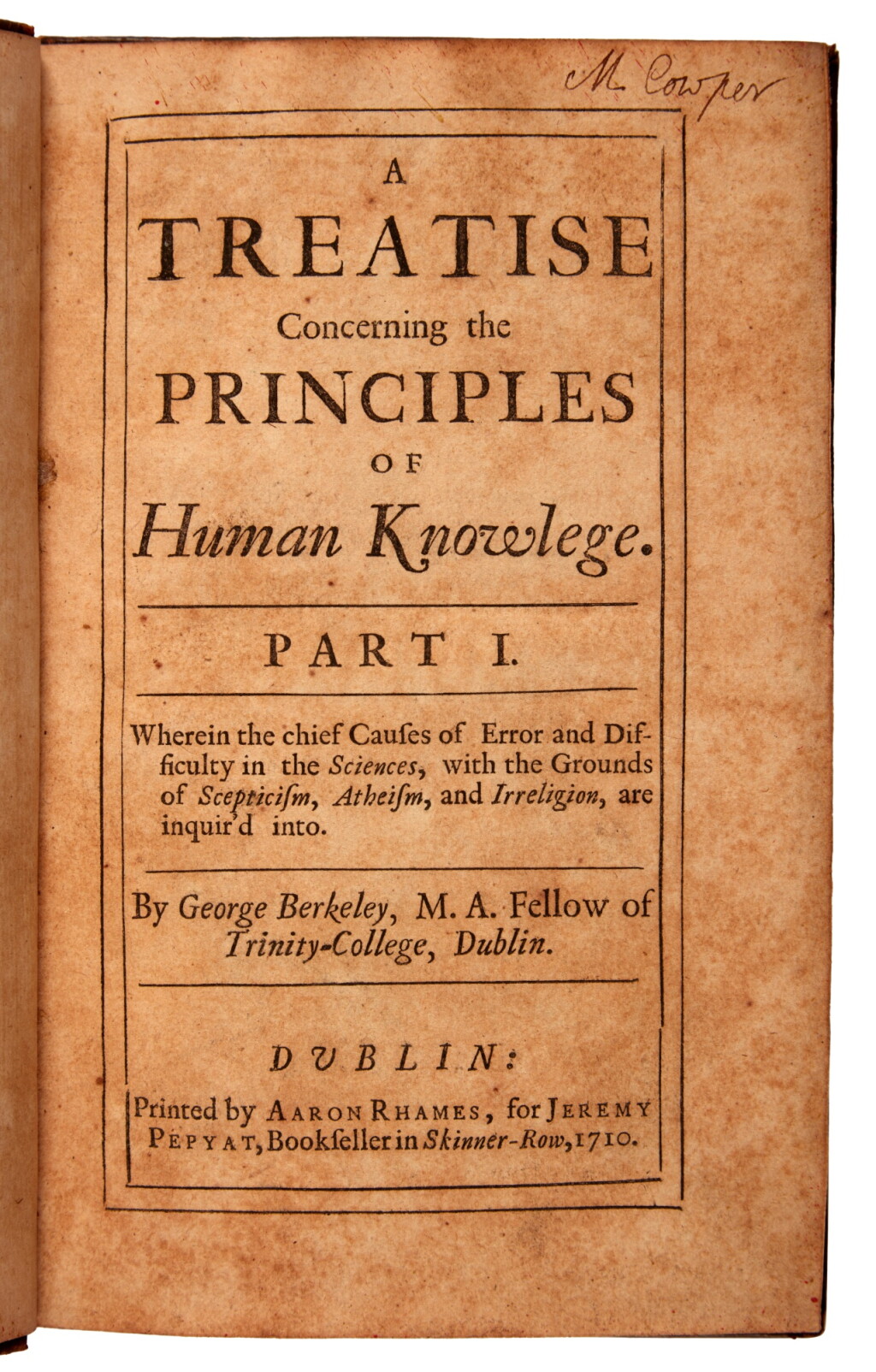
A Treatise Concerning the Principles of Human Knowledge. Part I. Wherein the chief Causes of Error and Difficulty in the Sciences, with the Grounds of Scepticism, Atheism, and Irreligion, are inquir'd into. Dublin: Aaron Rhames for Jeremy Pepyat, 1710.
FIRST EDITION, 8vo (210 x 140mm), title within double ruled border, contemporary calf with gilt border, spine gilt in compartments, upper joint cracked, loss at spine, spotting, especially to title page
"...As for what is said of the Absolute Existence of unthinking Things without any relation to their being perceiv'd, that is to me perfectly Unintelligible. Their Esse is Percipi, nor is it possible they shou'd have have existence, out of the Minds or thinking Things which perceive them..." (p.44)
FIRST EDITION OF BERKELEY'S GREAT WORK, EMPHASISING THE IMPORTANCE OF PERCEPTION AND QUESTIONING THE EXISTENCE OF THE MATERIAL WORLD. Although Berkeley’s book did not initially prompt much reaction, it has come to be seen as one of the most important works of philosophy of the early modern period and key to the development of empiricism. “Part one of A Treatise Concerning the Principles of Human Knowledge (1710) is the classic exposition of… [Berkeley’s] philosophy of immaterialism as an antidote to infidelity, prefaced with an influential essay in the philosophy of language” (ODNB), and in which he famously puts forward the idea that “no object can exist without a mind to conceive it”.
This work is described as "Part 1" but no continuation ever appeared; Berkeley explained to a friend in a letter written in 1730 that "I made considerable progress in it; but the MS was lost about fourteen years ago, during my travels in Italy, and I never had leisure since to do so disagreeable a thing as writing twice on the same subject" (quoted in Keynes, p.18).
PROVENANCE:
"M. Cowper", ownership inscription; Earl Cowper of Panshanger, armorial bookplate
LITERATURE:
Keynes, Berkeley, 5
You May Also Like


![Darwin and Wallace | On the Tendency of Species to form Varieties ... [1858–1859], in: Journal of the Proceedings of the Linnean Society, Vol. III, No. 9., 1859, Darwin announces the theory of natural selection](https://sothebys-md.brightspotcdn.com/dims4/default/0ae5d5e/2147483647/strip/true/crop/2000x2000+0+0/resize/150x150!/quality/90/?url=http%3A%2F%2Fsothebys-brightspot.s3.amazonaws.com%2Fmedia-desk%2Fwebnative%2Fimages%2F18%2F98%2Fd0ba6d9f4fada55611b512c2635f%2Fn12451-bkh45-t1-01.jpg)