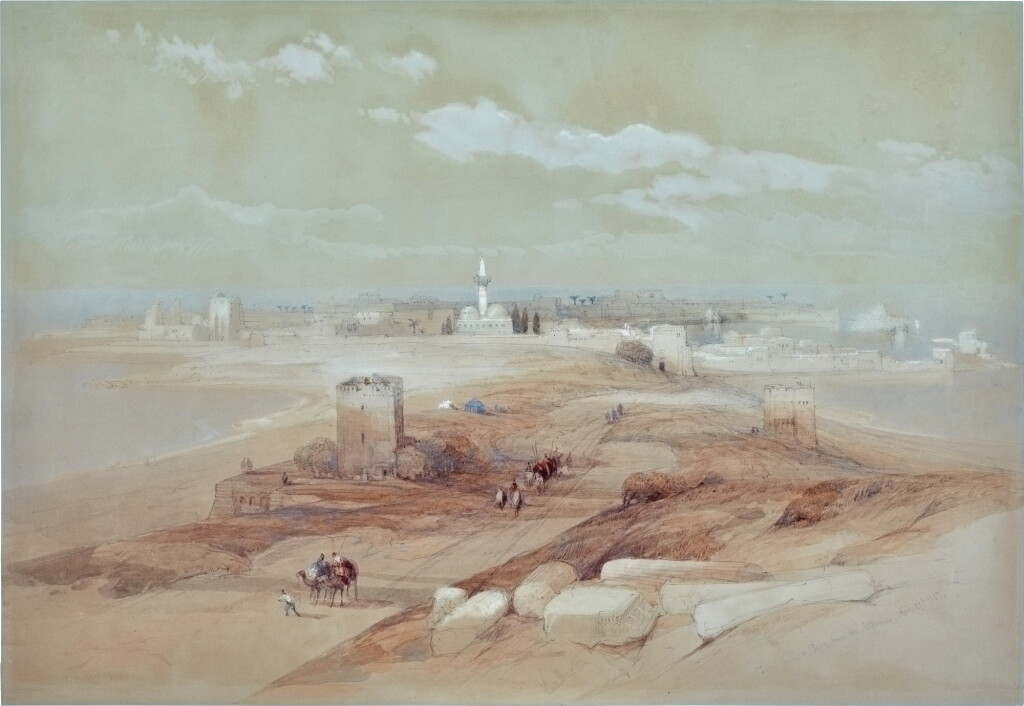
David Roberts, R.A.
Tsur, Ancient Tyre from the Isthmus
Auction Closed
April 29, 03:51 PM GMT
Estimate
25,000 - 35,000 GBP
Lot Details
Description
David Roberts, R.A.
(Edinburgh 1796 - 1864 London)
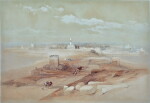
Tsur, Ancient Tyre from the Isthmus
Watercolour over pencil, heightened with bodycolour;
signed lower left: David Roberts. R.A., inscribed and dated lower right in a different hand: Tsur. ancient Tyre from the Isthmus. april 27th 1839
348 by 504 mm.
Probably Lord Francis Egerton, later 1st Earl of Ellesmere (1800-1857), purchased from the artist,
The Ellesmere Sale, London, Christie's, 2 April 1870, lot 70, bt Mackay;
Sir John Buchanan-Jardine, 3rd Bt of Castlemilk (1900-1969),
his sale, London, Sotheby's, 12 July 1967, lot 250, bt S. Spector;
with The Davis Galleries, New York, by March 1968,
Roger Cohen,
his sale, London, Christie's, 19 November 1968, lot 115, bt Leger,
with The Leger Galleries, London:
Miss L. M. Prior,
her sale, London, Sotheby's, 24 November 1977, lot 144, bt Burgess;
D. Burgess,
his sale, London, Christie's, 20 June 1978, lot 152, bt The Fine Art Society;
with The Fine Art Society, London, 1978 & 1980;
with The Mathaf Galleries, London,
from where acquired, in 1983, by the parents of the present owners.
Lithographed:
by Louis Haghe for The Holy Land, London 1843, vol. 1, pl. 71 & London 1855, vol. I, pl. 71 (as Tyre from the Isthmus)
New York, Davis Galleries, Edward Lear and David Roberts, 1968, no. 10;
London, The Fine Art Society, Travellers beyond the Grand Tour, 1980, no. 39;
London, Leighton House, Romantic Lebanon, The European View 1700-1900, 1986, no. 56;
London, Barbican Art Gallery, David Roberts, 1986-7, no. 173;
Oxford, The Ashmolean Museum of Art and Archaeology, on long-term loan, 2015 - 2021
Tsur, the ancient Phoenician city of Tyre, lies on the Mediterranean Sea and is reputedly the birthplace of Dido. Originally consisting of two distinct cities, one an island and the other on the adjacent mainland, Alexander the Great connected both communities by constructing a causeway during his siege of the city in 332 BC. Tyre was an important commercial centre in ancient times and was famed for its production of a rare purple dye, produced by sea snails, known as ‘Tyrian purple.’
Roberts arrived there, from the Cape Blanco, on the 26th of April and was to stay for just one night. He wrote in his journal: ‘Another hour’s ride along the sands brought us in front of ancient Tyre. In riding along, I could see fragments of the ancient village in places where the wind had cleared away the sand. The present town is a mere village, with a mosque rising in the centre…. Enormous pillars of Egyptian granite, some of them 10 feet in diameter, remains of the town’s ancient grandeur,’ however, ‘the city that sent out colonies to found Carthage is now little more than a naked rock in the midst of the sea.'1 Roberts’s viewpoint in the present watercolour brings to life much of what he described. He stands on the isthmus (or narrow strip of land) and looks westward. The town is directly ahead - with the eighteenth century 'Old Mosque’ occupying the centre of the composition. To the left and right is the sea.
The watercolour was lithographed for The Holy Land series and it is one of two views of Tyre in the collection (see lot 330 for the other). As with the great majority of watercolours in this sale, the present work has a long and well documented history. Among its most prominent former owners were the Earls of Ellesmere (see lot 301 for further information) and then, later, Sir John Buchanan-Jardine, who owned a significant collection of watercolours by Roberts, including views of Petra, Suez, Jerusalem and Ashkelon.
1. J. Ballantine, The Life of David Roberts, London 1866, p. 135