
'Votes for Women.'
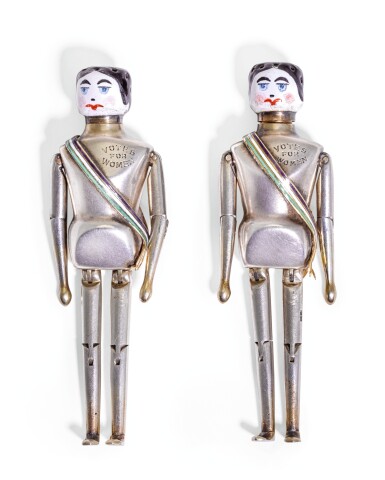
A RARE PAIR OF SILVER AND ENAMEL 'DUTCH DOLL' PEPPERETTES IN THE FORM OF SUFFRAGETTES, MAKER'S MARK (? LTD), LONDON, 1920
Lot Closed
September 9, 02:36 PM GMT
Estimate
12,000 - 15,000 GBP
Lot Details
Description
'Votes for Women.'
A RARE PAIR OF SILVER AND ENAMEL 'DUTCH DOLL' PEPPERETTES IN THE FORM OF SUFFRAGETTES, MAKER'S MARK (? LTD), LONDON, 1920
each pearl-finished figure engraved on the left shoulder 'VOTES FOR WOMEN' and applied with a gold sash enamelled in the suffragist colours of green, white and violet, screw-on enamelled heads, further struck with an unidentified maker's/retailer's mark, T&Co, a star above, in an oval
9cm., 3 ½ in. high
99gr., 3oz. 3dwt. all in
Please note: Condition 11 of the Conditions of Business for Buyers (Online Only) is not applicable to this lot.
To view Shipping Calculator, please click here
Although in Britain female suffrage had been discussed for several decades in the 19th century, it was not until 1903 when Emmeline Pankhurst and her daughter founded the Women's Social and Political Union that positive steps were taken in demands for Votes for Women. This was in spite of the fact that the Isle of Man had granted some women the right to vote as early as 1881. Mrs. Pankurst and her followers, frustrated by continuing Parliamentary opposition, became ever more militant. In extreme cases shop windows were smashed, bombs were planted and destructive fires were lighted. The authorities retaliated by issuing fines and prison sentences, in some cases leading to hunger strikes and the cruelty of force-feeding. One suffragette, Emily Davison, even sacrificed her own life by throwing herself in the path of George V's horse at the Derby in 1913.
The same year four Scottish suffragettes aimed red pepper at Prime Minister H.H. Asquith and his party on a visit to Stirling. Apprehended and charged, the women gave false identities. That of one, 'Violet Asquith,' was actually the name of the Prime Minister's daughter who was with him on that occasion. Another said she was 'Maud Allan,' a cheeky reference to to the Canadian dancer who lately had been seen in the eye-popping role of Salome 'in a costume consisting mainly of beads and gauze' at the Palace Theatre in London.
The suffragettes' aggressive activities ceased upon the outbreak of War in the summer of 1914 but the lobbying of Parliament continued. In November 1918, with the passing of the Representation of the People Act, all men over the age of 21 were given the right to vote as well as over 8 million women above the age of 30. At the General Election of 14 December 1918 Constance Markiewicz was elected to Parliament but, being a member of Sinn Féin, she refused to take her seat in the House of Commons. The first female M.P. to attend the House was Nancy Astor, who won a by-election in November 1919.
It is against this background that these unusual pepperettes were made. It is unfortunate that neither the actual maker's mark nor the second, T&Co. mark can be identified. It has been suggested, however, that the latter may be an unofficial retailer's mark of the New York-based goldsmiths and jewellers, Tiffany & Co. whose London premises in the early 1920s were moved from Regent Street to nearby Maddox Street. It also happens that the Astor family were old customers of Tiffany's. It may be a flight of fancy, but it is not impossible that the peppers were a special commission, perhaps intended as a gift to Lady Astor to mark the first anniversary of her election as an M.P.