
Property from an Important Swiss Private Collection
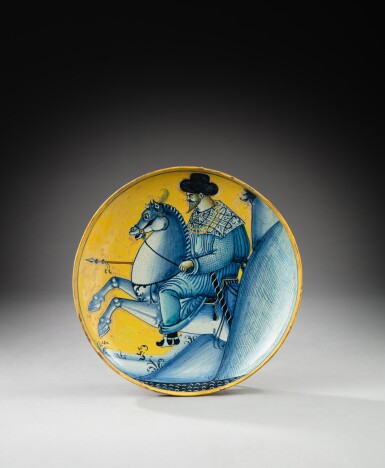
An Italian maiolica shallow dish, circle of Nicola Francioli, Deruta, circa 1520-50
Auction Closed
October 25, 04:59 PM GMT
Estimate
20,000 - 30,000 GBP
Lot Details
Description
of shallow round form on splayed foot, painted in blue, grey, black and gold on yellow ground, decorated with an Ottoman rider on horseback, the reverse painted freehand with blue floral and geometrical patterns, the foot's underside with a hatched mark and numbered 'AMM 47'
20cm. diam.
The theme of the galloping, armed Ottoman warrior became a popular depiction in European ceramics during the Renaissance. The present dish shows a Turkish rider charging on a horse, wearing the felt cap (uskiuf), kaftan, large trousers and thin shoes that characterised the Ottoman janissaries' uniform. He is portrayed emerging from a hillside scenery reminiscent of the fairy chimneys in Cappadocia, Turkey. On the back of its foot, the dish bears a distinctive mark composed of three parallel lines crossed perpendicularly by a fourth one.
This piece is directly related to fourteen maiolica dishes with almost identical scenes and similar dimensions. The two closest comparable dishes are kept in the Kestner Museum, Hannover, with a reverse bearing the same mark (inv. no.1915.53), and in the Narodowe Museum, Warsaw (inv. no.SZC 1530 MNW). Five other maiolica dishes with a similar mark flanked by two spirals are in the British Museum, London (inv.1855,3-13,3), the Fitzwilliam Museum, Cambridge (inv. no.C.100-1927), the Museum für Angewandte Kunst, Vienna (inv. no.KE 7981), the Cassa di Risparmio, Macerata (inv. no.22) and one formerly in the Collection Imbert (published in André Dubrujeaud, Faîences italiennes de la collection Al. Imbert, Paris, Union centrale des arts décoratifs, 1911, cat. no.413). Another dish in the Museo Civico, Pesaro (inv. no.4246), bears only two small spirals. Six further examples depicting the same scene are known, although the decoration on their back was not made public: one is in the Cincinnati Art Museum (inv. no.1923.769) and four are in private collections (three sold respectively in Parke Bernet, New York, 17 February 1976, lot 41; Sotheby's, Florence, 8 October 1971, lot 28; Sotheby's, Florence, 11 October 1972, lot 40, and the last one formerly in the collection Duseigneur). Another dish with the same horseman, formerly in the Herzog Anton Ulrich-Museum, Brunswick (inv. no.1183), was destroyed during the Second World War. Finally, a large dish in the Museum für Angewandte Kunst, Vienna (inv. no.KHM 49) depicts an 'Eastern warrior' sharing similar traits with our horsemen as well as the artist's mark and its spirals on the reverse.
In this corpus of fifteen pieces, the figures' facial expressions and physiognomies are identical, and most share the same types of clothing. The horses are also distinctively recognisable, although, just as with the horsemen's attire, some features differ.
A link was established between the individual who evidently produced this set of maiolicas and Nicola Francioli, an influent Renaissance painter from Deruta, known as 'Co'. This connection is based on a dish in the Louvre, Paris (inv. no.0A 1621) depicting a soldier holding a lance in a style specific to Francioli, but also displaying the same hatched mark with two spirals on its back. Although the style used to portray the horsemen on our group of dishes is clearly different to Nicola Francioli's, this suggests that the artist who produced the present piece evolved in his circle, most likely in the city of Deruta during the first half of the sixteenth century. Besides, the rendering of the hillside on our dish appears to be inspired by Francioli's treatment of landscapes, as visible on a dish attributed to him sold in Sotheby's Milan, 9 June 2009, lot 150.
As such, the present dish constitutes an important addition to a known group illustrating the talent, creativity and profuseness of craftmen active in Deruta, one of the major centres for the production of maiolica during the Renaissance.
You May Also Like


