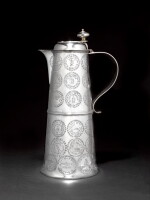
A silver-inlaid brass bucket bearing the coat of arms of two noble Venetian families, Italy, Venice, 16th century
Auction Closed
October 25, 04:59 PM GMT
Estimate
40,000 - 60,000 GBP
Lot Details
Description
of deep cylindrical form on flat base, decorated throughout with a ground of dense arabesques and foliate motifs beneath arabesques in silver, bearing two coats of arms of noble Venetian families and four roundels with silver-inlaid profile portraits, the base similarly decorated around a central flowerhead, with zoomorphic handle
22.9cm. diam.
This bucket is associated with a group of finely incised and inlaid metalwork that was originally categorised as Veneto-Saracenic or Veneto Islamic due to the nineteenth century belief that these objects were produced by Muslim craftsmen in Venice. This theory was later questioned in the 1970s and further research indicates that these objects were probably made in the Eastern Mediterranean and exported to Europe by the Mamluks and then later emulated by Italian craftsmen. This intriguing group of metalware is representative of the extensive trade network that existed between Renaissance Europe and the Islamic World. This was "a time of reciprocal contact, when some states in the east sought support and friendship from the west, transcending differences in race and religion." (Auld 2004, p.7).
The export of Mamluk metalware to Europe greatly increased during the fourteenth century with the lifting of the papal embargo in the 1340s allowing Venetian merchants to trade with the Mamluks. By the late fifteenth century these export wares had developed a distinctive style that was tailored to the requirements of their European patrons. Vessels began to be cast in European shapes that included lidded bowls, salvers, dishes and buckets, sometimes with the Mamluk blazons being replaced by European coats of arms. Workshops were established to cater for this increase in demand, overseen by master craftsmen who developed their own distinctive style with some pieces bearing their signatures. One such craftsmen was Master Mahmud al-Kurdi whose signature in both Arabic and transliterated Roman script has been found on a number of recorded pieces. Sylvia Auld’s Renaissance Venice, Islam and Mahmud the Kurd, a metalworking enigma (London 2004), examines the work of this talented craftsman and arranges the previously labelled Veneto-Saracenic wares into three distinct groups. With group A being late Mamluk and made in either Egypt or Syria, group B being produced by the workshops associated with the Master Mahmud al-Kurdi and group C that "demonstrate a deliberate attempt to emulate Levantine originals in design and technique and are vivid witnesses to the fascination of late 15th-century and early 16th-century European society with Levantine work." (Auld 2004, p.8).
The present bucket falls into Auld's third category, group C, an example of an item made in Italy by Italian craftsmen but following a very similar style to the ‘export ware’ of the second category, group B. This emulation and imitation of the much admired export wares produced by the workshops of Mahmud al-Kurdi is clearly demonstrated by comparing the present lot with a signed bucket of al-Kurdi sold at Christie’s, 1 April 2021 lot 10. The bucket is almost identical in form and size, possessing a deep cylindrical body with bulbous flat base and the same zoomorphic handle. Other comparable buckets that would have been the prototype for the present lot include examples in the Museum fur Kunst und Gewerbe, Hamburg (inv.1878739), the Museo Nazionale del Bargello (inv.Bronzi 837) and the Courtauld Institute (inv.1966.GP.198).
Although the Italian craftsmen imitated the shapes of these export wares they didn't always interpret the inlaid decoration in the same manner. As with other pieces from Auld's group C the decoration on the present bucket is more fluid in design, with fleshier foliate forms bordered by stylised silver scrolls that Auld identified as a classicising of the arabesque. An Italian salver in the Courtauld Institute (inv. no.O. 1966.GP.202) and an Italian pen-box (Christie's 1 April 2021 lot 11) also with the coat of arms of the Giustiniani family display a similar western approach to the use of negative and positive space in ornamentation (see Auld 2004, pp.66-70 for further discussion on this subject).
The coat of arms with the three dolphins is that of the Delfin family, a prominent noble family of Venice, part of the twelve original noble lineages of the Republic. The other crest is possibly from the Giustiniani or Sagredo families and the salver in the Courtauld collection mentioned above also displays a closely comparable crest. Given the intriguing portraits that punctuate the decoration, it is likely that this bucket was intended as a luxurious gift to denote a marriage between the two families.
You May Also Like