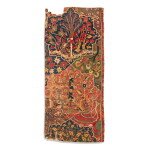
A brocaded silk velvet and metal-thread embroidered dalmatic, Italy, late 15th-early 16th century
Auction Closed
October 25, 04:59 PM GMT
Estimate
15,000 - 25,000 GBP
Lot Details
Description
on cream ground, woven with floral garlands, tulips, pomegranates and various fruits in crimson-red and forest-green, the lower section with applied panel embroidered in silk and metal-thread with the Virgin Mary to one end and John the Baptist to the other, each figure surrounded by arabesques terminating in birds and mythical creatures, the sleeves with similarly embroidered panels, lined
237 by 156cm. max.
116cm. length (neck to lower edge)
Ex-private collection, USA
Sumptuous velvets appeared in Europe in the thirteenth century, introduced from the Mongol empire along with other textiles, and eventually becoming among the most highly prized and prestigious items in the Renaissance period. Unlike the trade of carpets in this period which was defined by a unilateral movement from Ottoman Turkey to Italy, the trade of luxury velvets was more reciprocal.
The expense of such fabric in Western Europe restricted their use to the ruling elite and the Catholic church. Velvets were formed into opulent ecclesiastical garments, such as the present dalmatic, but demand was somewhat limited. Due to the great expense of velvets, every fragment was precious and smaller fragments could also be used in accessories and coverings. A fragment from the same velvet is incorporated into a mitre in the Victoria and Albert Museum (inv. no.4015-1856), possibly a headpiece to be worn en suite with the present example.
A portrait of Francesco Foscari, Doge of Venice (1423-57) in the Museo Civico Correr, Venice, portrays the Doge dressed in a robe of a comparable velvet to this dalmatic, with a matching headpiece (Carboni 2006, p.189, no.21). In this textile, and that depicted in the portrait of the Doge, the rich crimson is off-set against a cream ground, with the present dalmatic also incorporating highlights of forest green.
The demand of the Ottoman courts far outweighed that of the European market and Istanbul became the largest single-export market (Atasoy et al., 2002, p.182). Although the Ottomans established their own luxury workshops in Bursa in the fifteenth and sixteenth centuries, they nonetheless appreciated the high quality of Italian manufacture which were even used in garments for the Ottoman sultans (Atasoy et al., 2002, pp.182-4, figs.36, 38 and 40).
It is unsurprising, therefore, that Italian workshops incorporated distinctly Ottoman motifs. This dalmatic is no exception and incorporates the Ottoman motif of the tulip which centres the floral garlands, flanked by a panoply of fruits including pomegranates. Comparable velvets with similarly drawn tulip motifs are in the Cooper Hewitt Museum (inv. no.1902-1-833-a/j) and the Museo del Tessuti.
You May Also Like