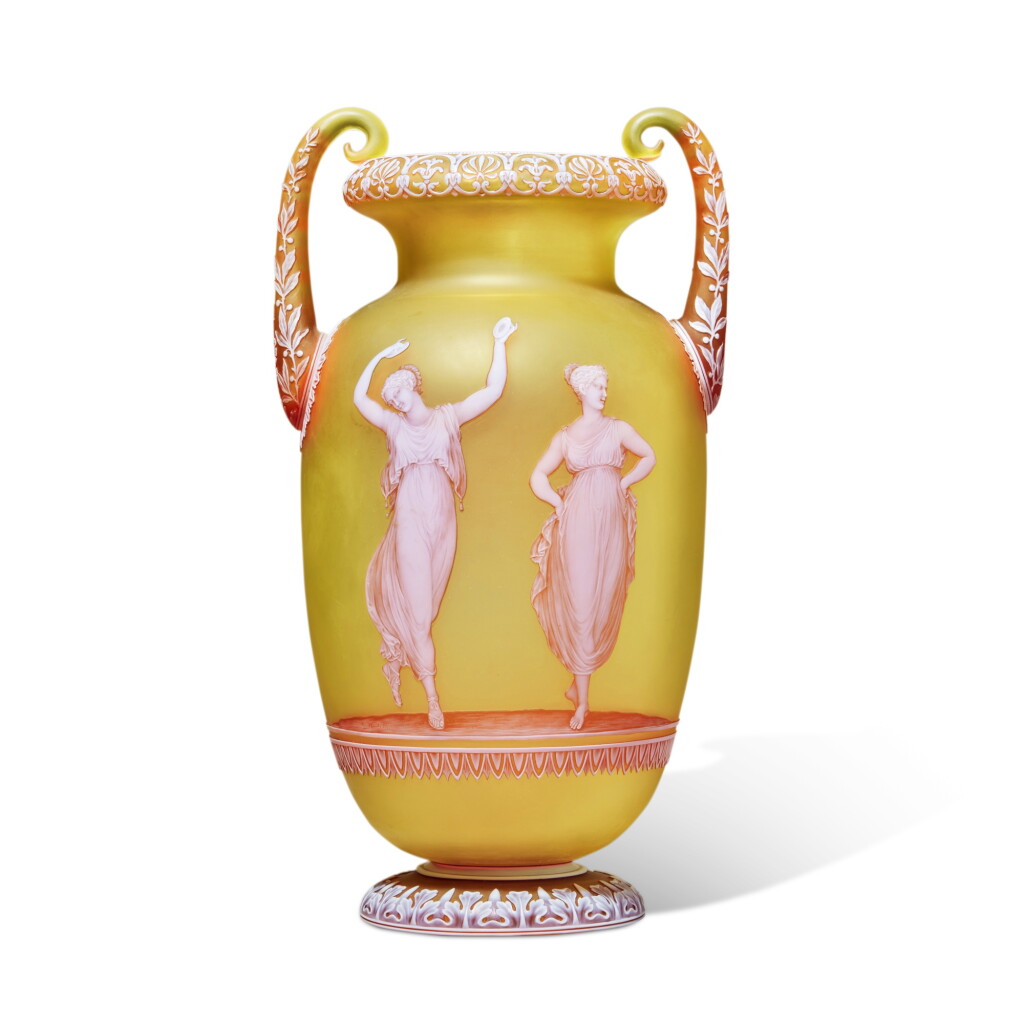
A Thomas Webb & Sons Three-Color Gem Cameo Large Two Handled Amphora Vase by George Woodall, Circa 1887
Auction Closed
June 18, 05:01 PM GMT
Estimate
20,000 - 30,000 USD
Lot Details
Description
overlaid in translucent red and opaque white and carved through to the yellow glass underneath with two female figures dancing, incised signed G. Woodall., supported on a dart band, the verso with a grotesque mask with leafy ornament, the handles with fruiting vine, the rim with an acanthus leaf and scroll band, the foot with a stiff leaf and dart band, etched THOMAS WEBB & SONS banner mark over/ GEM/CAMEO.
Height 13 1/8 in.
33.3 cm
Mrs. C. E. Udell Collection, Yakima, Washington D.C. (by 1956);
Dr. & Mrs Leonard S. Rakow Collection, bearing label, typed no. CG-28 (by 1982)
New York, The Corning Museum of Glass, Cameo Glass: Masterpieces from 2000 Years of Glassmaking, May 1-October 31, 1982, no. 71
Geoffrey W. Beard, Nineteenth Century Cameo Glass, Newport 1956, pp. 81, 112-113, fig. 36, pl. IX
Sidney M. Goldstein, Cameo Glass: Masterpieces from 2000 Years of Glassmaking, exh. cat., Corning 1982, pp. 55, 77, 115, fig. 33, no. 71
Christopher Woodall Perry, The Cameo Glass of George Woodall, Shepton Beauchamp 2000, p. 31, illus.
This exceptional vase can be tentatively identified as W1753, as numbered in the factory records, though Woodall's cost and the sale price are unknown.
Both figure subjects are based on marbles carved by Antonio Canova (1757-1822). The figure playing cymbals, is based on the marble commissioned by Count Andrei Razumovsky, Russian Ambassador in Vienna, now in the Bode Museum, Berlin, Id. No. : 2/81; and the figure with her hands at her waist is based on the marble once owned by Empress Joséphine de Beauharnais, and since 1815 has been in the Hermitage Museum, St. Petersburg, Inv. no.: Н.ск-18. When the latter marble was exhibited at the 1812 Paris Salon, one critic purportedly that “The novelty of both the concept and the figure’s action, the charm of life and the illusion of movement in this, the simplest of compositions, made all Paris run to it, as if to a new play. I doubt that in the theatre, the most celebrated dancer has ever gathered such a crowd of admirers and received such applause.” Engraving of both marbles, respectively by Angelo Bertini and Pietro Fontana which would have been available to Woodall, are reproduced by Goldstein, op.cit., figs. 31-22.
Beard, op. cit., refers to the design in Design Book folio 46, and references a similar version, with a cover, formerly in the H. C. Ash Collection, perhaps that illustrated by Perry, op. cit., p. 31. Woodall visited the subject of Dancers several times during his career. Around the time this vase was completed he worked on a large plaque showing two dancers, dated 1886; and perhaps most notably in the tragic case of a large plaque, The Dance, featuring three figures and measuring 20 inches in diameter, which was destroyed by the fire that ravaged parts of the 1910 Exposition Universelle et Internationale de Bruxelles (both plaques, illustrated by Perry, ibid, p. 105, pattern numbers GW30 and W733).
You May Also Like