
PROPERTY FROM A BELGIAN PRIVATE COLLECTION
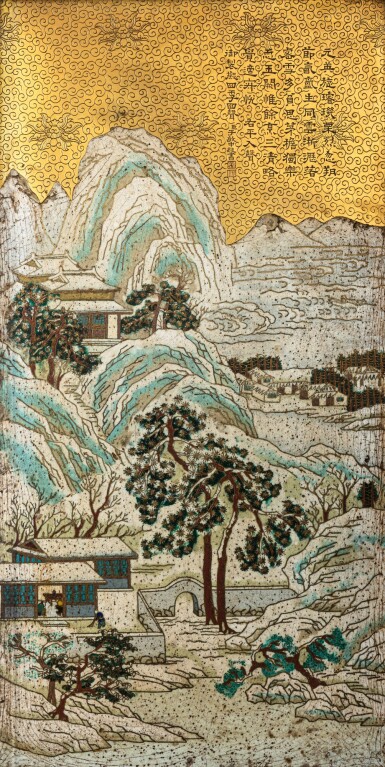
An important imperially inscribed cloisonné enamel 'Winter' panel, Qing dynasty, Qianlong period
Auction Closed
June 11, 03:42 PM GMT
Estimate
60,000 - 120,000 EUR
Lot Details
Description
inlaid with an imperial poem in the hand of Yu Minzhong, framed
66.2 x 34 cm, 26 by 13⅜ in.
Acquired in an antique market in Lille, France, circa 1985, and thence by descent.
釋文:
元英旋璿璣,栗烈忽朔節。氤氲生同雲,淅瀝落宻雪。
多貧思茅簷,獨樂恧玉闕。惟餘烹三清,略覺適寂恱。
The yearly cycle turns on the celestial axis,
A biting cold, suddenly winter arrives.
Dense vapours rise, merging into clouds,
Starting with a soft patter, soon dense snow falls.
In extreme poverty, I think of my thatched roof;
Alone in contentment, I feel no shame before jade palaces.
All that remains is to brew the “Three Purities” [tea],
And I begin to feel at ease; quiet and delighted.
This reflection on the quiet peace of winter, carefully composed in rhyming wulü verse, accompanies a rare cloisonné panel from the height of imperial production. Depicting rolling hills and drooping pines covered in lightly drifting snow and a secluded studio glowing with the warmth of the hearth, the present panel is among the most important of its type to come to market in recent years – filling a gap in scholarship once thought unfillable.
While the present poem purports to be composed by the Qianlong Emperor (r. 1736–1795) himself (see Yuzhi shiji [Compilation of Imperial poems], vol. II, juan 55), it appears here immortalised in the clerical-script calligraphy of famed scholar Yu Minzhong (1714–1780). Born in Jintan in Jiangsu province, Yu received his jinshi degree with the highest honours, soon became a first-class compiler of the Hanlin Academy, and eventually served in many official posts, first in the provinces and, from 1750 onwards, mainly in Beijing. Working directly in the company of the Qianlong Emperor in the capital and on tours, Yu was at the core of imperial policy-making throughout the mid-18th century and, from 1773 until his death, was undoubtedly the most powerful minister of the empire, directing the compilation of the Siku quanshu, the Imperial Manuscript Library.
Due to his scholarly nature and close bond with the Emperor himself, one of Yu’s roles in the court was the editing of the Emperor’s poems. Often composed during brief intervals between audiences and merely dictated to his scholars, Yu was tasked with writing down the Emperor’s poetry from memory and, while he reputedly seldom made a mistake, the quality of those poems ‘remembered’ by Yu is notably higher than those in the Emperor’s own hand – a possible indication of his prodigious editorial skills. For an example of the present poem in Yu’s own hand in ink, possibly its first record following the aforementioned dictation, see a small album preserved in the Qing Court Collection at the National Palace Museum, Taipei (accession no. 故玉004536), illustrated on the Museum’s website.
Thanks to the emergence of the present lot, three of the four panels originally produced in this series ‘Comparing the Four Seasons to the Four Tones’ have now been published. The other two known panels are as follows: one from an English Collection, sold in our London rooms, 18th May 1971, lot 44, depicting the Autumn as the level departing (pingqu) tone; and the other from the collection of early twentieth century diplomat Charles H. Thorling, depicting Spring as the level (ping) tone, sold at Christie’s Hong Kong, 27th November 2013, lot 3469. In size, style and design, both panels are almost identical to the present with similarly minimalist renderings of figures, expansive court buildings in differing seasons and a grand gilded sky incised with lotus blossoms and corresponding poems in Yu Minzhong’s hand.
Only four other closely related sets of panels featuring landscapes and imperial poems in the hand of Yu Minzhong appear to survive. The first, similarly depicting the Four Tones, appears to be the only set to remain complete; initially from the Collection of the Earl of Iveagh and more recently sold in our Hong Kong rooms, 23rd October 2005, lot 36. The second set, similarly depicting the Four Seasons, appears to only have two surviving panels attested: ‘Spring’ preserved in the National Palace Museum, Taipei, illustrated in Enamel Ware in the Ming and Ch'ing Dynasties, Taipei, 1999, pl. 45; and ‘Autumn’, now in the Metropolitan Museum of Art, New York (accession no. 2023.259), previously sold at Christie’s New York, 24th March 2023, lot 1228 and currently on view in Embracing Color: Enamel in Chinese Decorative Arts, 1300–1900, Metropolitan Museum of Art, New York, 2022. The third set, possibly always only a pair, is preserved in the Palace Museum, Beijing, illustrated in Compendium of Collections in the Palace Museum. Enamels (3). Cloisonné in the Qing Dynasty (1644-1911), Beijing, 2011, pls 63 and 64; and the fourth, depicting scholar’s studios and poems in Yu’s hand on the subject of the ‘Four Scholar’s Treasures’ remains similarly fragmentary with one panel depicting ‘Paper’ from the Collection of Viscount Rothermere (1868–1940) sold at Christie’s New York, 20th October 2004, lot 698, now preserved in the Guanfu Museum, Beijing; and a fragment of another depicting the ‘Inkstone’, sold in our London rooms, 13th May 2009, lot 36. As above, these four sets are undeniably from the same imperial context as the present, with finely incised golden skies, lush yet naive landscapes, and poems in Yu’s celebrated delicate clerical script.
For other panels produced in a similar context, also compare a closely related pair with poems and seal marks inscribed after a contemporary of Yu Minzhong, senior scholar Wang Jie (1725–1805), now preserved in the Staatliches Museum fur Volkerkunde, Munich, illustrated and discussed by Gunhild Gabbert Avitabile in the exhibition catalogue, Die Ware aus dem Teufelsland: Chinesische und Japanische Cloisonne- und Champleve-Arbeiten von 1400 bis 1900, Frankfurt am Main, 1981, cat. no. 95.
You May Also Like


