![A Rare Decorated Booklet-Form Shivviti, [Central Europe: 18th century]](https://sothebys-md.brightspotcdn.com/dims4/default/d316ba5/2147483647/strip/true/crop/1650x2000+0+0/resize/150x182!/quality/90/?url=http%3A%2F%2Fsothebys-brightspot.s3.amazonaws.com%2Fmedia-desk%2Fwebnative%2Fimages%2F75%2F0c%2Fda92b66f41e89dbe03ef94732638%2F027n10971-c5grm-t2-02.jpg)
![View full screen - View 1 of Lot 128. A Rare Decorated Booklet-Form Shivviti, [Central Europe: 18th century].](https://sothebys-md.brightspotcdn.com/dims4/default/2c2a5ef/2147483647/strip/true/crop/1650x2000+0+0/resize/385x467!/quality/90/?url=http%3A%2F%2Fsothebys-brightspot.s3.amazonaws.com%2Fmedia-desk%2Fwebnative%2Fimages%2F75%2F0c%2Fda92b66f41e89dbe03ef94732638%2F027n10971-c5grm-t2-02.jpg)
A Rare Decorated Booklet-Form Shivviti, [Central Europe: 18th century]
Auction Closed
December 15, 09:26 PM GMT
Estimate
10,000 - 20,000 USD
Lot Details
Description
A Rare Decorated Booklet-Form Shivviti, [Central Europe: 18th century]
Since at least the early modern period, Jewish thinkers have attached mystical significance to two separate passages from the Psalms: “I am ever mindful of the Lord’s presence” (Ps. 16:8) and psalm 67. With time, the practice developed to write these texts on pieces of paper or parchment or to inscribe them on plaques in order to heighten concentration and intentionality during prayer. By the late seventeenth or early eighteenth century, artists began to combine these two devotional items into a single object today called a shivviti or menorah, referencing, respectively, the first word of Ps. 16:8 and the seven-branched form in which psalm 67 was typically written out.
The present lot is a rare example of a booklet-form shivviti consisting of a single bifolium of parchment folded in half. In all likelihood, it was meant to be inserted into a worshipper’s prayerbook and taken out at various points during synagogue services. Aside from the psalmic texts themselves, various kabbalistic formulas, and extracts from poetic and ethical literature, this shivviti includes several supplications to be recited during the removal of the Torah from the ark throughout the year, as well as specifically on the High Holidays, Yom Kippur at minhah, the first and last days of Passover, Shavuot, Sukkot, and Shemini Atseret (the last preceded by a Yiddish instruction that the prayer be intoned only by scholars, as it is based on Kabbalah). The latter two pages of the document contain two different petitions for the blessing of the New Moon, a plea for a good livelihood to be said during the amidah and avinu malkeinu, and special prayers to accompany the priestly benediction and the beating of the willow on Hoshana Rabbah, among others.
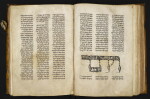
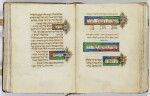
Most likely created for a wealthy patron, this shivviti should be viewed as part of the revival of Hebrew manuscript culture that took place in German-speaking lands during the eighteenth century. Penned in an accomplished scribal hand, the document is adorned on its opening leaf with pairs of birds, lions regardant, hares, and monkeys surrounding a disk inscribed with the words of Ps. 16:8 surmounted by a jeweled crown. In the lower half of the page, images of Moses and Aaron flank an ornate menorah composed of the text of psalm 67 above a cartouche containing a gift-giving scene. The use of rubricated initial words and instructions and a complex, Talmudic page layout further highlight the luxurious nature of this liturgical object.
Sotheby’s is grateful to Esther Juhasz for providing information that aided in the cataloging of this manuscript.
Physical Description
2 folios (10 1/2 x 8 in.; 265 x 205 mm) on parchment; written in elegant Ashkenazic square (text body [though cf. f. 1v]) and semi-cursive (instructions) scripts in dark brown ink; ruled in plummet; complex page layout; some catchwords at the bottom of columns. Elaborately decorated opening page colored yellow, green, teal, and magenta; enlarged, rubricated incipits; borders infilled with various liturgical, poetic, and ethical texts; some letters flourished with tagin (crowns). Some text and decoration stained, smudged, and/or abraded throughout.
Literature
Esther Juhasz, “Bein ruah le-homer, bein tekst li-temunah: li-she’elat hivvatseruto shel hefets dati ba-heksher ha-yehudi—ha-mikreh shel ha-‘shivviti-menorah,’” Mehkerei yerushalayim be-folklor yehudi 24-25 (2006-2007): 349-382, at pp. 367-368.
Esther Juhasz, “Luah ‘shivviti’ ba-merhav ha-ashkenazi,” in Israel Bartal et al. (eds.), Hut shel hen: shai le-havvah turniansky, vol. 1 (Jerusalem: Merkaz Shazar, 2013), 423-470.
You May Also Like