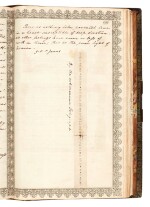

Telecommunication | Early telegram sent by the submarine telegraph, 1851
Lot Closed
May 25, 01:50 PM GMT
Estimate
3,000 - 5,000 GBP
Lot Details
Description
History of Telecommunication
Telegram
"PRINTED - FROM - ENGLAND - TO FRANC [sic] - SEPT - 28 1851 - 6 - P - M", 144mm length, followed by a handwritten caption "By the submarine Telegraph"
mounted in a copy of: Manuscript Gleanings and Literary Scrap Book. London: I. Poole, [1830?], with printed "address"and "Contents" pages followed by 238 numbered pages with engraved borders, filled with printed cuttings and manuscript quotations, the telegram mounted on p.199 and the album also including "Sonnet on the Submarine Telegraph" (p.200), as well as poems, riddles, obituaries, news reports, extracts from books, and other items, 1830s-50s, 8vo, contemporary green calf gilt, spine lettered "Manuscript Gleanings", with clasp
A KEY BREAKTHROUGH IN TELECOMMUNICATION: UNDOUBTEDLY ONE OF THE EARLIEST, IF NOT THE EARLIEST, KNOWN MESSAGES SENT BY SUBMARINE TELEGRAPH. The invention of the commercial electric telegraph in the 1840s held out the prospect of a connected world linked together by instant communication and the development of the first submarine telegraph, across the English Channel, was a vital step in making this vision a reality.
The current message, kept as a memento in a scrap book, comes remarkably early in the history of this key breakthrough in technology. Following the failure of an earlier attempt to lay a cross-Channel cable in 1850, the Submarine Telegraph Company launched a ship, the Blazer, on the morning of 25 September 1851 holding 25 nautical miles of insulated copper wire coiled in her hull. One end of the cable was landed on the Kentish coast at South Foreland and the rest then uncoiled onto the seabed. It was a difficult process undertaken with minimal technology:
"What with the totally inadequate 'brake' power, cable entangles caused by foul flakes, broken wires and tow ropes, the roaring wind and agitated sea, a desperate struggle between mind and matter lasted nearly the whole of that memorable day." (W. Smith, The Rise and Extension of Submarine Telegraphy (1891), p.17)
Unfortunately, the cable ran out about a nautical mile short of Sangatte, near Calais. The following day temporary cables were spliced on in order to complete the line to the telegraph office in Calais, and "congratulatory messages freely passed to and fro between England and France." The current message was sent just two days after the completion of this temporary cable. It was not until the following month, however, that the final mile could be replaced with cable of matching quality. The official opening of the submarine telegraph took place on 15 October 1851 and the line opened to the public on 19 November. THIS MESSAGE THEREFORE PREDATES THE FIRST COMMERCIAL SUBMARINE TELEGRAPH MESSAGES BY NEARLY TWO MONTHS.