
Che Lovelace
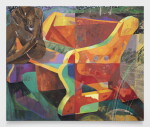
Tobago Bench
Lot Closed
August 5, 06:35 PM GMT
Estimate
30,000 - 50,000 USD
Lot Details
Description
Che Lovelace
b.1969
Tobago Bench
Signed
Acrylic and dry pigment on board panels
50 by 58 in.
127 by 147.3 cm
Executed in 2016-2022.
Please note that while this auction is hosted on Sothebys.com, it is being administered by the Aspen Art Museum, and all post-sale matters (inclusive of invoicing and property pickup/shipment) will be handled by the Aspen Art Museum. As such, Sotheby’s will share the contact details for the winning bidders with the Aspen Art Museum so that they may be in touch directly post-sale.
As such, there is no buyer's premium in this auction - all sale proceeds will go directly to the Aspen Art Museum to support its programs. Certain amounts paid above the value of the property or services provided may qualify as a tax deductible donation to the museum. Sotheby’s does not offer tax advice. Please consult your tax advisor, and for any tax related inquiries please contact bid@aspenartmuseum.org at the Aspen Art Museum.
Kindly donated by Che Lovelace and Various Small Fires
Che Lovelace (b. 1969, San Fernando, Trinidad) paints the constantly intersecting lives of the people and landscape of his native Trinidad. With rich color and bold shapes, his paintings straddle the boundary between realism and abstraction. Increasingly, his practice includes elements of performance as part of his painting process.
Lovelace’s vibrantly-colored paintings are rooted in the flora, fauna, and culture of the artist’s native Trinidad, where he lives and works. Lovelace’s work centrally occupies itself with what the artist calls a “lyricism of place.” These paintings depict Lovelace’s colorful vision of Trinidad and the artist’s lived experience, each painting offering a brief glimpse of Lovelace’s own “encounters,” alternatively spiritual, intellectual, emotional, and physical, with his home country— the center, as the artist describes, from which he views the world.
Lovelace speaks often of how Trinidad itself is composed of people from many different ethnic backgrounds— his mother, for instance, is Indian, and his father is of African descent. Layered identity and different forms of cultural expression are, as Lovelace describes, the essence of Trinidadian culture. The artist acknowledges the parallel here between the visual compositions of his work and the ethnic makeup of Trinidad—various dynamic parts grappling to form a whole. It is this array of people and places whose “potency,” as the artist describes, informs his work, and from which Lovelace derives boundless inspiration.
Lovelace received his artistic training at l’Ecole Régionale des Beaux-Arts de la Martinique. A ceaseless collaborator, he has been involved in developing several arts and entertainment projects—especially related to the Trinidad Carnival, where he is the founder of “Friends For The Road J’Ouvert,” a traditional Carnival project. He currently lectures at the University of the West Indies, Creative and Festival Arts Campus. He has had solo exhibitions at institutions and galleries including the National Museum and Art Gallery of Trinidad and Tobago, Port of Spain; Y Art Gallery, Port of Spain; Galerie Éric Hussenot, Paris; and Half Gallery, New York, NY.
You May Also Like
![[Gandhi, Mohandas K.] | The independence leader gifts a symbol of resistance](https://sothebys-md.brightspotcdn.com/dims4/default/ac76035/2147483647/strip/true/crop/2000x2000+0+0/resize/150x150!/quality/90/?url=http%3A%2F%2Fsothebys-brightspot.s3.amazonaws.com%2Fmedia-desk%2Fwebnative%2Fimages%2F32%2Ffe%2Ff55b07cc4fc8ad2f6a333219b4c4%2Fn12191-dk44c-t1-02.jpg)