
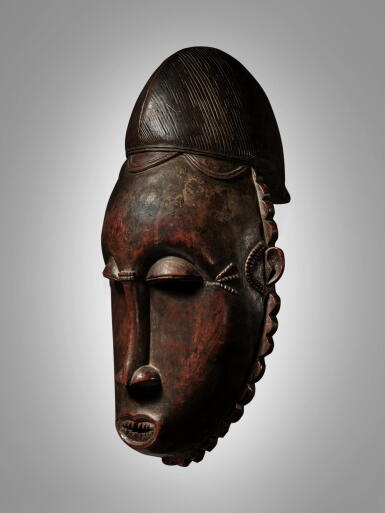
Baule Mask, Côte d'Ivoire
Auction Closed
May 24, 03:58 PM GMT
Estimate
40,000 - 60,000 USD
Lot Details
Description
Baule Mask, Côte d'Ivoire
Height: 14 in (35.6 cm)
Champin-Lombrail-Gautier, Enghien-les-Bains, June 23, 1984, lot 95, consigned by the estate of the above
Jean-Claude Bellier, Paris, acquired at the above auction
Lance and Roberta Entwistle, London, acquired from the above
American Private Collection, acquired from the above in 1993
Bonhams, Los Angeles, May 23, 2017, lot 70, consigned by the above
Acquired at the above auction
Kunsthalle Nürnberg, Nuremberg, Magie und Abstraktion. Primitive Kunst aus dem besitz moderner Künstler, January 26 - March 10, 1968
Magie und Abstraktion. Primitive Kunst aus dem besitz moderner Künstler, Nuremberg, 1968, cat. no. 94 (listed)
This dignified and majestic mask is a kpwan, the senior female mask which is the last to appear in the goli dance series. Alain-Michel Boyer notes the kpwan is “praised as ‘the queen of goli’, and therefore the most important figure in the cult, [kpwan] only appears in exceptional circumstances.” (Boyer, Baule, Milan, 2008, p. 50).
The style of the mask is one of great refinement, with the artist pursuing a profoundly balanced composition in which greater weight is given to creating a harmonious interplay of volumes than to surface adornment. Seen from the front, the nose neatly divides the oval face, which has a solemn, peaceful expression, with downcast eyes that are embellished by the presence of delicate scarification marks at the corners and the bridge of the nose. The brows are sweeping curves that echo the form of the high coiffure, which arcs beyond the back edge of the mask, lending the composition a dramatic grandeur. Seen in profile, the graceful line of the forehead continues into the finely modeled nose in a single, sinuous curve. Possessed of a serene and graceful beauty, the kpwan is far removed from the everyday disorder of the world.
Susan Vogel describes the dance of the kpwan as that “of a woman or an elder, a slow and stately dance. The entrance and exit of [kpwan] are theatrically managed for greatest effect. She appears at the end of a long day of dancing, music, eating, and drinking that leave the village bathed in a sense of euphoria. When the masks arrive, it is nearly dusk, and women have been dancing and singing through the street in anticipation, begging [kpwan] to come.” (Vogel, Baule: African Art, Western Eyes, New Haven, 1997, p. 178).
You May Also Like


