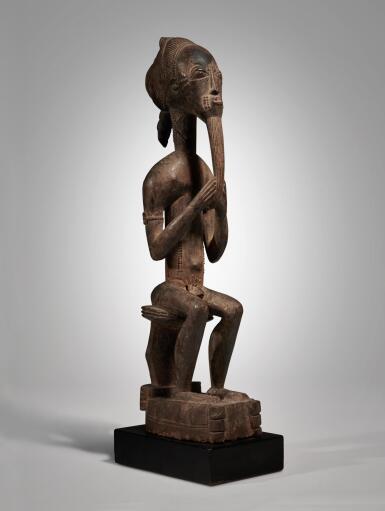
Baule Seated Figure, Côte d'Ivoire
Auction Closed
May 24, 03:58 PM GMT
Estimate
60,000 - 90,000 USD
Lot Details
Description
Baule Seated Figure, Côte d'Ivoire
Height: 16 1/4 in (41.3 cm)
Acquired from the above on December 8, 1962
Mary Washington College, ed., The Sculpture of Primitive Peoples, Fredericksburg, 1966, pl. 5, cat. no. 16
In the 1890s, the famous Africanist Maurice Delafosse, the administrator in Toumodi in the heart of Baule country, toyed with the idea that Egyptian civilization had left its mark there. Long before this branch of the Akan group settled in the center east of Côte d’Ivoire after crossing the Tano river to flee their homeland in present-day Ghana, caravans from the shores of the Mediterranean had taken the same path, carrying the goods of their trade, customs, religion, and culture. Whether coincidences or borrowings, the similarities noted by Delafosse, the first and far-sighted observer of Ivorian culture, suggest themselves to our minds as we look upon the statue from the Lawrence collection, a sculpture that is at once both representative of the Baule aesthetic and original.
The hieratic male character, enthroned on his seat, his body and gaze directed out towards an inaccessible beyond, irresistibly evokes the majesty of Ptah, the god of craftsmen, who is immortalized on the frescoes of the tomb of Irunefer, near Luxor. In his hands, our Baule ancestor holds his carefully combed beard like a holy sacrament. His beard, a mark of his prominent social position, recalls that of the demiurge of the Nile, who holds to his chest the tool of his office. The coiffures of this figure and Ptah are both impeccably flattened on the forehead, but the analogy ends there; the nape is treated very differently, with the hair of the Egyptian cut simply, while the councillor of the Ivorian hinterland wears his hair in an elegantly and meticulously braided chignon. This elaborate coiffure is entirely in accordance with the stylistic canons that govern Baule ideas of beauty, which, among other things, dictate that one must not neglect any detail.
The sculptor was, however, able to make a few distinctive touches here that reveal his talented hand. The curve of the unusually sloped shoulders and the folded arms create a composition of rare elegance. The idealized proportions, with long and slender limbs and barely defined muscles, are in striking contrast with the morphology of the group, which favours a solid body with a long torso and short legs. The narrow face, marked with keloids around the lips that echo those on the temples and the neck, borrows some features from the nearby Atié. Finally, there is a detail that catches the eye: although the presence of a jewel on the arm of an effigy of a dignitary is common, the bracelet surrounding the biceps of this figure is unusual. Composed of a ring in a material that is difficult to identify - leather, gold, brass or other metal - it seems to hold an amulet of the type used by the neighbouring Guro. These small leather pouches containing verses from the Koran were adopted very early on by animist practitioners in the region for their supposed protective power. A beautiful dark and lustrous patina emerges evenly from under a crust whose thinness indicates that the celebrant probably reserved “heavy” anointings to the feet of the sculpture to preserve the beauty of the figure.
This observation gives a clue as to the function of the statue which, in Akan culture, and particularly amongst the Baule, is not obvious at first glance. Its size, the genre represented, and the offerings it has received, which can be detected by its patina, are all criteria to consider in determining the use of this sculpture. Between husbands and wives of the beyond, and agrarian or village deities, the difference is tenuous. In this case, this beautiful character with a dignified posture, imbued with wisdom and serenity, could be the intermediary of a diviner, used as an asye usu during the rites dedicated to him. Reputed to be ugly and deformed, this powerful and disturbing spirit of the groves, paths, and undergrowth required, in exchange for his benevolent intercession, that the statue designed to honor him be his exact opposite, and so, just as he is repulsive and unremarkable, the statue that depicted him must be handsome and striking.
It is the seated position that confirms the status of this sculpture. Although it is present in every point of life, the use of the seat is very codified, and its form depends on the social status of the person who possesses it. In this case, the very particular form of this piece of furniture, with its circular seat, suggests that it is not just any adammadwa, or “two-penny seat”, according to the classification established by the Reverend Peter Sarpong. The superb figure brought back by Hans Himmelheber in the 1930s and the statue which belongs to the fondation Dapper both sit enthroned on stools of identical form to that of the Lawrence figure.
Bertrand Goy
You May Also Like