Jan Fris
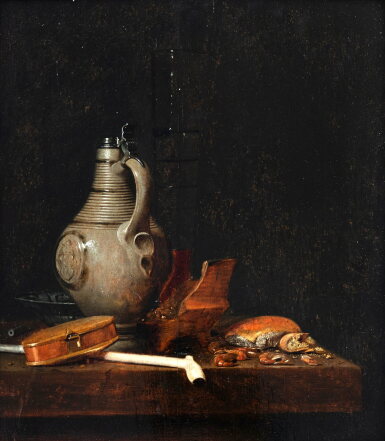
Still life of a glass, a jug, a brasero and a pipe arranged on a table
Lot Closed
June 10, 01:06 PM GMT
Estimate
20,000 - 30,000 EUR
We may charge or debit your saved payment method subject to the terms set out in our Conditions of Business for Buyers.
Read more.Lot Details
Description
Jan Fris
Amsterdam 1627-1672
Still life of a glass, a jug, a brasero and a pipe arranged on a table
Oil on panel
Signed and dated on the ledge lower centre J Fri : s. 1660 (?)
43,9 x 38 cm ; 17¼ by 15 in.
Sale Collection de M. X, Me Maurice Rheims, Galerie Charpentier, Paris, 3 December 1959, lot 9 (as signed and dated 1660 lower centre on the ledge).
A clay pipe, a tobacco box and a brazier were the indispensable requisites for a seventeenth century Dutch smoker. Still lifes depicting this specific ensemble of objects, also called Toebackjes, grew in popularity from the 1620s, when tobacco was introduced into the United Provinces. Much of Johannes Fris’s work was devoted to them. Still a mysterious figure, this artist worked in Amsterdam between 1647 and 1672, specializing in still lifes. Materials and textures are reproduced in the finest detail, with a restrained palette of grey, ochre, white, terracotta and brown tones. These ‘tonal’ still lifes followed in the wake of Pieter Claesz’s work in the 1630s, though Fris was closer to Jan van de Velde the Younger in the arrangement of the objects and his manner of applying colour to the canvas (see for example Still Life with Stoneware Jug and Pipe, 1650, National Gallery of Art, Washington, inv. 2019.13.1).
The pipe, the tobacco box, the brazier, the Westerwald stoneware jug (decorated with the emblem of the city of Amsterdam) and the glass seem to be objects taken from the painter’s workshop: they appear in several of his works, for example the Still Life signed and dated 1650 in the Fondation Custodia, Paris, and in the Still Life signed and dated 1665, sold in our rooms (Sotheby’s, New York, 28 January 2021, lot 37). The tall beer glass, commonly called a pasglas, was used for drinking games and often depicted in debauched tavern scenes. The elements assembled in the painting suggest an evening of drinking and smoking among friends, but point out to a keen-eyed viewer the dangers of idleness and excess. The pasglas references the notion of measured temperance , while the broken brazier and the pipe may be associated with the concept of vanitas, underlining the fragility of human life, as ephemeral as a coil of smoke.
You May Also Like