
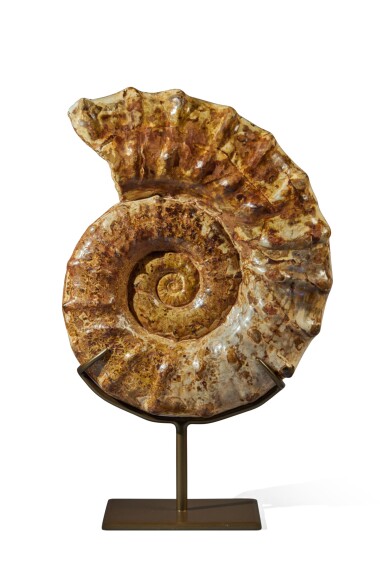
Mounted Jurassic Ammonite
Late Jurassic, Oxfordian Stage (approx. 161-154 million years ago), Madagascar
Auction Closed
July 14, 07:13 PM GMT
Estimate
6,000 - 9,000 USD
Lot Details
Description
Mounted Jurassic Ammonite
Euaspidoceras jeanneti
Late Jurassic, Oxfordian Stage (approx. 161-154 million years ago)
Madagascar
21¼ x 17½ x 5 inches (54 x 44.5 x 12.7 cm), 27 inches (68.6 cm) tall on stand. 84 pounds (38.1 kg).
This large fossilized ammonite shell exhibits natural sculptural qualities. It is complete, without distortion, and matrix-free. It remains in an unaltered state, revealing its natural surface and original luster.
Alongside trilobites and dinosaurs, ammonites are among the most iconic fossils. Ammonites swam the seas freely during the Jurassic and Cretaceous Periods, evolving rapidly and leaving abundant examples in the fossil record. Scientists estimate that there were at least 10,000 species of ammonite during their roughly 150 million year reign on Earth, and possibly up to 20,000 species.
The outermost layer of ammonite shells was made up of aragonite, a type of calcium carbonate, which provided strong protection and allowed ammonites to fossilize much more readily than animals that either had a soft shell or lacked a shell. Because ammonites rapidly evolved into new species and their shells were prone to fossilization, they have been crucial for scientists interested in dating the Earth's layers: finding the same species of ammonite in layers of soil thousands of miles apart implies that those layers are from the same time period in Earth's history.
Ammonites were cephalopods, a class of mollusk that includes present-day nautilus, octopus, and squid. Euaspidoceras lived during the Oxfordian Stage of the Late Jurassic, roughly 161 to 154 million years ago. This fossil shows two extremely desirable characteristics in fossil ammonites: a nacreous and pearlescent outer layer, as well as gorgeous and intricate suture lines where the walls separating each chamber, known as septa, joined the wall of the shell. Although scientists once believed that the intricate suture lines strengthened the shell and supported the animals in deep water, it is now believed that the suture lines helped with buoyancy regulation and made it harder for predators to puncture their shells. Ammonite suture lines are unique to each species, and thus the patterns on different ammonites can be used for identification.