

S otheby's is honored to present the Collection of architect, educator, and historian Robert A.M. Stern. Among the most influential American architects of his generation, Stern built his legacy on the conviction that tradition and innovation need not be opposing forces. His architecture, scholarship, and teaching were grounded in a deep understanding of history while remaining open to the possibilities of the present. The Collection he assembled over decades reflects this same sensibility. Bringing together works by leading figures of Minimalism, Post-Minimalism, and Pop Art, it reveals an enduring engagement with form, space, materiality, and the ways artists and architects alike have reimagined modernism across generations.
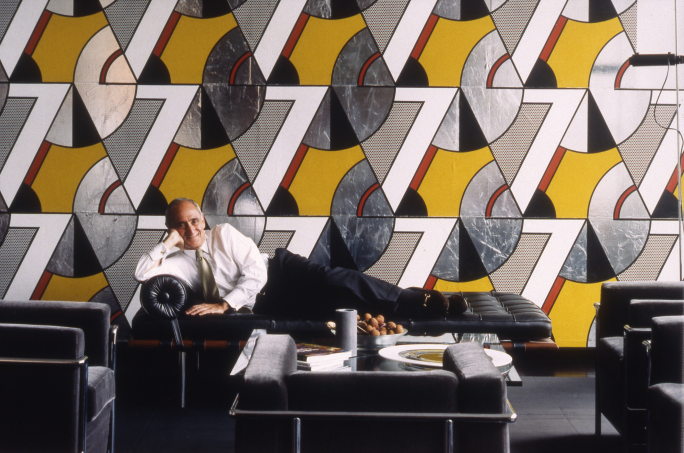
Robert A. M. Stern was a defining voice of twentieth-century architecture. Born and raised in New York, Stern studied at Columbia University before earning his master’s degree at Yale University in 1965. It was at Yale that he encountered a generation of thinkers who would profoundly shape his understanding of architecture, including Paul Rudolph, Robert Venturi, and the influential architectural historian Vincent Scully. These encounters established the intellectual foundation for a career defined by a sustained dialogue between the history of architecture and its future.
"Robert A.M. Stern's entire life revolved around architecture—its study, its practice, its teaching, its sharing, its research, its documentation, its celebration. The dialogue of architecture was everything."
Stern emerged as an important voice in the development of American postmodernism, advocating for an architecture that could draw freely from history, tradition, and the particular character of a place. Rather than rejecting the past in pursuit of modernity, he believed that architecture could move forward by understanding and reinterpreting what had come before. His oft-repeated maxim, “You have to go back to go forward,” became a concise expression of this philosophy. Throughout his career, Stern incorporated classical and vernacular references into contemporary buildings. As his son describes, his buildings “are about their place and take their architectural cues from the immediate surroundings and the history of whatever location they are commissioned. Bob’s architecture was always about the moment and the place.” Thus, Stern’s was an architectural language that embraced pluralism and resisted the notion of a monolithic universal style.

Stern's commitment to plurality extended naturally to his role as an educator and advocate for emerging architects. In 1965, while a fellow at the Architectural League of New York, Stern organized 40 Under 40, an exhibition that brought attention to a new generation of architects whose ideas he believed deserved recognition. He later became the youngest president of the League’s board in 1973. Stern began teaching at Columbia University in 1970 and, decades later, returned to his alma mater as the dean of the Yale School of Architecture, a position he held from 1998 to 2016. His return to institutions that had helped shape his own intellectual development was, in many ways, characteristic of his approach: he looked to established traditions not as fixed models, but as foundations from which new ideas could emerge.
As an educator, he championed an expansive understanding of architecture, encouraging students to engage with the discipline’s many traditions and possibilities rather than adhere to a singular orthodoxy. Deborah Berke, Stern’s successor as dean, recalls, “What Bob really cared about was the strength of the idea, the depth of knowledge behind the idea. He was not driven by stylistic judgment. He knew what he wanted to make, and then if you made what you believed in and you did it well, he embraced you with open arms." For Stern, history was not a constraint but a means of expanding the possibilities of the present. His architecture, scholarship, and teaching were united by a belief in continuity, plurality, and dialogue: between old and new, tradition and invention, and architecture and the broader cultural world.
"He was interested in the breadth of what people are making from the most traditional, the most classical, to the most avant-garde, to the most traditionally modern early twentieth century, to practices around the world."

Stern's engagement with writing, teaching, and leadership did not diminish his extraordinary productivity as a practicing architect. Through Robert A.M. Stern Architects, the firm he established in 1978, he designed projects ranging from private residences and university buildings to cultural institutions, hotels, and major residential towers. Across an extraordinarily varied body of work, Stern responded to the character and history of each setting, whether by reinterpreting the traditions of New York apartment architecture at 220 Central Park West, drawing on Yale’s collegiate traditions, or engaging with the civic and institutional legacy of the Bush Presidential Center.
Notable Projects by Robert A.M. Stern Architects


Stern’s Collection is led by Andy Warhol's Flowers (1964), one of the most iconic images of post-war American art. Alongside works including an early light work by Dan Flavin, an outstanding enamel by Roy Lichtenstein, an elegant Robert Mangold painting, and a rare John Chamberlain steel sculpture, Stern’s Collection brings together a remarkable group of artists who played a central role in redefining the possibilities of painting, sculpture, and installation through the 1960s and 1970s. The artists that held Stern’s attention approached familiar materials and everyday imagery in strikingly original ways. Considered together, the works offer a concise survey of some of the most innovative artistic developments of the post-war period in New York.


Stern was an early champion of each of the artists represented in the Collection, acquiring all in the 1960s and 1970s. Purchased from historic New York City galleries like Leo Castelli Gallery and Kornblee Gallery, the works demonstrate Stern's discerning eye. Viewed today, the Collection reveals the depth of Stern's engagement with the artistic culture of his time. Bringing together works that have become touchstones of postwar American art, it reflects a collector who recognized originality, ambition, and historical significance with great clarity. The collection's distinction lies not only in the importance of the works themselves, but also in the foresight with which they were acquired, preserving a remarkable record of artistic innovation at a pivotal moment in American cultural history.
Upcoming Highlights




Auctions

This Legendary Architect Had One Rule for Art: Inside the Robert A.M. Stern Collection


Exhibition Information
Exhibition Information
2–7 October | Prints Part II
Monday–Saturday 10:00AM–5:00PM
Sunday 1:00PM–5:00PM
945 Madison Ave, New York, NY 10021
