Live Auction: 18 November 2026 • 6:00 PM • New York

Legendary: The Blaquier-Arrieta Collection Evening Auction 18 November 2026 • 6:00 PM EST • New York

The Blaquier-Arrieta Collection, A Memoir

By Desmond Corcoran, London, 30 September 2026

"A window on the street is as though an opening into heaven."
- Victor Hugo

This old quote was more than borne out on a late December afternoon in 1974 when Carlos Pedro Blaquier and Nelly Arrieta de Blaquier walked into my gallery, The Lefevre Gallery, on Bruton Street. They had been shopping for shooting paraphernalia at Holland & Holland which was then on the opposite side of the road and were on their way to the Wildenstein Gallery on Bond Street. At the time, we had a Christmas exhibition of 19th and 20th Century Paintings and in the window was a Bonnard still life which caught their eye. They duly bought the painting and while giving my partner, Martin Summers, delivery instructions, Carlos Pedro happened to mention that they were looking for a Gauguin. We had just purchased an important late Brittany Gauguin, Promenade sentimentale, from the Vanderbilt family in the United States which was due to be delivered the following morning. Martin said to Carlos Pedro: "If you come back tomorrow at the same time, we might be able to help you."

The Blaquier-Arrieta apartment featuring the Monet, Pissarro and Cezanne.

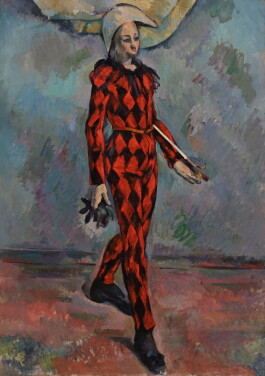
Thence, the fairytale began, and many major paintings followed over the next eight years until the unfortunate break-out of the Falklands War. A mutually beneficial business relationship started, and a burgeoning lifelong friendship developed. One of the high points was the purchase, the following year, of Paul Cézanne's Arlequin, which my friend Jacob Rothschild had just given us to sell.

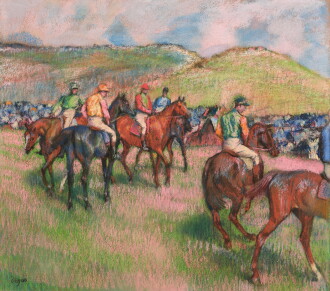
Among the great paintings that flowed to Buenos Aires were an important Henri de Toulouse-Lautrec (from the Lasker Collection which we had just purchased), Pierre-Auguste Renoir's En Canot (Jeune fille à la barque), also from the Lasker Collection, and a sumptuous pastel by Edgar Degas, Avant la course, from the Brody Collection in Los Angeles.

Over the years, Martin Summers, my wife Josephine and I made many trips to Buenos Aires and to the Blaquier-Arrietas' magical ranch, La Biznaga, in the province of Buenos Aires. We became great friends with Carlos Pedro, Nelly and their family. Nelly would remark when I arrived in Buenos Aires: "Have you come to visit your babies?" as the collection was known.

The Blaquier-Arrieta apartment featuring the Renoir and Vlaminck.

With the outbreak of hostilities, all communication sadly ceased. However, soon after the Falklands War was over, the telephone rang one day and it was Carlos Pedro. Although their collecting urge had somewhat tailed off by then, they did subsequently buy, some years later and at my instigation, a beautiful small Derain painting of Collioure which was in an auction in New York.

The friendship continued even after the collecting stopped. Nelly had always dreamt of a major auction encompassing her collection; the forthcoming auction is a fair representation of that dream. I have fond memories of their beautiful apartment in Buenos Aires in the Plaza San Martín, glowing with masterpieces, stunning French silver and beautiful gold boxes. Quite apart from the great wines and wonderful food, I think that helping form the Blaquier-Arrieta Collection was without doubt one of the high points of my career, something never to be forgotten.

The Blaquier-Arrieta Collection 

By Joachim Pissarro

"It is not what is available that shapes art, but what an artist chooses to find meaningful."
- Kirk Varnedoe, A Fine Disregard: What Makes Modern Art Modern

This epigraph by one of the great curators of The Museum of Modern Art, Kirk Varnedoe, not only crystallizes the extraordinary strength and potent richness of the Blaquier-Arrieta Collection, but it also says something else. Carlos Pedro Blaquier and Nelly Arrieta de Blaquier were not only visionary collectors, but they were also what one could call “curator’s collectors.” They not only had a capacity to identify one chef d’oeuvre after another, but, somehow, through time, distilled patience and tireless personal engagement, they created a collection that was more than a collection. What I mean is that they had somehow succeeded in creating an ensemble that appeared to be indissociable: the Blaquier-Arrieta Collection could be compared to a Matisse painting: every part, every element, was absolutely indispensable to the whole. In a sense, they managed to recreate this swath of history—the seminal few decades at the end of the nineteenth century and early twentieth century—that formed the bedrock of modernism. The Blaquier-Arrieta Collection stands today as a magnificent gem, that in its totality would tell, better than any written volumes, the fascinating story of the passage from Impressionism to Post-Impressionism and the plunge into Modernism. Today, Sotheby’s offers one of the last rare opportunities to admire this exceptional achievement.

One of the remarkable features of this group of works is that, not only does each masterpiece scintillate on its own particular merits and visual strengths, but the entire collection itself holds together as The Lady and the Unicorn, the spectacular six-panel medieval tapestry at the Paris Musée de Cluny. That great marvel created circa 1500, is another superlative example of a masterwork that mediated an earlier tectonic shift, from theocentric devotion to Renaissance concerns with human experience and critical thinking.

The paintings selected here are not only a perfect encapsulation—a kind of pantheon—of the key moments of transformation from Impressionism to Post-Impressionism which itself formed the foundation of a hundred years of creative production to come; these works also reflect and express the deep-seated metaphorical and literal revolution of infrastructure of western society at the end of the nineteenth century—a portentous premonition that dictated the era we are fully immersed in today. In France, those unprecedented changes took place at a staggering rate and are exemplified by the travaux haussmanniens, the rebuilding of Paris, helmed by Baron Haussmann under Napoleon III. This almost incomprehensibly vast project redeveloped the capital from its cramped and unsanitary medieval environs into a planned urban layout of broad boulevards, avenues, grand buildings and elaborate facades. Concurrently, industrialization, technological invention and expanded railways advanced and connected the country as never before, ushering in the Belle Époque.

To reveal some of the fascinating inner dialogues interwoven within the fabric of this collection, we will consider several case studies that illustrate its uniqueness, in a sequence that notes some of the revolutionary personal relationships between the artists. These divining lines connect and enrich the artistic explorations, sociological concerns and aesthetic discourses as a new century approached. One collective association is the confounding of expectation: presumed intellectual and contextual cartographies, established means of perceiving the world through art are withheld, rerouted, or disappeared. Even the spectator is made complicit in the process of destabilizing the canon, the academy and the very meaning of things, by the adjustment of our position relative to what we are seeing. Motifs, signifiers and geographic locations often begin as traditional subjects but discard or are separated from their definitions through the creative process—painting reassigns matter, as these visionary artists were reshaping how the new age of human progress was perceived and understood.

We will see how a household object, or individuals, and even an entire city become other. In this beguiling, almost magical milieu of experimentation and the forging of new expressive means, even the critical language employed to discuss these unprecedented ideas had to evolve; nothing is at its seams; there is more than meets the I, and we will go beyond a shadow in a doubt. These fascinating multi-layered shifts of understanding and newly formed semblances, intercrossing each other, have made this collection a paragon of modernity that still powerfully resonates in us as we approach each of its singular masterpieces.

The Blaquier-Arrieta Collection

Works in The Blaquier-Arrieta Collection

  • Paul Cézanne, Arlequin
    View Lot

    By Joachim Pissarro

    Cézanne’s charismatic Arlequin bursts forth more as an explosion of colors, brushstrokes, and marks than as a representation of a person. The half-moon, faintly Napoleonic hat; the striking full-body costume of red and black diamond shards; the stance of an opening moment as if he is being met with applause at the opening of a ruckus farce or circus; all recall the street theater of the Commedia dell’arte tradition. Our commanding protagonist strides toward us as a monumental figure, even exceeding the bounds of the picture as his foot punches through its lower edge. The inference of a coming performance is palpable.

    But it is at precisely this juncture of breathless trepidation and pause that Cézanne reveals the painting’s principal mechanism—there is no story, no narrative thread visible; there is no thunderous adulation; there is only silence—the swelling promise of an entertaining bacchanal is denied. Our hero—his face a fixed and distant mask—is alone without an accompanying troupe, no context, no sequential development or fulfilling act. The pantomime never arrives, spectacle is arrested, anticipation dissipates. Our ringleader has exited an unseen arena jolting us from the suspension of disbelief.

    The background conspires in this dissociative scene. Cézanne’s quick, dashed brush marks form a benign bluish atmosphere, an impenetrable and separating curtain. Even the biographical fact that the model was Cézanne’s son, Paul, deepens the contradiction. Someone intimately known has been transformed into an oddly remote grotesque. The familiar and familial have become strange and estranged—arousing what Freud called the unheimlich—eerie, the recognizable turning into its opposite.

    There is something unsettling in Cézanne’s wrong-footing of our assumptions in this delinquent outcome à la Ray Bradbury’s novel, Something Wicked This Way Comes, but that sensation is quickly superseded by a deeper vein of comedic revelation. Here is Cézanne, who the academy has embalmed as the deadly serious, cerebral modernist architect, defying and mocking his canonical bearing as if to say, “books will tell you stories. I will show you what paint is for.” It is not his harlequin, but Cézanne himself who assumes the role of humorist, taking up the mantle of a painterly Charlie Chaplin. The tramp who could speak but chose not to, instead trusted his body to convey expressive language through reaction, rhythm and movement. There is something both grandiose and drole about this immense effigy of a jester that brings Cézanne here into an expected proximity to Maurizio Cattelan.

    Cézanne could tell stories. His earlier work demonstrates that abundantly through his approach to grandiloquent literary and mythic subjects. As Chaplin with spoken word, in Arlequin, Cézanne hasn’t happened upon narrative austerity because he lacks the capacity—he has elected not to activate it. The audacity of that refusal aims the joke squarely on the audience and detonates it in the face of the artistic establishment that would calcify Cézanne into inert historicism. Cézanne in this extraordinary painting, stands alone, stands out—creating a paragon that defies all attempts at classification, or any art historical categories. A pure celebration of the multifarious games of the painting, conducted at the hands of this magician, Paul Cézanne.
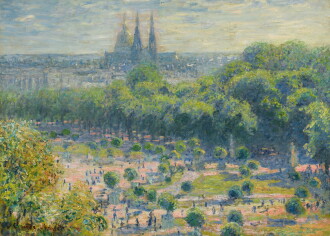
  • Claude Monet, Le Jardin des Tuileries
    View Lot

    By Joachim Pissarro

    In this quintessential impressionist painting from 1876, Claude Monet moves us into a maelstrom of oppositional dynamics that belie the soft dewy atmosphere of the Tuileries Garden. The ascendant architectural magnificence of Sainte-Clotilde’s neo-Gothic spires and the dome of Les Invalides draw our eye toward a gauzy horizon, while a great surging tide of trees cuts across the composition horizontally, billowing into a verdant cloud that engulfs the right of the picture. The vertical background architecture and middle ground riptide of greenery foment a genteel visual tussle that pulls us deep into the seductive atmospherics of Monet’s mise-en-scène.

    And what of the foreground? We observe tiny human figures moving among the pink ground and fragmented shrubbery of the open parkland; a congregation beneath a shaded copse, a coalescence of a dozen or so people by the nearest canopy. These strolling visitors are not merely decorative; they serve the composition in subtle and delectable ways. Do they not, in their diminutive manner, mirror semi-distant boles and limbs, echo the upward thrust of shadowed blue brush-marks under foliage, and even, in contrasting scale, wryly note the towering steeples of the far-off churches?

    While their stature is small, their contribution to the coherence of Monet’s symphonic arrangement is cardinal and could scarcely be grander. This device is repeated and intensified by two vertical purplish shafts which split the trunks and glimmer through the otherwise impenetrable phalanx of trees, opening a faultline through the picture from person to forest to spire. And a paradox in this optical continuum is revealed, wherein the monumental is unsolidified by atmosphere and the ephemeral acquires pendulous physical presence. The sum of all these parts is barometric—rushing breezes breathing through leaves, undulating pressure and dappling illusion. Monet surpasses the civic context of his earthly Eden, rendering Paris not as a city, but as mellifluous condition.

    The extraordinary dialogue between Monet and Camille Pissarro over these two Parisian cityscapes calls for pause. Monet’s splendid, pure impressionistic rendering of the Tuileries Gardens, anticipates by more than twenty years, Pissarro’s own series of the Tuileries Gardens, in 1900. The same collection showcases another cityscape by Pissarro, 1897—one of his major series—which was largely executed as an emulation of Monet’s grandiose exhibition of his Rouen Cathedrals in 1895, at the Durand-Ruel Galleries.
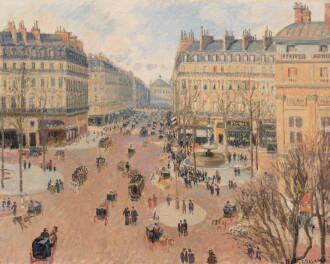
  • Camille Pissarro, La Place du Théâtre-Français et l'avenue de l'Opéra, soleil d'après-midi en hiver
    View Lot

    By Joachim Pissarro

    When Pissarro turns to Paris as the site of several pictorial series the results became a vortex of his post-impressionist decade (the 1890s). Pissarro, looking down from his rented room in the Grand Hôtel du Louvre (overlooking the Place du Palais-Royal and Place du Théâtre-Français), with the famous Palais Garnier (the Opera House) completed in 1875—Pissarro is here deliberately grappling with the utmost modern clusters of newly wide opened avenues, and lush and splendid architecture. Laying out his lofty view of the soft, pink light-infused city below. We are in the thrall of the streets, buildings, pedestrians, carriages, intersections—a cavalcade of invigorating metropolitan action.

    Unlike his countryside snow works, or Monet’s dreamlike gardens, this Paris is emphatically constructed. Massive city blocks and dramatic perspective that sheers into the distance are the defining structure of the composition. The scene is populated with horse-drawn carriages extending like moving columns; chimneys, lampposts and windows all reiterate vertical accents against the hard sight-lines of the city’s geometric architecture. There are disruptions to this order in the form of circular motifs—a fountain, the turning patterns of traffic, a domed edifice on the central horizon.

    Near the fountain, a concentration of figures makes us peer more closely. Has something happened? The density of bodies creates the appearance of an event without supplying one. Could this be a grouping of anti-Dreyfusards? As with Cezanne and Degas (his two foremost allies among the Impressionists) all traces of meaning, or narrative are withheld.

    The city’s infrastructure is evident as a directional system that funnels its inhabitants’ movements and therefore their interactions with each other: pavements are channels, building facades and street corners direct the flow of vehicular progress. The civic development organizes all movement so effectively that there is no sense of noise, discord or chaos, but smooth, flowing migration ushered by urban planning precision which operates like a perfectly efficient organism.

    If this is Pissarro’s rejoinder to Monet—both look down upon Paris from above—while Monet allows the city to diffuse into a pleasant miasma, Pissarro insists upon scaffolding structure, and brand new (at the time) architectonics. Yet, light still bathes this conglomeration in softening tones that prevent his angular framing from hardening into mere brittle description. Infrastructure supplies the skeleton; light dissolves its severity and people remain the lifeblood of the city’s vascular system.
  • Camille Pissarro, Maison de Piette à Montfoucault, effet de neige, avec un homme portant un fagot
    View Lot

    By Joachim Pissarro

    The fondness between Camille Pissarro and fellow artist (alas, undeservedly little known) Ludovic Piette-Montfoucault, and between their two families cannot be overstated. Piette’s aristocratic but impoverished clan gave the Pissarro family shelter when they were in dire straits themselves, and in perhaps the ultimate gesture of friendship and legacy, Pissarro named his fourth son after Piette, following his friend’s death in 1878 (Pissarro’s fourth son was Ludovic Pissarro who eventually completed the catalogue raisonné of his father’s paintings).

    The latter’s Montfoucault farm in Mayenne is where Pissarro spent time in the mid-1870s, painting an astonishing series of eighteen works that meld desolate winter vignettes, pastoral stylings and the humility, honor and pride of country folk and their way of life. It is notable that such warm bonds were the catalyst for paintings so sinuously and piercingly aligned with the icy chill of Eastern Brittany, and Pissarro’s plein air response to its frigid climate. Maison de Piette à Montfoucault, effet de neige, avec un homme portant un fagot, is one of several works that not only portray the effects of snow, but cause us to feel, almost physically, the ruddy embrace of those conditions.

    A palette of mint greens, and ice blue blankets the foreground, and a dark trail of perhaps footprints leads to the hunkered safety and earthy invitation of a farmhouse which is in the center of the picture. As with Paul Gauguin and Edgar Degas, Pissarro’s low-slung reddish structure acts as the heated core of the painting, whose gravitas dissipates outward into the cooler surroundings.

    Brushstrokes dart and scrape across the surface; dirty whites are punctuated by flickering eruptions of light orange, violet and russet. Weather is not simply represented here—it is as if the painting itself was formed by it. Almost absorbed within the white veil, a solitary figure emerges, trudging with a bundle of wood. His bantam proportions contravene the majesty of the setting, and he acts as a kind of kindling for human survival—labor, transport, fuel, warmth. The fagot on his back harks to the surrounding branches not yet cut. Pissarro neither monumentalizes the worker nor reduces him to picturesque incident. Instead, he is an accelerant igniting the painting’s larger context.

    Here we find a compelling distinction between Monet’s addressing of human bearing, and Pissarro’s. While both paintings unmoor the distinction between figure and environment, they do so from opposing social vantage points. Monet’s Parisians promenade leisurely, caressed by nature in motion; Pissarro’s dweller toils in the pristine stillness of snowbound silence.
  • Vincent Van Gogh, Châtaigniers en fleurs
    View Lot

    By Joachim Pissarro

    While we are still in the realm of Impressionism’s greatest proponents it is instructive to pause for a moment and consider how far-reaching their influence was on subsequent generations who would pick up the baton of artistic invention. Pissarro’s support of, and influence on Vincent van Gogh is a marvelous example. They met under the auspices of Vincent’s art dealer brother, Theo, with Pissarro taking on a mentor-like presence, and even advising Van Gogh to relocate to Auvers-sur-Oise for health reasons, which he did in 1890. It is perhaps in the application of paint as individual, blended marks to build up a picture, and the bold use of color that we can discern the attributes of Van Gogh’s interactions with Pissarro and inevitably, with Cézanne. His Châtaigniers en fleurs is superlative. The chestnut tree is monumental, towering over the scene and rendering the figures below it less participants than markers of its scale. The triumvirate of women—The Tree Graces—walk beneath it on a street bathed in a haunting pale-yellow chartreuse. They carry parasols, or maybe they are wide-brimmed hats for what: diffidence or protection? A lone male with crooked knees in the foreground is broken, crumpled, as if already crushed by an enormous weight—a visage of future torment, an embodiment of the post-impressionist vision of the world. Van Gogh departs here from Monet and Pissarro who repeatedly absorb humanity into a larger atmospheric continuum, Van Gogh’s walkers seem weary, almost overwhelmed, and at the mercy of nature’s whim under which they are both sheltered and threatened. The tree is both beneficent and indomitable.

    The flowering canopy prolongs this paradox. A profusion of tumescent buds, color upon color, signifies vigor and life, yet their combined mass is an ominous harbinger of suffocation and doom. The brushwork carries that contradiction upward. Pink, white and golden petals glow within dense green foliage and shiver in an upward current toward the deep, cobalt sky like embers into the darkening cosmos. The entire composition leans leftward, the road disappears over a crest, the little house seems to move as if for its life, nearly swallowed in the wuthering atmosphere, and even a greyish cloud above it conveys evasive maneuvers. This is not quite the sublime, but the botanic as kinetic energy, as the unseen rhythm of our universal totality.
  • Edgar Degas, Avant la course
    View Lot

    By Joachim Pissarro

    In Avant la course Degas too suspends prediction and denies our suppositions, this time in the crucible of sport. The composition coalesces from a central mass of jockeys’ bright silks, jostling horses, and a broad blue-grey horizontal band running across the picture. The latter, rendered so summarily that it reads almost as a compressed and continuous strip of terrain, is revealed to be a bank of spectators along the racecourse. Like Cézanne’s background, Degas’s muted environs concentrate our attention on the central players, while dematerializing the onlookers not as an agitating melee of individuals, but as a nebulous mass that resists certainty. How such compositional devices locate the viewer and disrupt our thinking elucidates the mastery with which Degas intercedes and orients our perception. What he gives us to see is not what holds everyone’s attention: the race, the potential winners, the stakes, the pending anticipations. As with Cézanne, all traces of any narratives, or drama, leave space for this sumptuous arrangement of colors. The racing skills of the riders leave room to the vibrant sheen of their silk shirts.

    This containment is startling, albeit in slow motion, because horse racing depends upon excitement; the fleeting collision of speed, money, risk and competition. It is predicated on an edge-of-the-seat release of unbearable tension and adrenalin that affects and bonds all present—riders, owners, animals and observers. But there is no release here, no one is taut with adrenalin. Horses mill and snort; jockeys posture, but everything seems at relative ease occupying the space preceding or following the event.

    If Cézanne conjures theatricality devoid of any play, Degas here promises a sport without action or winning. They work differently; Cézanne isolates; Degas assembles. Cézanne’s solitary figure becomes uncanny through its separation from narrative context; Degas fosters bemusement by his eternal delaying of our high-speed quarry. Both leave us idling for an opening number, the shot of a starting gun that will never arrive.
  • Alfred Sisley, La Seine à Port-Marly
    View Lot

    By Joachim Pissarro

    By portraying La Seine à Port-Marly, Alfred Sisley subverts the urban spaces of Monet and Pissarro’s central Parisian vistas and brings our attention to a wistful panorama of the titular commune on the capital’s far western suburbs. Here, periphery becomes locus. There are commonalities though, in the central band of clustered houses, the smoking chimney—probably of domestic origin but with an air of industrial aesthetics—and the distant landscape. Like Monet’s sweep of lush greenery across the Jardin des Tuileries, Sisley’s composition encourages us to move from left to right tracing the gently declining horizon line into the forested mass that claims the far bank of the river, in a visage of warm browns and apparitional greys.

    Then we notice the tonal quality of the Seine which floods the foreground. Its surface is sleek with glassy reflections of palest green that race to meet their cloudy counterparts above. Suddenly everything bolts into silent action racing toward the farthest point of the river; the spindled trees buffer it, the smokey trail bends to it, the maw of a looming, feathered sky presses down upon it, and the faintest rosy glow of a fading sunset just above the disappearing water intensifies our visual destination. Sisley succeeds in uniting optical dissonance with the utmost subtlety and understatement; calm becomes speed, plane become depth, agrarian stasis rolls into molten slippage. Sisley’s seemingly gentle pastoral belies nature’s perpetual motion.
  • Pierre-Auguste Renoir, En Canot (Jeune fille à la barque)
    View Lot

    By Joachim Pissarro

    The title of this work is as straightforward as it is obfuscating. It is undoubtedly a girl in a boat, but her image can almost be considered as placed within a separate painting like a glitch in time or a double-exposure photograph. She is in many regards, the antithesis of the environment around her. Her deep navy dress is opaque, heavy, quasi-funereal against the dancing watery dissolution around her; the pose is curiously rigid, symmetrical, stoic, whereas the boater behind her is mid-stroke navigating his kayak with muscled tension; her sun hat keeps her almost entirely out of the direct light that floods the rest of this scene. In her hands she gently holds each end of a short flaccid rope. It is a looped, closed circuitry that begins and ends with her, and offers little obvious practicality.

    Renoir provides many of the hallmarks of a pleasurable day—water, small craft, benevolent rippling conditions, and a furling breeze which teases the flag behind her. Yet our heroine’s bearing permits no animation or giddy lakeside pleasure. The vessel may be moving, the water shifting and the oarsman laboring behind her, but she remains curiously fixed—less absorbed in the excursion than extracted from it. These effects cause a cinematic diminution of the supporting cast into the vanishing point. Renoir sets the solidity of the poised woman against the fleeting sensations of his impressionist landscape. Rather than fully reconciling the two, Renoir allows subject to be portrait and setting to be leisure scene—two paintings—sliding almost imperceptibly in and out of synchrony before us and increasing our fascination with the story and intentions of this pelagic Mona Lisa. Ironically, this painting by Pierre-Auguste Renoir appears to anticipate what could be a frame in a film by the artist’s son, Jean Renoir “one of the greatest of all film directors” (according to Orson Wells).
  • Paul Gauguin, Fleurs dans une coupe
    View Lot

    By Joachim Pissarro

    Completed circa 1899-1901, toward the end of his remarkable life, Paul Gauguin’s Fleurs dans une coupe can be read quasi-autobiographically. By this point, he had endured critical and financial hardship, debilitating illness, the deaths of three of his children and extreme disillusionment on his travels, particularly in Panama. His imagined, much anticipated nirvana on the French Polynesian islands of Tahiti and latterly Hiva Oa in the Marquesas Islands turned into the very opposite of what he expected. His desperate attempt to “escape civilization” turned out to be a sheer impossibility. Georges Daniel de Monfreid, a close friend of the artist, thus described Gauguin in 1902, “a great man who, in a way, has already gone from this world.” His far-flung existence had promulgated a perception of him so distant and exotic that he had almost ceased to be regarded as a living artist. The pathos and cumulated anguish of his losses, set against his florid determination to continue his vibrant and singular artistic practice coalesce with almost unbearable poignancy in this exquisite ensemble still life. In his relentless efforts to pursue his dreams, Gauguin tore at the bonds of family, duty and tradition at great personal cost—a melancholy echo of the cultural fracture underway, to which he is so foundationally bound.

    Gauguin, like Van Gogh, draws from the impressionist legacy of Cézanne and Pissarro, exquisitely so in the organization of composition, which we see here in interlocking planes of color, deftly arranged balance and distinguished zones of fore, middle and background. Deep, rich olive leaves spring from a mauve vessel which rests on a white cloth, and is half obscured by sprigs of plucked growth; delicate rose and white petals as translucent as butterfly wings pop from the denseness, cascading diagonally from the top left of the picture to meet ripened fruits that are flanked by the table’s dressing. It is almost as if we are observing a journey written in nature’s bounty, from emergence and virility, through fullness, to the august remnants of senescence. A possible self-portrait rendered in the balm of Gauguin’s wildest dreams—rich promises that never could yield Gauguin’s oneiric projections.
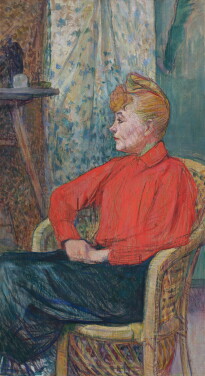
  • Henri de Toulouse-Lautrec, Femme assise de profil vers la gauche
    View Lot

    By Joachim Pissarro

    Of all the artists associated with fin-de-siècle Paris, perhaps none is as synonymous with it as Henri de Toulouse-Lautrec. After his aristocratic upbringing and a series of debilitating health issues that left him physically underdeveloped, he found solace, camaraderie and inspiration among the dwellers and decadence of Montmartre’s nightclubs, brothels and cafés. The subjects of his drawings, lithographs and paintings included the performers, prostitutes and habitués of the night—among them were the model and artist Suzanne Valadon, and the dancers Jane Avril, and Louise Weber; the ripping melees and heady, whirling choreographies of dance and music halls like the Moulin Rouge and the Folies-Bergère; and the bustling interiors of cafés and cabarets where artists, poets and writers would gather.

    While Toulouse-Lautrec is the famed chronicler of Montmartre’s high-spirited celebrations, vixenesque showgirls and libatious, eager patrons rendered in lithe motion and boisterous aliveness, he also depicted individuals absorbed in quieter moments, away from the blazing lights and merriment. These women are often alone in dressing rooms and bedrooms, stilled, posed or at rest. Through them Toulouse-Lautrec invites us into the stolen instances and privations that are the unseen counterpart to their public lives, where the audience is just one man. Femme assise de profil vers la gauche is such a portrait.

    The titular figure is seated, composed, hands clasped in her lap, and motionless, wearing a look of introspection. Fully clothed, the flesh is concealed, the carnality of the artist’s bacchanals set aside. The crimson flare of her blouse contrasts against the deep navy field of her skirt, anchoring her in pacific solemnity not unlike Renoir’s lady. Though we cannot know this woman’s story, we can infer from the tonal collision of her attire a subtle embodiment of the alternating highs and lows of the hardscrabble bohemian life, when performers could be exalted as icons, adored and adorned in their prime, only to slip into obscurity when their stars dimmed. Her head is in profile, held in noble mien, her torso turned slightly towards us, which conveys both knowing and ambivalence toward any spectators; another look at her hands suggests a little more tension than at first glance; and her location at the picture’s center pronounces her gravitas while the peripheries of the picture fade into domiciliary obeisance. As we gaze in silence, wondering at her thoughts, her personal history and what brought her to this occasion, we may feel almost that we have made an incursion by breaching the solitude of this Delphic figure, perhaps one of the feted and fated doyennes of Parisian nightlife
  • André Derain, Bateaux au port de Collioure
    View Lot

    By Joachim Pissarro

    With Derain, we see another kind of unseating: that of a bucolic scene evoked and exalted—not defined—by strokes of kaleidoscopic brilliance and solar-powered luminosity. Here, the modest fishing village of Collioure, at the southernmost extent of the French coast is emblazoned in hues that transform the humble quotidian into golden reverence. We almost have to squint our eyes at the blaze of serpentine strokes and liquescent slips that Derain streaks across the composition. Via a seemingly thaumaturgical process Derain succeeds in converting pigment and substance into heat, light and rhythm; color has become elemental, primal, raw, pure incandescence.

    Yet Derain does not snatch the perceptible world from our gaze. We can still discern a clutch of small blue, red and green skiffs bumping each other to plant a kiss on the shore’s safety (a watery reenactment of Degas’s equine frolics), spars and masts bisect; the harbor, despite Derain’s transformation still offers succor. From the foreground bank to the watery outline of a distant hill, each blurry component retains just enough of itself to preclude total evaporation. The anchorage and its industry survive, but color has shed academic restraints. Color reigns supreme.

    These were the first loud steps towards the formation of what became known as the Fauvist revolution occurring in Collioure. It was there that Henri Matisse and Derain worked together for two months in the summer of 1905, at Matisse’s invitation. It was a union that produced one of the most sensational artistic movements in history. It is noteworthy that this first major artistic revolution of the twentieth century did not come about in the roiling cultural arenas of Paris, Moscow or London, but in a hole-in-the-wall seaside village—the unassuming arcadian locale where the everyday attained supranatural vigor. Derain’s depiction of Collioure also relates back to Cézanne. If his Arlequin exceeds narrative grounding, Derain’s earthly haven exceeds the physical, metamorphizing everything into primal spurts of pure pigment.
  • Maurice de Vlaminck, Nature morte à la cruche bleue
    View Lot

    By Joachim Pissarro

    This still life by Maurice de Vlaminck, the Fauvist consort of Henri Matisse and André Derain, extols the core aesthetic component of the artist’s expressive ambition. What he achieves here is a composition of such nuclear ferocity, which rivals even Derain’s intensity, that the viewer can expect to receive third-degree burns by proximity. Substance is perceptible, but it is not the point. The lowly and ostensible bowl of fruit is supercharged by the fusing of emotion and gesture into grenades of orange and yellow, set against a cataclysmic red sky.

    The tablecloth, in necessarily cooler tones of greenish-blue, winds and trips downward, flowing like a river, and tipping its contents toward us. Jug, plate and fruit are all uplifted and carried on a boiling riptide. Movement is palpable, breath is bated, the entire plane shifts and lurches forward and even today, 120 years after its making, this work still shocks, still takes its toll. This isn’t a painting; it’s a blast furnace, whose Fauvist intentions vitrified sensorial vigor and painted material, changing the course of artistic expression.

    After this brief journey into the inspirations and circumstances of their making, this unparalleled group of masterworks reveals how profoundly committed its visionary makers were to free themselves from the strictures of academic requirement, to test untried and even perilous concepts and forge neoteric synapsis of creative and emotive expression. Their ambitions required them to undertake gargantuan endeavors that became even greater achievements which in turn owe much to the conversations, support, and deeply committed engagement the artists shared with one another. These paintings are the rarest evidence of those daring explorations and the meteoric brilliance that was required to found modernity itself.

Stay informed with Sotheby’s top stories, videos, events & news.

Receive the best from Sotheby’s delivered to your inbox.

By subscribing you are agreeing to Sotheby’s Privacy Policy. You can unsubscribe from Sotheby’s emails at any time by clicking the “Manage your Subscriptions” link in any of your emails.

Sell with Sotheby's

Sell with Sotheby's

Curious to know if your item is suitable for one of our upcoming sales?

Provide information and share images to request an online estimate now.

Start Selling
arrow Created with Sketch. Back To Top