Live Auction: 22 October 2026 • 6:00 PM CEST • Paris

T he quality of a collection lies first and foremost in its works. But it becomes even more beautiful when a certain mystery surrounds that collection, and its sale lifts the veil on masterpieces never before shown to the public. This is one of the many appeals of the Schlumberger Collection and perhaps its very first.

The Schlumberger family's immense success began with two men, brothers Marcel and Conrad, coming from Alsace, who in 1926, the year Claude Monet died, founded the first company of what would become the Schlumberger group (SLB), now based in Houston.
But the Schlumberger collection is the story of two women: Jeanne Schlumberger (1889–1983), the collector, and Katia Granoff, the Parisian dealer who introduced the world to Monet's late-period works and who accompanied her client and friend through most of her acquisitions.
Born the same year as the inauguration Eiffel Tower, Jeanne married Marcel Schlumberger in 1909. Her brother-in-law was Jean Schlumberger, who helped found the NRF (Nouvelle Revue Française) and would go on to publish In Search of Lost Time.
Jeanne was a brilliant woman – a daughter of an engineer, independent, fond of driving fast cars between Paris and Normandy. She was one of the first French women to obtain a driver's license. In 1964, at age 75, she took all her grandchildren to see the first concert of the Beatles in France. She avoided Parisian society life and any publicity around her person her whole life, preferring instead to oversee the properties she owned or patronized, such as the Château de Crèvecœur, intended to become the Schlumberger Museum Foundation, or her manor in Honfleur. Very few photographs of her are known to exist.
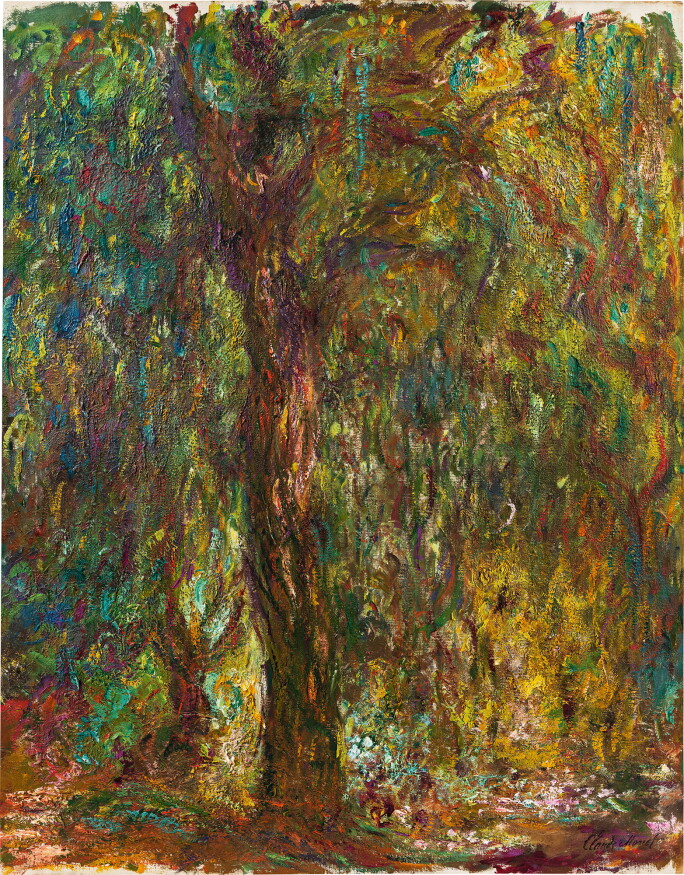
Her meeting in the 1950-s with another powerful woman, the dealer Katia Granoff, revealed Jeanne's extraordinarily visionary eye and this is the other supreme quality of this remarkable collection: Jeanne Schlumberger acquired Monets from the final period (post-1914), such as Irisand Saule pleureur, long before anyone else, at a time when the master of Giverny's last monumental compositions were still largely misunderstood or even rejected - both by public institutions and by the art-market as well, dealers and private collectors. Until 1970, when Michel Monet's bequest was inaugurated at the Musée Marmottan, there were only three places in Paris and in all of Europe that held major works from Monet's final period (the series of Les Nymphéas, Iris, Le pont japonais, Saule pleureur): the often-empty rooms of the Musée de l’Orangerie, Galerie Katia Granoff, and the Schlumberger family's townhouse on Rue Las Cases.
Though Jeanne Schlumberger was an active and generous patron throughout her life, she never lent her paintings to exhibitions. Once hung on the walls of Rue Las Cases, the works never left. As a result, they were handled very little and preserved in perfect condition. Unvarnished, unlined, untouched: Iris and Saules remain today exactly as Monet painted them. Faced with canvases so rich in material - "the substance of dreams," as the painter himself called it - where the color is sometimes left unmixed, the sight of the paint surface offers an experience of joy, as moving as it is grand. Gazing at a late Monet that Katia Granoff had sold to MoMA, Mark Rothko would write that looking at the color makes you become that color.
While Jeanne Schlumberger preferred the late Monet to the early Monet, she also had a particular love for 19th-century French painting: Delacroix, Daumier, Courbet, and the young Cézanne decorating the family villa in the manner of the old masters. And above all, Gustave Moreau, the hallucinatory Symbolist: Rêve d'Orient, one of the masterpieces of the Schlumberger Collection, depicts a female figure descending from the sky on a dragon at night, to lull humans to sleep and feed on their dreams and on magnificently colored flowers
To paint the dream by painting flowers. It always comes back to Monet. All roads lead to Monet. The one taken by the Schlumberger Collection has now been found again.