I t all began with Cheval d’attelage, a bronze by Paul Gayrard gifted to François Rochas by his mother when he was sixteen years old. It remained with him throughout his life and is now included in this sale. That sculpture was soon joined by many other animals, among them Condor by Édouard-Marcel Sandoz, Animal tournant by Gustave Miklos, and Panthère à sa toilette by Georges-Lucien Guyot—also gifts from Hélène Rochas, who had, in the meantime, developed an appreciation for Art Deco under the guidance of Kim d’Estainville. Above all, however, François Rochas’ marriage greatly expanded this bestiary. His wife, Carole, had a deep affection for animals, and searching for their bronze representations became the purpose of countless excursions to antique dealers and auction rooms. What began as a series of spontaneous acquisitions gradually evolved into a true collection that, over the years, came to inhabit every corner of their apartment.
Occupying the top floor of an elegant modern building in Paris’s 7th arrondissement, with terraces overflowing with lush vegetation, the Rochas apartment was transformed by Carole into an exotic interior imbued with a distinctly Far Eastern atmosphere, the perfect setting for this menagerie. Leopard-print carpeting, straw-covered walls, Chinese furniture, Meiji-period vases, and, serving as a coffee table, an elephant howdah acquired by François as a young man from Jean-Michel Beurdeley on Boulevard Saint-Germain, together created an evocative backdrop for the collection. Around Sandoz’s Condor gathered other sculptures by the artist: Cacatoès, Lady Mac-Dougal-Scottish Terrier, Corbeau, Poisson Rouge, Carpe plongeante and Macrurus Dressé. They were joined by Elephant arrachant une branche by Gustave Hierholtz, Canari by Jan and Joël Martel, Poisson by Chana Orloff, and countless works by more contemporary artists, including François-Xavier Lalanne’s Petit Ours acquired at the end of a dinner at Ury, where the artist lived and worked with his wife, Claude Lalanne. Claude herself was equally present within the intimate world of François and Carole Rochas, as evidenced by Pomme à deux bouches, a special commission made by Hélène Rochas in 1971.
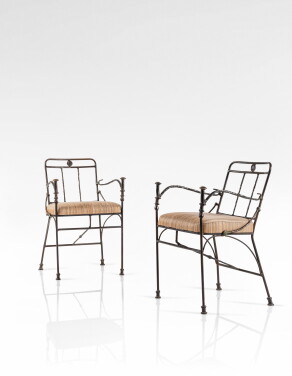
As this remarkable collection is dispersed, the presence of François Rochas’ mother, who passed away in 2011, remains perceptible throughout. Her legacy is reflected in works such as the Diego Giacometti seats, formerly in her New York apartment. Carole Rochas shared Hélène’s admiration for the sculptor, whose poetic furniture so often came alive with animals, and delighted in visiting him in his studio. Together, François and Carole acquired additional Têtes de lionnes armchairs as well as a console, a variant of the Hommage à Böcklin model. Also included are two drawings by Balthus, gifts from Hélène Rochas to her son, which will recall to those fortunate enough to have visited her home on Rue Barbet-de-Jouy the magnificent painting by the artist that once hung there.
Perhaps the most intimate work of all is André Levasseur’s 1965 gouache depicting the façade of La Grande Cascade. At first glance, its subject may seem anecdotal, were it not for the fact that this celebrated restaurant in the Bois de Boulogne hosted one of the most legendary balls of the 1960s: the lavish fête organised by Hélène Rochas to celebrate the release of My Fair Lady. Its success was such that Prince Rainier of Monaco invited her to organise the following year’s Second Empire Ball for the centenary of Monte-Carlo. Long before Marie-Hélène de Rothschild’s celebrated Proust Ball and Surrealist Ball, Hélène Rochas, who had assumed control of the company after the death of her husband in 1955, not only multiplied the profits of the Rochas perfume house but had also become one of the undisputed arbiters of Parisian society. Her beauty, elegance, and impeccable taste were universally admired. In the collection now offered by her son, one can still sense their lingering fragrance.
Eric Jansen
Read LessAuction Highlights
The works in this collection eloquently embody the singular vision of Diego Giacometti, whose furniture invariably transcends its functional purpose to become an expression of poetic imagination. Whether the Pommeaux de Canne armchairs, their exceptionally rare Têtes de Lionnes variant, or the Hommage à Böcklin console, each reveals the artist's extraordinary ability to combine formal restraint with profound sculptural sensitivity.
Entirely modelled by hand, each bronze preserves the subtle irregularities of the artist’s touch, while its richly nuanced patina enlivens the surface with delicate modulations of light. This interplay between architectural clarity and the vitality of the material lends Giacometti’s furniture its unmistakable presence, where elegance arises as much from the harmony of its proportions as from the life breathed into the bronze.
Diego Giacometti’s work is equally inseparable from the close relationships he cultivated with his collectors. He readily conceived highly personal commissions inspired by their character or private universe, as illustrated by the Têtes de Lionnes armchairs, originally created for Madame Henriette Vronsky-Asch in reference to her zodiac sign, and the Hommage à Böcklin console, executed in a unique version for François and Carole Rochas. Far from serving as mere decorative motifs, animals, trees and artistic allusions become the protagonists of an intimate narrative in which memory, symbolism and imagination are seamlessly intertwined.
Drawing upon sources as diverse as Classical Antiquity and the Symbolist vision of Arnold Böcklin, yet never yielding to literal illustration, Diego Giacometti transforms furniture into a poetic landscape. Owls, cypress trees, lionesses and simple spheres all belong to a unified visual vocabulary in which suggestion takes precedence over description. Suspended between sculpture and functional design, his work achieves a rare sense of balance, endowing each creation with a quiet yet compelling presence—at once timeless and deeply personal.
With Animal tournant, a unique piece created in 1928, Gustave Miklos presents a sculpture that is both powerful and enigmatic. Drawing inspiration from his study of Mesopotamian sculpture, he simplifies the volumes, geometrises the forms and enlivens the surface of the bronze with engraved ornamentation.
Presented at the solo exhibition held at the Galerie La Renaissance in Paris in 1928, Animal tournant can be linked to two other sculptures in the exhibition: Animal (1926) and Chien (1928). They belong to this fantastical bestiary, which directly extends the research carried out for Jacques Doucet with Bêtes affrontées (1925).
Animal tournant was acquired by Jacques André, a collector and patron of Miklos. A loyal supporter of the artist, he assembled a remarkable collection of works and made a lasting contribution to the recognition of his work.
When Art Deco was rediscovered in the 1970s, Animal tournant emerged as one of the artist’s masterpieces. Presented in 1972 at the L’Enseigne du Cerceau gallery as part of a major solo exhibition, it was selected three years later to feature in the major exhibition at the Musée des Arts décoratifs in Paris celebrating the fiftieth anniversary of the 1925 International Exhibition, thereby cementing its place amongst the major works of Art Deco sculpture.
Animal tournant was successively acquired by several of France’s most prestigious collections. It first became part of Michel Périnet’s collection, where it stood alongside works of African art, Art Deco and modern painting. It then joined the equally renowned collection of Hélène Rochas, before finding its place at the heart of the “bestaire rêvé” assembled by her son, François Rochas.
A leading figure in 20th-century animal sculpture, Édouard Marcel Sandoz (1881–1971), the Swiss-born artist trained in Paris, made the animal kingdom the central subject of his artistic practice. A pioneering and multidisciplinary artist, Sandoz distinguished himself through his remarkable ability to capture the distinctive character of each of his subjects. From close naturalistic observation to a stylization of striking modernity, his oeuvre reflects a constant exploration of form, material, and the expressive possibilities of patina.
Assembled over many years by François Rochas, the seven sculptures in his collection form a remarkably coherent bestiary, spanning nearly three decades of artistic production. From Sandoz’s earliest decorative experiments to the refined naturalism of the 1930s, the ensemble offers a particularly representative overview of the artist’s work.
Beginning in 1908, Sandoz abandoned the human figure to devote himself almost exclusively to animal sculpture. Rejecting theatrical effects, he favoured the patient and meticulous observation of his models. Following in the footsteps of François Pompon, he simplified volumes and distilled forms into a highly original sculptural language while maintaining a distinctly personal artistic identity. This evolution was already evident in the Condor (1911) and the Raven (Corbeau, 1912), from which the bronzes in the present collection were cast. Exhibited in marble at the Salon of the Société des Artistes Décorateurs in 1912, these works reveal a new conception of sculpture, in which the layering of planes and the purity of the silhouettes endow the compositions with exceptional decorative power and a compelling sense of movement.
The marine world also occupies a central place in Sandoz’s oeuvre. Thanks to his extraordinary mastery of bronze casting and patination—developing his own formulas by enriching his alloys with copper, iron, or gold—he achieved surface effects of unprecedented richness and subtlety. The Macrurus Dressé, poised delicately on its fins, the Poisson rouge (Cyprin bouche ouverte), and the spectacular Cacatoès décoratif all testify as much to his technical virtuosity as to his remarkable sense of composition. From the 1930s onwards, his style evolved towards a strikingly precise naturalism, exemplified by Lady Macdougall, a portrait of a Scottish Terrier first exhibited at the Salon of the Société Nationale des Beaux-Arts in 1933, and by the Carpe plongeante (1934), whose dynamic movement creates the illusion of a living fish emerging from the water.
With a discerning eye for rarity and quality, François Rochas assembled a collection that reflects both the stylistic evolution of Édouard Marcel Sandoz and the refined taste of a passionate and knowledgeable collector.