Property from the Sze Tak Tong Collection | 世德堂珍藏
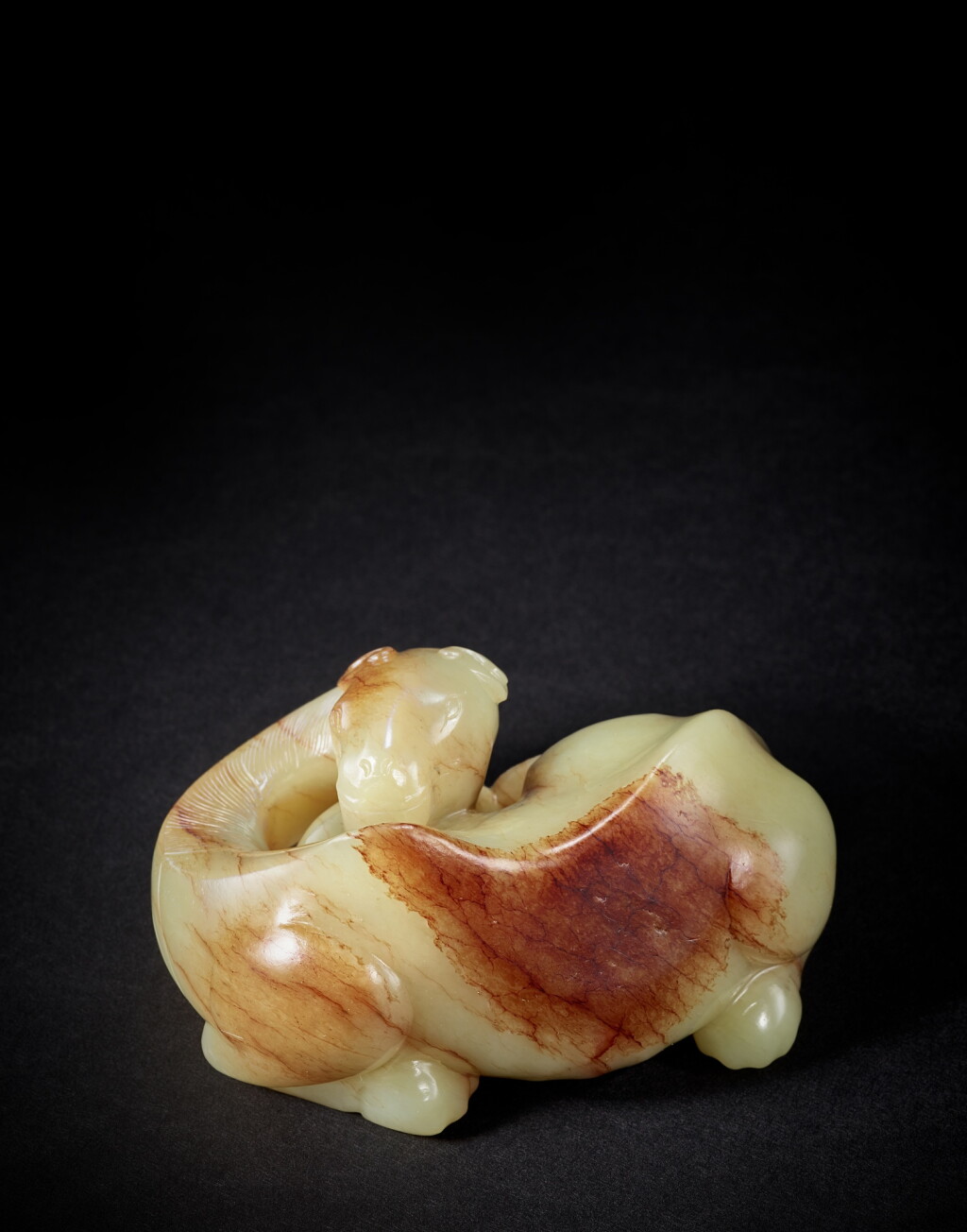
A superb and large yellow jade figure of a camel, Tang – Song dynasty | 唐至宋 黃玉駱駝
Premium Lot
Auction Closed
May 5, 01:09 PM GMT
Estimate
12,000,000 - 25,000,000 HKD
Lot Details
Description
wood stand
10.3 cm
Trio Pearl Co., Ltd, Hong Kong, 14th December 1976 (HKD 110,000).
Chinese Jade Carving, Hong Kong Museum of Art, Hong Kong, 1983, cat. no. 128.
This superbly rendered figure of a camel is an exceptionally rare and fine example of jade carvings for its unusual subject matter, exceptional size and superb material. A relatively rare motif in jades, camels are traditionally associated with the prime periods of activity on the overland Silk Routes during and just before the Tang dynasty (618-907). They are more commonly portrayed in ceramic as majestic figures carrying foreigners or loaded with precious goods. They were therefore naturally associated with the exotic and with luxury, thus conferring status and wealth to their owners.
See a white jade recumbent camel (accession no. gu-yu-5668) from the Han dynasty (206BC-AD220), preserved in the Taipei Palace Museum, probably one of the oldest published examples of this motif, included in the Museum’s exhibition Art in Quest of Heaven and Truth. A Guide to Chinese Jades Through the Ages, Taipei, 2011, p. 78, fig. 5-4-12. Incised on the underside of this Taipei carving is an imperial poem composed by the Qianlong Emperor (1736-95), demonstrating not only the keen art collector’s appreciation for the unusual piece centuries after it was created, but also his imagination of camels accompanying one of the Four Beauties of ancient China, Wang Zhaojun (b. c.50BC), who had to cross the desert to marry a nomadic tribe ruler.
The coiled position of the animal seen here appears to be known from earlier jade animal figures. Compare a model of a feline from the Han dynasty, similarly depicted, with minimal adornment, illustrated in Jessica Rawson, Chinese Jade from the Neolithic to the Qing, British Museum, London, 1995, pl. 26:4.
A similar coiled camel figure (9.8 cm) in the collection of the Victoria and Albert Museum, London, was included in the Oriental Ceramic Society exhibition Chinese Jade throughout the Ages, Victoria and Albert Museum, London, 1975, cat. no. 201, together with a larger example from the collection of Dr Paul Singer, cat. no. 202, both attributed to the Tang dynasty. Another smaller example (6 cm) formerly from the collection of Stephen Junkunc, III (d. 1978), was sold in our New York rooms, 10th September 2019, lot 205. Compare also a jade camel figure with its legs tucked under its body, included in the Oriental Ceramic Society exhibition, op. cit., cat. no. 258, from the collection of Mr and Mrs Richard C. Bull, sold in our New York rooms, 6th December 1983, lot 212.
Three other jade camels, recumbent, but in different positions were included in the exhibition Chinese Jades from Han to Ch’ing, The Asia House Gallery, New York, 1980, cat. no. 40, from the Brian McElney Collection, attributed to the Tang dynasty or earlier, cat. no. 41 from the collection of Victor Shaw and cat. no. 42 from the Guan-fu Collection, the latter two attributed to the tenth century. See also three jade camels in the Seattle Art Museum, illustrated in James C. Y. Watt, Chinese Jades from the Collection of the Seattle Art Museum, Seattle, 1989, nos 32a-c, Six Dynasties to Tang, Tang or earlier and Tang to Ming dynasty respectively attributed, and a large Ming dynasty (16.7 cm) example, sold in these rooms, 29th April 2022, lot 3622, from the De An Tang collection.
來源
屈利華珠寶有限公司,香港,1976年12月14日(港元110,000)
展覽
《中國玉雕》,香港藝術館,香港,1983年,編號128
黃玉駱駝雕工靈動,玉質潤澤,尺寸碩大,甚是珍稀。駱駝亦是少見題材,唐代以前,蓬勃發展的絲路文化傳統相關,常見作為陶俑,搭配胡人,或押運異國珍稀商品。駱駝因此有異域、奢侈品等含意,並象徵其主人之財富與地位。
台北故宮藏一件漢代白玉駱駝(館藏編號:故玉5668),或為著錄中年代最早的駱駝玉雕之一,展出於《敬天格物:院藏玉器精華展》,台北,2011年,頁78,圖5-4-12,此例銘有乾隆皇帝御題詩,不僅表現帝王慕古之情,亦展現其詩興,想像駱駝陪伴四美之一王昭君(西元前50年)出塞和親。
此玉駱駝之盤曲造型,早見於先前之玉雕動物形象。可參考一件漢代貓科動物玉雕模型,其表現手法相近,裝飾極為簡約。相關圖例見傑西卡・羅森(Jessica Rawson)著,《Chinese Jade from the Neolithic to the Qing》,倫敦:大英博物館,1995年,圖版26:4。
倫敦維多利亞與艾伯特博物館亦存一造型相仿例(9.8 公分),展於東方陶瓷學會,《Chinese Jade throughout the Ages》,維多利亞與艾伯特博物館,倫敦,1975年,編號201,同錄一稍大例,出自 Paul Singer 醫生收藏,編號202,此二例均應屬唐物。另比一唐玉雕,尺寸略小(9.8 公分),出自史蒂芬・瓊肯三世(1978年卒)舊藏,售於紐約蘇富比2019年9月10日,編號205。
Richard C. Bull伉儷亦藏一駱駝玉雕例,四肢收於身下,圖載東方陶瓷學會展覽圖錄,上述出處,編號258,後售於紐約蘇富比1983年12月6日,編號212。
另見三類例,臥姿各異,展於《Chinese Jades from Han to Ch’ing》,The Asia House Gallery,紐約,1980年,編號40-42,其一為Brian McElney舊藏,斷代唐或以前;其二、三均斷代十世紀,分別為邵維錫寶蓄及Guan-fu收藏。此外,西雅圖藝術博物館亦存六朝至唐、唐或更早及唐至明玉駱駝實例,分別錄於屈志仁,《Chinese Jades from the Collection of the Seattle Art Museum》,西雅圖,1989年,編號 32a-c。
You May Also Like