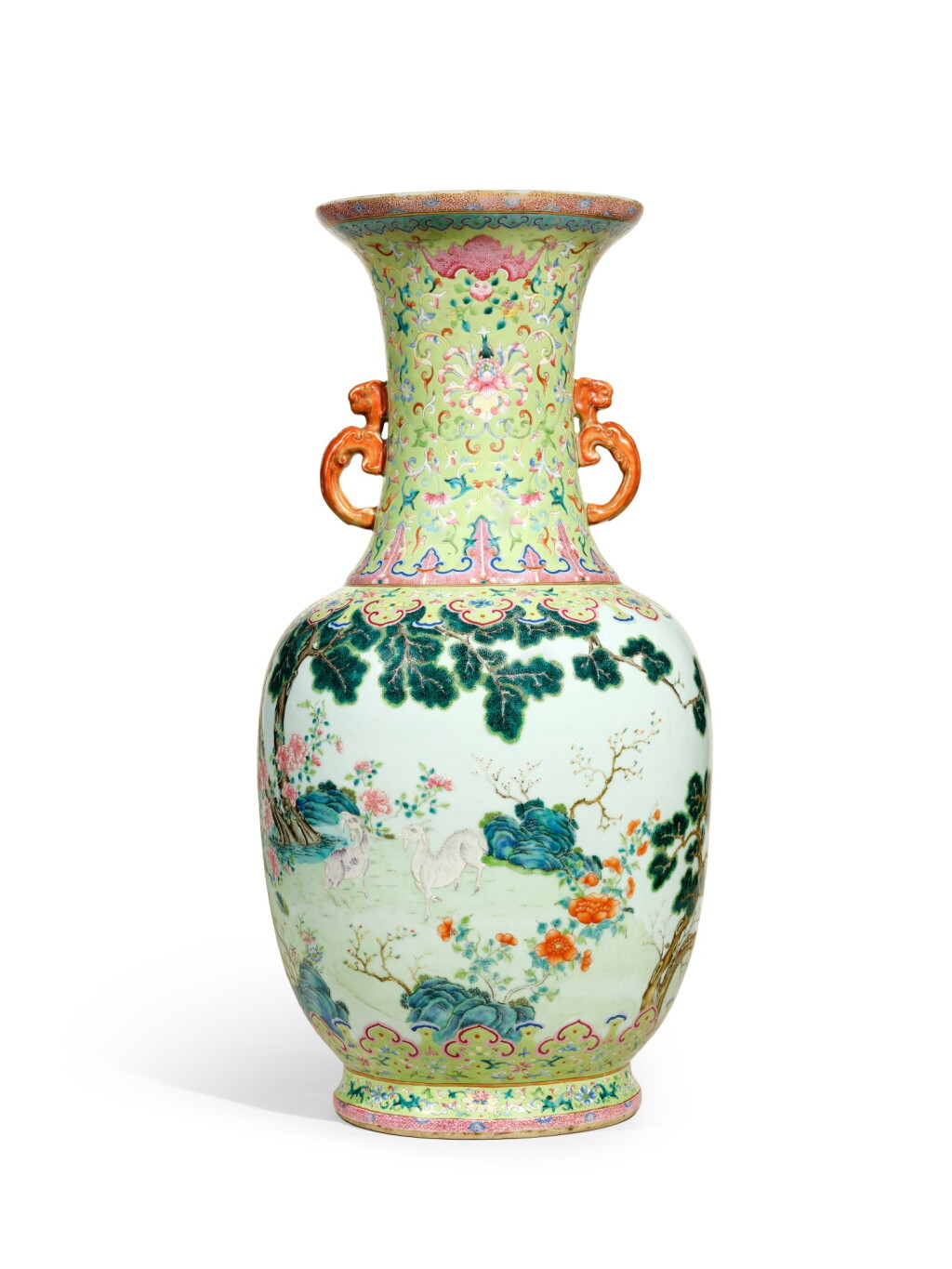
A massive lime-green ground famille-rose ‘three rams’ vase, Shende Tang hall mark, Qing dynasty, Daoguang period | 清道光 綠地粉彩通景三羊開泰雙螭耳大瓶 《慎德堂製》款
Auction Closed
May 5, 01:09 PM GMT
Estimate
1,000,000 - 2,000,000 HKD
Lot Details
Description
71 cm
A British private collection.
Sotheby's London, 11th May 2011, lot 283.
This remarkably large vase belongs to a special group of imperial porcelains made during the Daoguang reign to furnish the emperor's newly built 'Hall of Prudent Virtue' (Shende Tang). Vessels of such imposing dimensions testify to the technological prowess of the potters active at the imperial kilns in Jingdezhen and showcase the opulence preferred at the imperial court.
Part of the Jiuzhouqingyan complex in the Yuanming Yuan, the Shende Tang was completed in 1831 and became the Emperor’s preferred residence until his death there in 1850. Featuring three connecting wave roofs on a square-shaped structure, the hall was markedly different from the more characteristic Confucian-inspired architecture, a feature that was reflected in the style of porcelain that was produced for it. Porcelains bearing Shende Tang marks such as this vase, are often decorated in brilliant coloured enamels against rich colour grounds, a style pioneered by the Qianlong emperor (r. 1736-1795) and inspired by paintings mounted on silk. Stacey Pierson notes that no less than 30 types of imperial Shende Tang porcelains are extant in public and private collections, mostly in the shape of bowls, dishes and vases, see Stacey Pierson, Rare Marks on Chinese Ceramics, London, 1998, p. 36.
This vase is painted with the 'Three Rams (san yang)' design that represents a change of fortune with the arrival of Spring and the New Year and is thus closely associated with New Year celebrations. The three rams are often shown together with the rising sun (taiyang) to form the rebus for 'three ram (yang) bring prosperity'. The Book of Changes (Yijing) first mentions the phrase san yang referring to the three male lines, called tai – the symbol of heaven. Tai is positioned under three female lines called kun that represent earth. Hence the phrase 'sanyang kaitai' which means the New Year brings renewal and a change in fortune.
Vases of such large dimensions and painted with this motif are rare, and no other closely related example appears to have been published. Compare a slightly smaller vase painted with this motif also inscribed with a Shende Tang mark, but with a more globular body, sold in our New York rooms, 4th December 1985, lot 283; and a much smaller vase with a Daoguang mark and of the period, sold in our Hong Kong rooms, 11th April 2008, lot 3025.
Compare also a Guangxu period example with Shende Tang mark, of smaller dimensions, from the Qing court collection, now in the Beijing Palace Museum, Beijing, illustrated in Porcelains with Shende Tang Marks in the Palace Museum Collection, Beijing, 2014, pl. 78.
來源
英國私人收藏
倫敦蘇富比2011年5月11日,編號283
本瓶編制龐大,出自一組道光年製、作為慎德堂陳設御瓷,如此龐大之器,反映景德鎮御窰瓷匠絕技,彰顯宮廷華麗氣派。
慎德堂,圓明園後湖「九洲清晏」島上,道光十一年(即1831年)落成,道光皇帝喜愛之寢宮,道光三十年皇帝駕崩於此。慎德堂屋頂起伏如波浪,堂呈正方形,建築風格有別於儒家風格之殿堂樓閣,如此特色,亦見於為該堂特製之瓷器。 如本瓶般帶《慎德堂製》款之瓷器,多屬色彩豔麗者,釉上彩與釉下色地呈強烈對比,此乃乾隆年間首創風尚,取靈感自裝裱於絲絹之書畫之上。Stacey Pierson論述,現存慎德堂瓷器僅有少於30款,主要為盌、盤及瓶類,屬於博物館及私人收藏(Stacey Pierson,《Rare Marks on Chinese Ceramics》,倫敦,1998,頁36)。
三羊開泰紋飾,多喻新春到臨,羊與陽諧音,寄曉日初昇意境,《易經》記載,正月為泰卦,乾上坤下,卦象由三陽爻三陰爻組成,三陽生於下,冬去春來,陰消陽長,意象吉祥。
如此尺寸龐大之三羊開泰紋飾瓷器甚為珍罕,本瓶疑為孤例。比較一瓶,尺寸較小,帶慎德堂款,瓶腹更渾圓,售於紐約蘇富比1985年12月4日,編號283;另比一例,尺寸遠較本品為小,售於香港蘇富比2008年4月11日,編號3025。
再比一例,斷代光緒,帶慎德堂款,尺寸較小,清宮舊藏,現存於北京,圖載於《故宮博物院藏慎德堂款瓷器》,北京,2014年,圖版78。
You May Also Like