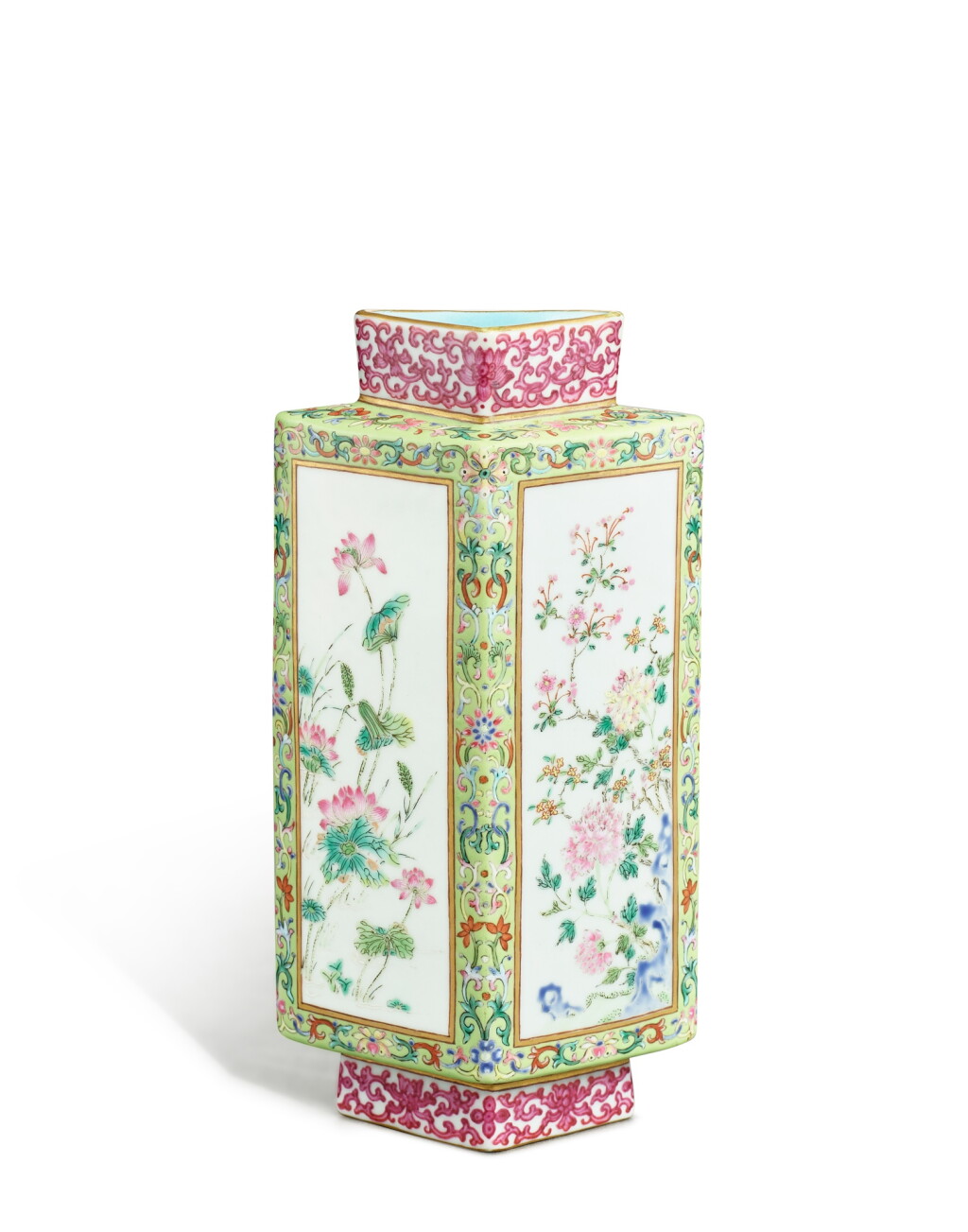
A lime-green-ground famille-rose facetted wall vase, Seal mark and period of Jiaqing | 清嘉慶 綠地粉彩開光花卉紋轎瓶 《大清嘉慶年製》款
Auction Closed
May 5, 01:09 PM GMT
Estimate
150,000 - 300,000 HKD
Lot Details
Description
19.1 cm
Wall vases of the Jiaqing period were produced in an array of shapes and designs; see one of ovoid form, similarly painted with floral cartouches against a green ground, sold at Christie’s London, 22nd July 1981, lot 198; and one of rectangular section with a turquoise ground, in the Capital Museum, Beijing, illustrated in The Complete Works of Chinese Ceramics, vol. 15, Shanghai, 2000, pl. 130. Compare also a Qianlong mark and period wall vase painted with floral cartouches, in the Huaihaitang collection, included in the exhibition Ethereal Elegance. Porcelain Vases of the Imperial Qing, Art Museum, The Chinese University of Hong Kong, Hong Kong, 2007, cat. no. 130, together with another pair, cat. no. 132.
Wall vases first appeared in the Ming dynasty, although their popularity increased dramatically in the eighteenth century when they were made in a variety of media. Flattened at the back as through cut in half and often made in pairs, these vases were commonly hung inside sedan chairs, as depicted in the hand scroll An Ice Game by Jin Kun, Cheng Zhidao and Fu Longan, in the Palace Museum, Beijing, illustrated in The Complete Collection of Treasures of the Palace Museum. Paintings by the Court Artists of the Qing Court, Hong Kong, 1996, pl. 61.
嘉慶時期的壁瓶造型與紋飾極為豐富,建一件橢圓形壁瓶,同樣於綠地上繪花卉開光,售於倫敦佳士得,1981 年 7 月 22 日,編號198 ;一件長方截面、施松石綠地的壁瓶,藏於北京首都博物館,見《中國陶瓷全集》,第 15 卷,上海,2000 年,圖版 130。另可比較一件乾隆本朝燒造、帶乾隆款識且繪花卉開光的壁瓶,屬懷海堂收藏,曾展於香港中文大學文物館 2007 年舉辦的《機暇清賞》展覽,編號 130;同場亦展出一對同類壁瓶,編號 132。
壁瓶雖最早見於明代,但其真正風行是在十八世紀,材質亦趨多樣。此類器物背部被削平,宛如從中剖開,常成對製作。其經典用途是懸掛於轎內作為裝飾,此場景可見於北京故宮博物院藏、清宮畫家金昆、程志道與福隆安合繪的《冰嬉圖》手卷,載於《故宮博物院藏清宮繪畫》等出版物,畫中清晰描繪了轎內懸掛的壁瓶。
You May Also Like