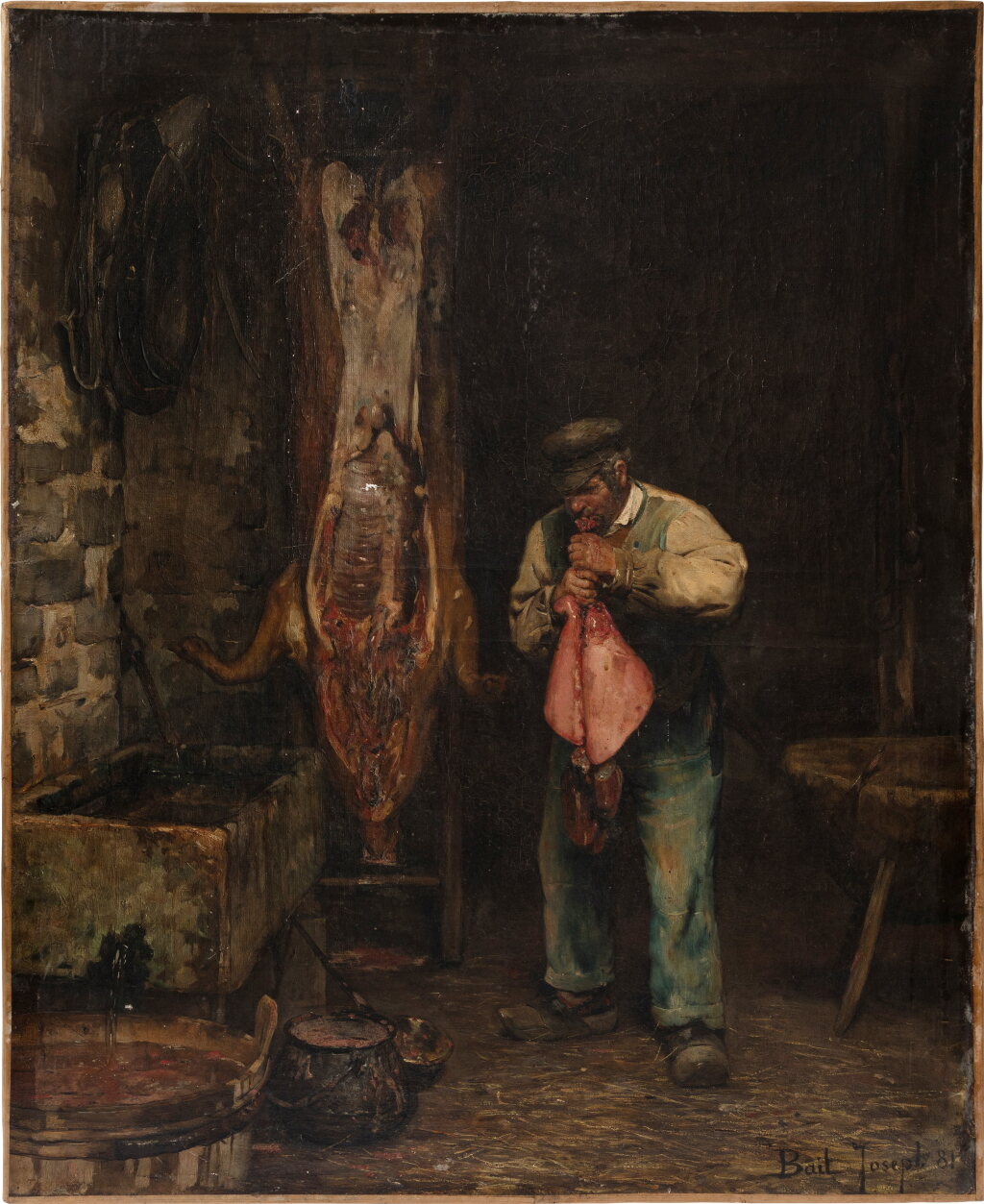
Joseph Bail
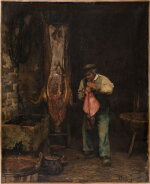
The Butcher
Estimate
4,000 - 6,000 EUR
We may charge or debit your saved payment method subject to the terms set out in our Conditions of Business for Buyers.
Read more.Lot Details
Description
Joseph Bail
Limonest 1862 - 1921 Paris
The Butcher
Oil on canvas
Signed and dated on the lower right Bail Joseph 81
100 x 81 cm ; 39⅜ by 31⅞ in.
Joseph Bail received his early training from his father, Antoine Jean Bail (1830–1919), a specialist in genre painting, before studying in the studio of Jean-Léon Gérôme and then in that of Carolus Duran. As early as 1878, he began painting his first still lifes and exhibited these works at the Salon the following year. His Bibelots de Cluny (Musée d’Orsay, Paris, inv. RF 466) won a medal of honor in 1886, followed by his famous Marmiton (Musée de l’Échevinage, Saintes, inv. 1895.3.1B) in 1887. He drew inspiration from 17th-century Dutch genre painting, as well as from his realist contemporaries such as Théodule Ribot and Antoine Vollon, and from his study of the works of Jean Siméon Chardin. Bail was an intimist painter; he enjoyed playing with contrasts and light to better bring out the texture of objects or the atmosphere of interiors.
Here, the man is performing a traditional technique: he is blowing into the lungs of the slaughtered animal. This action, which may seem surprising, served to check whether the organ was airtight—and thus to verify the animal’s health—but also to make it look more presentable on the market stall. Bail thus offers an extremely accurate depiction of the realities of a butcher’s work in his time. The animal’s carcass is reminiscent of the treatment of Rembrandt’s Slaughtered Ox, which the artist likely had the opportunity to study at the Louvre (inv. MI 169).
You May Also Like