Collection of the Rochechouart de Mortemart Family
Workshop of Hyacinthe Rigaud
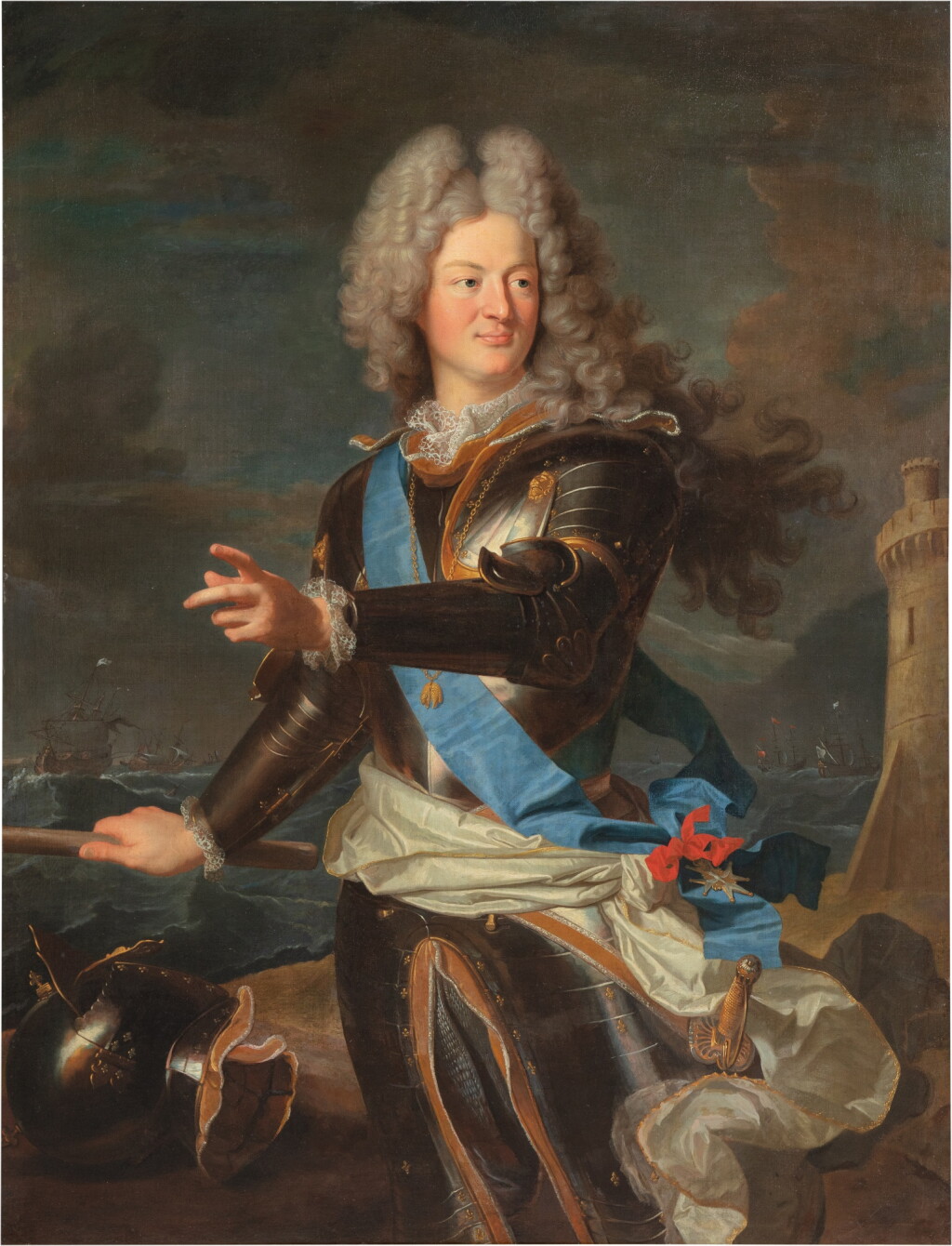
Portrait of Louis Alexandre de Bourbon, Count of Toulouse (1678-1737)
Auction Closed
June 9, 01:57 PM GMT
Estimate
30,000 - 50,000 EUR
Lot Details
Description
Collection of the Rochechouart de Mortemart Family
Workshop of Hyacinthe Rigaud
Perpignan 1659 - 1743 Paris
Portrait of Louis Alexandre de Bourbon, Count of Toulouse (1678-1737)
Oil on canvas
136 x 105,1 cm ; 53½ by 41⅜ in.
Collection of the Rochechouart de Mortemart Family since the 18th Century;
Thence by descent.
In his autobiographical missives to the Grand Duke of Tuscany, Hyacinthe Rigaud describes the portrait of the Comte de Toulouse painted in 1708 as follows: ‘That same year, 1708, he [Rigaud] began the portrait of Monsieur le Comte de Toulouse, son of the King and Grand Admiral of France. This portrait is on a canvas five pieds tall; in the background there is a stormy sea view’ (see H. Van Hulst, ‘Abrégé de la Vie de Hyacinthe Rigaud, daté de 1716’, in Mémoires inédits sur la vie et les ouvrages des membres de l’Académie royale de peinture et de sculpture, Paris, 1854, vol. II, p. 120). A very similar description also appears in the commentary by H. van Hulst on the engraving by P. Drevet, which he claims is inspired ‘by a painting in which the figure is knee-length, with a marine background, whereas here there is a fragment of landscape […]’ (see H. Van Hulst, ‘Ensemble de textes comprenant une vie de M. Rigaud […]’, op. cit., vol. II, p. 151).
This painting is the second portrait of Louis-Alexandre de Bourbon by Rigaud to appear in the artist’s account books, after the one he painted in 1690 when the sitter was only twelve. Although the original canvas is now lost (see A. James-Sarazin, Hyacinthe Rigaud 1659-1743, Dijon, 2016, vol. II, pp. 353–354, cat. no. * P. 1042), there are several copies in museums or hidden away in private collections. Some of these replicas – repeating the whole composition or in truncated variants – were certainly commissioned directly from Rigaud’s workshop, enabling the dissemination of the image of one of the most important figures in the courts of Louis XIV and later Louis XV. Particularly well known for his portraits whose likenesses were so perfect that they were disconcerting, Rigaud developed a client base among the European aristocracy and the Bourbon dynasty, portraying nearly four generations.
Last of the children born out of wedlock to King Louis XIV and his mistress Madame de Montespan, Louis-Alexandre de Bourbon was legitimized and made Comte de Toulouse in 1681. He was then named Duc de Penthièvre in 1697 and later Duc de Rambouillet en 1711. In 1684, upon the death of his half-brother Louis de Bourbon, he was made Admiral of France when he was only five years old. This high-profile political and military role, given to a child, was part of a strategy to legitimize the illegitimate children of the King: by strategically giving them a position at the heart of the State and the armed forces, they remained in the service of the royal line, strengthening the sovereign’s control (see P. Le Bot, ‘La charge d’un prince. Louis-Alexandre de Bourbon, comte de Toulouse, amiral de France (1683-1737)’, in Bulletin du Centre de recherche du château de Versailles [online], 28 | 2026, uploaded 26 March 2026, accessed 05 May 2026, §5-6). For eight years, he also attended the Regency Council, oversaw the Council of Marine and often contributed to the Royal Council for Finances. As Grand Admiral of France, he was well-regarded, playing a particularly illustrious part in the Spanish Wars of Succession.
Rigaud took great care to adapt the background and accessories in a portrait so that they would convey the status and role of the sitter to best effect. The figure of the Comte de Toulouse here stands out vividly against a marine background with a sky darkened by stormy clouds, while behind him ships pitch dangerously in the rough sea. The tower on his left is imaginary and appears identically in the Portrait of Frederik Walter dated 1702. Louis-Alexandre stands in armour, his helmet resting on a rock. His left arm is raised, as he points with his forefinger at something invisible to the viewer, while his right hand holds the baton of command firmly. He wears the ribbon of the Order of the Holy Spirit as a sash – he received the Order in 1693 – while the insignia of the Toison d’Or is attached to his breastplate. He received this Order in 1704, after his military successes in Malaga, where he succeeded, while leading his squadron, in defeating an Anglo-Dutch fleet.
In the context of the retrospective exhibition organized by the Musée de Caen, C. Marcheteau de Quinçay recently demonstrated that the artist was probably inspired by the Portrait of Henry de Berghe painted by Van Dyck in about 1630. It is easy to recognize the left-facing gaze, the very similar position of the hands and the decision to portray the model in armour, in the act of performing his duties. These portraits thus project the image of powerful and charismatic military leaders.
You May Also Like