Simon Luttichuys
Still life with a tazza
Auction Closed
June 9, 01:57 PM GMT
Estimate
30,000 - 50,000 EUR
Lot Details
Description
Simon Luttichuys
London 1610 - 1661 Amsterdam
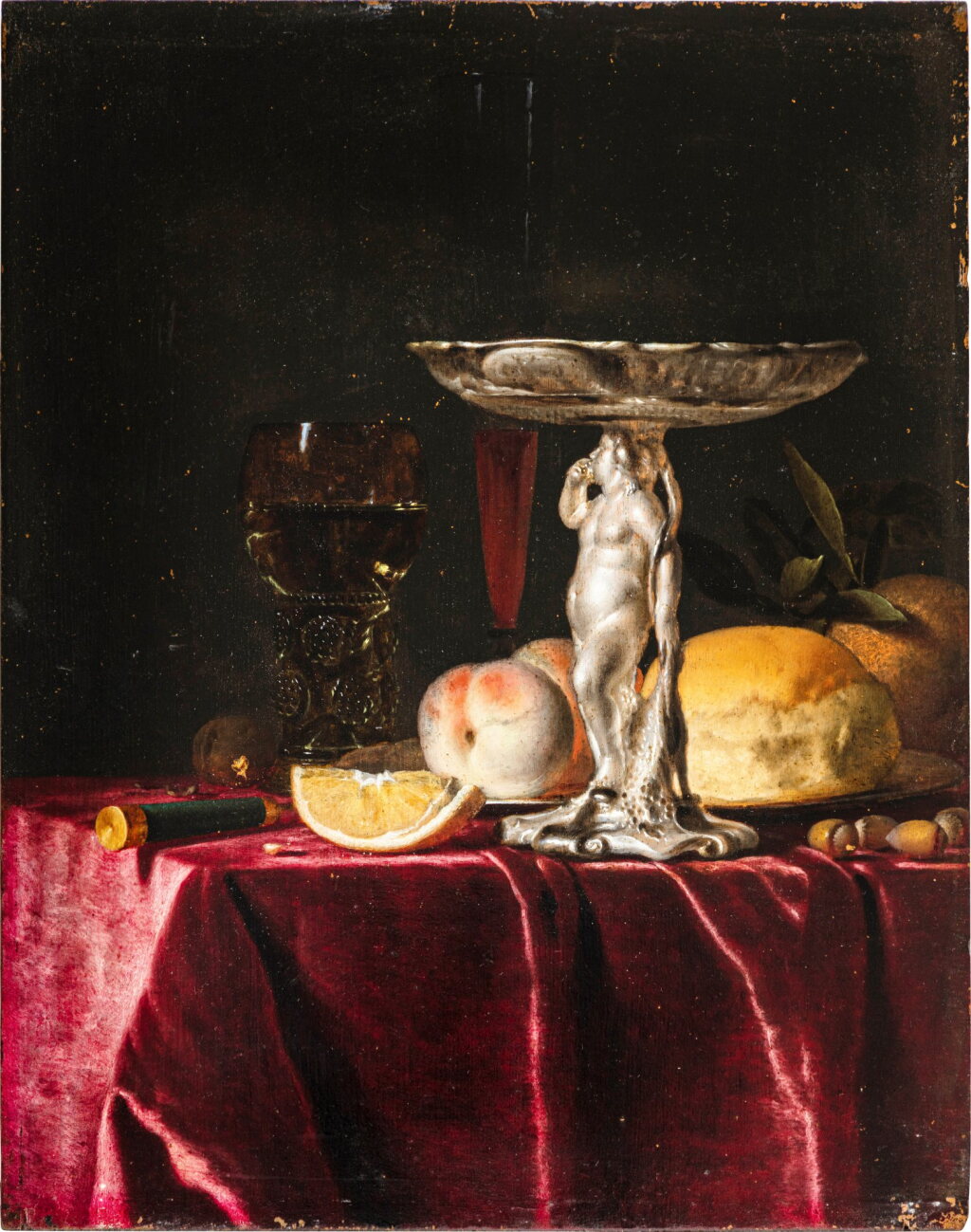
Still life with a tazza
Oil on panel
47,5 x 37 cm ; 18¾ by 14⅝ in.
We are grateful to Dr. Fred G. Meijer, who endorsed the authentication of this painting based on photographs.
This exquisite Still life with a rummer and a silver tazza is a rediscovery that adds to the corpus of works by Simon Luttichuys. In the same private collection for several generations, it has been reattributed to the artist by Dr Fred G. Meijer, who suggests a date of about 1655 to 1660.
Simon Luttichuys was born in England into a Flemish family. He went to join his brother Isaack in Amsterdam in 1649, and they both remained there for the rest of their lives. Simon worked as a painter of vanitas and still lifes, while Isaack was a portrait painter.
In the present painting, the magnificent silver tazza on a sculpted foot is typical of the auricular style which was fashionable in the mid-seventeenth century. It is particularly close to the work of the Van Vianen brothers, although it seems impossible to identify it precisely. The light from the side gives particular prominence to the curves and delicate facture of this masterpiece of silverware. Further back, the light subtly illuminates a tall glass in the Venetian style, which stands out against the dark background. The cut lemon, the half-empty glass and the fruits set on a rich purple velvet cloth suggest a human presence that brings life to the composition, while remaining invisible to the viewer.
Some of these motifs can be found in other compositions: for example the Still life with a rummer on a silver tray (private collection, Germany, see B. Ebert, Simon und Isaack Luttichuys. Monographie mit kritischem Wewrkverzeichnis, Munich, 2009, p. 392, no. A 51) features the same rummer and glass in the Venetian style, as well as the cut lemon and very similar pieces of bread and peaches, placed at the foot of an impressive piece of silverware.
You May Also Like