Property from a French Private Collection
Pieter Cornelisz. van Slingelandt
A woman holding a partition
Auction Closed
June 9, 01:57 PM GMT
Estimate
20,000 - 30,000 EUR
Lot Details
Description
Property from a French Private Collection
Pieter Cornelisz. van Slingelandt
Leiden 1640 - 1691
A woman holding a partition
Oil on panel
20,4 x 17,8 cm ; 8 by 7 in.
Collection Madame Hoofman, Haarlem, in 1829 and 1842;
Sale, 2 June 1846;
Where acquired by Nieuwenhuys;
Collection Pierard, Valenciennes, in 1855;
His sale, Paris, 20-21 March 1860, lot 74;
Anonymous sale, Me Baudoin, Paris, Galerie Georges Petit, 12 June 1919, lot 19;
Jean Hamburger, Amsterdam / Paris;
Inventoried by ERR (Einsatzstab Reichsleiter Rosenberg) and returned to Jean Hamburger, July 1941 (per Bundesarchiv, Jeu de Paume Inventories, B323/272)
Anonymous sale, Artcurial, Paris, 11 December 2007, lot 508.
J. Smith, A catalogue raisonné of the works of the most eminent Dutch, Flemish, and French painters [...], London 1829, p. 56, no. 27;
J. Smith, A supplement to the catalogue raisonné of the works of the most eminent Dutch, Flemish, and French painters [...], London 1842, no. 28;
C. Hofstede de Groot, A Catalogue raisonné of the works of the most eminent Dutch painters of the seventeenth century, Cambridge 1976, vol. 5, p. 467, no. 165.
Pieter Cornelisz van Slingelandt (1640–1691) was a painter of the Netherlandish Golden Age, known for his genre scenes and portraits. A pupil of Gerrit Dou, he followed him as a member of the group of fijnschilders in Leiden and stood out for the quality and fine detail in his work. A member of the Guild of St Luke in Leiden, he became its doyen shortly before his death.
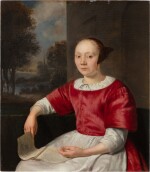
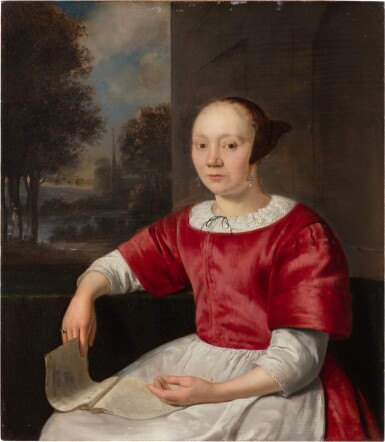
The present portrait, with a vibrant palette, is a good example of the intimate scenes, often in interiors, for which he was renowned. The model, a woman about thirty years old, is seated in three-quarter view by a window, her right arm resting on its sill, gazing out at the viewer. A uniform lighting throws the subject into relief. With her right hand, she lifts the pages of a score resting on her knee, while her left hand simply lies upon it. Her hair is tied back and held in a black velvet cap. She is portrayed knee-length and wearing a scarlet dress, with a lacy chemise visible beneath its sleeves. A white muslin pinafore is tied around her waist. Through the window, on the left of the background, a river landscape can be seen, with a church belltower rising above the vegetation beneath a cloudy sky, while the right side is occupied by an architectural structure.
This small portrait bears witness to the fine detail that made Slingelandt’s name. He has created a smooth pictorial surface, paying particular attention to the modelling of the face and hands. As his contemporaries reported in relation to his Portrait of Frans Gerritsz. Meermanl (1668, Paris, Musée du Louvre, inv. 1840), he sometimes spent many hours working on the detail in his paintings. Here, that characteristic meticulousness is apparent in the rendering of the earrings decorated with pearls, the ring on the little finger of her right hand, the texture of the scarlet dress and the lace of the chemise.
Past sale catalogues for the present portrait indicate that it had a pendant portraying a man in a black suit and brown cloak, whose location is now unknown. Seated at a table, he was holding a letter in his left hand, which rested on a book, while his right hand gestured as if he were speaking. Responding to each other, the two portraits must have been designed to face each other; in the male pendant, the right side of the background was filled with a landscape.
You May Also Like