Property from a Belgian Private Collection
Jean-Guillaume Carlier
Let the little children come to me
Auction Closed
June 9, 01:57 PM GMT
Estimate
100,000 - 150,000 EUR
Lot Details
Description
Property from a Belgian Private Collection
Jean-Guillaume Carlier
Liège 1638 - 1675
Let the little children come to me
Oil on canvas
129,9 (including a probable 20,5 cm addition to the top) x 195,7 cm ; 51⅛ (including the probable 8⅛ in. addition to the top) by 77 in.
Collection of the Burgomaster of Stembier (as per L. Abry, in 1867);
Collection of The dowager Lady de Theux de Montjardin, in 1903;
Private Collection, in 1973 and 1975.
Liege, Musée de l'art wallon, Le siècle de Louis XIV au pays de Liège (1580-1723), September-November 1975, no. 340.
L. Abry, Les hommes illustres de la nation liégeoise, Liege 1867, p. 263;
A. Michiels, Histoire de la peinture flamande, tome X, 1876, pp. 167-168;
J. Helbig, La peinture du pays de Liège, Liege 1903, pp. 280-281 (titled Les portraits de la famille du bourgmestre Guillaume de Stembier);
J. Hendrick, La peinture liégeoise au XVIIe siècle, Gembloux 1973, pp. 47-48;
J. Hendrick, La peinture au pays de Liège. XVIe, XVIIe et XVIIIe siècles, Liège 1987, pp. 163-164 and 269, fig. 142 and 255.
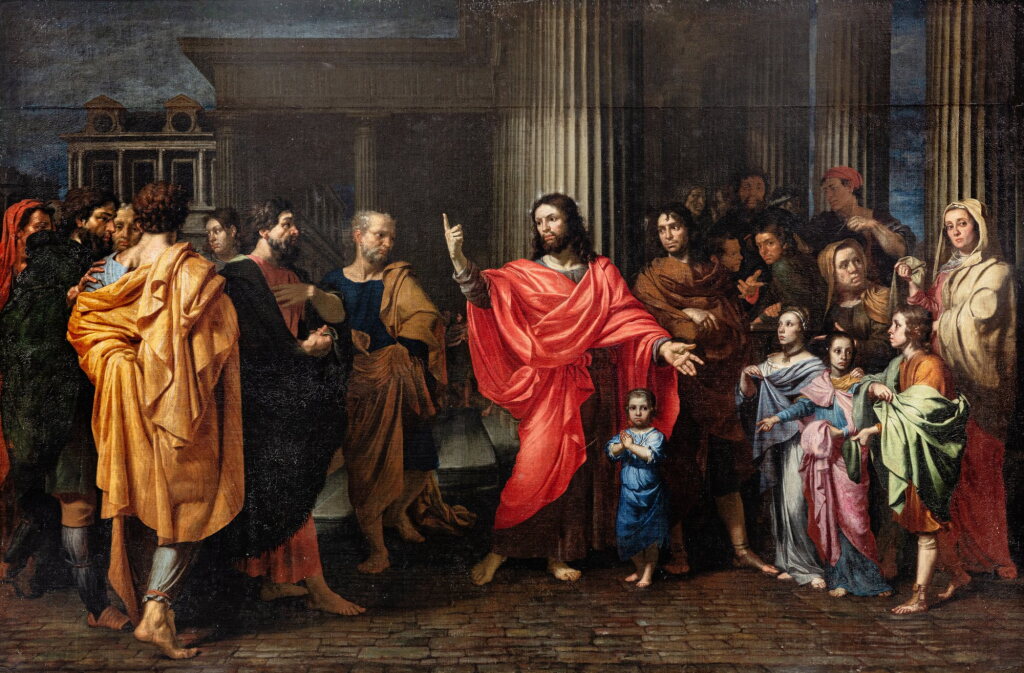
Described by Louis Abry as one of the most beautiful paintings in Liège, placed above the fireplace in the room of the burgomaster de Stembier, this painting is particularly striking for the quality of its composition, its remarkable pictorial mastery and its harmonious colours. Its extended horizontal format seems to confirm that it was intended as an overmantel, as suggested by Abry, probably for the family portrayed on the right, witnessing Christ’s invitation to the children. The fact that the upper part of the canvas has been enlarged along its whole length reinforces this hypothesis: initially conceived as an overdoor or overmantel, the painting was no doubt extended at the time it was taken down so that it could be framed.
Unfortunately, nothing is known about the commission for this work, not even whether it was painted for the de Stembier family. However, Abry describes the painting as Les Portraits de la famille du bourgmestre Guillaume de Stembier (portraits of the family of the burgomaster de Stembier), expressing admiration for this work as a religious history painting as much as a family portrait. According to Abry, it is possible to identify portraits of the father, the mother, three daughters and a son, all members of the de Stembier family. He even suggests that the facade with a balcony, visible in the background, represents the burgomaster’s residence.
Hendrick, on the other hand, sees the man on the left of Christ not as the burgomaster but as a self-portrait of the artist (see J. Hendrick, op. cit., 1973, p. 48), comparing it with the one in the Musée des Beaux-Arts in Liège (inv. AW 0009).
Guillaume Carlier was one of the most important painters active in Liège in the seventeenth century. After a brief but pivotal trip to Rome in 1660, he joined Bertholet Flémal in Liège, at first as his pupil and then as a collaborator on important commissions. In 1670, he also accompanied Flémal to Paris, but soon broke away from his influence and turned to a livelier, less academic style of painting. Above all, he retained what he had learnt from the Caravaggesque painters, whom he had studied while in Italy, and it was this that marked his whole oeuvre: his paintings are characterized by their strong contrasts, dramatic gestures and bright colours, making him Liège’s very own Caravaggesque artist.
His career was unfortunately brought to an end by his premature death in 1675, at the age of thirty-six. Nonetheless, Carlier made a significant contribution to the development of painting in Liège, especially thanks to his masterly rendering of draperies and his talent as a colourist, qualities that are admirably represented in Suffer the little children to come unto me.
You May Also Like