English School, circa 1595
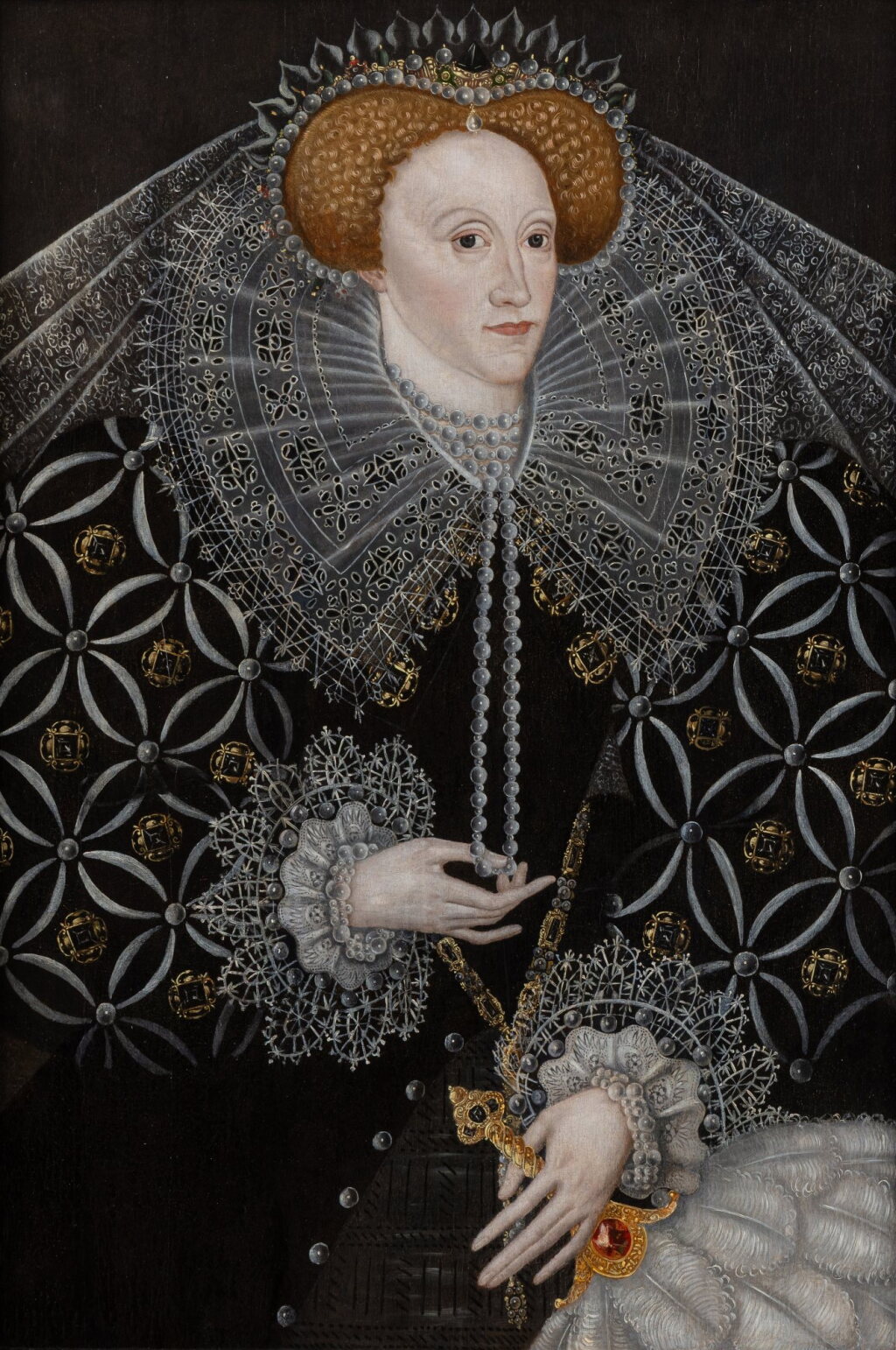
Portrait of Elizabeth I (1533–1603), Queen of England
Estimate
150,000 - 200,000 EUR
Lot Details
Description
English School, circa 1595
Portrait of Elizabeth I (1533–1603), Queen of England
Oil on panel
90 x 63,5 cm ; 35⅜ x 25 in.
Possibly commissioned by Sir Thomas Hesketh (1548–1605) and hung in his gallery in the Great Hall at Heslington Hall, Heslington, North Yorkshire;
Thence by descent to his brother Cuthbert, following which the picture remained in the family until it was inherited by George John Yarburgh (1811–1875), Heslington Hall;
Thence by descent to Stephen Nicholas de Yarburgh-Bateson (1903–1964), 5th Baron Deramore, who lent the picture to Ampleforth Abbey, Ampleforth, North Yorkshire;
From whom acquired at the time of his death by the Abbey;
From whom sold (‘The Property of the Trustees of Ampleforth Abbey’), Sotheby’s, London, 6 July 2011, lot 40, for £193,250;
Where acquired by the present owner.
J.P. Neale, Jones' Views of the Seats, Mansions, Castles, &c. of Noblemen and Gentlemen, in England, Wales, Scotland and Ireland and other Picturesque Scenery…, vol. I, London 1829, p. 46 (as hanging in the Great Hall at Heslington Hall);
R. Strong, Portraits of Elizabeth I, London 1963, p. 83, no. 90.
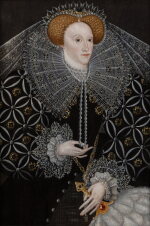
This magnificent portrait of Elizabeth I (1533–1603) dates from circa 1595, towards the end of her tumultuous reign. Born in 1533, she was approximately sixty-two years old at the time, yet she maintained an image of majesty emphasized by her splendid costume. Her dress is decorated with fine jewels, probably diamonds, and her fine lace ruff and veil are surmounted by pearls and further precious adornments. She is holding a string of pearls in her right hand, an attribute conventionally associated with the Queen’s virginity and chastity, and a feather fan in her left hand. Fans were among the luxury gifts presented by courtiers to the Queen at New Year; a fine example was presented to her by the Earl of Leicester at New Year 1573–74. It is significant that the colours shown in the portrait are black and white. As Roy Strong has commented: ‘Black and white were Elizabeth's personal colours and were worn, for example, by her champions in the tiltyard and by dancers in court masques’.1 In Elizabethan portraiture, white was associated with virginity and black with constancy, reinforcing the carefully constructed image of the ‘Virgin Queen’.
For most of Elizabeth's reign, attempts were made by the Crown and its officers to regulate the production of portraits of the monarch, notably in 1563 when a draft proclamation was prepared prohibiting unauthorised likenesses of the Queen until an approved portrait had been made from life. The intention was that this portrait should serve as a pattern from which other painters and engravers could work. 'All sortes of subjectes and people both noble and meane' wanted portraits of the monarch.2 The popularity of Elizabeth’s image meant that once an approved pattern had been established, it could be reproduced repeatedly to satisfy demand. The aim was to project an image of majesty aided by elaborate costumes, jewellery and attributes, what Strong calls 'an impenetrable mask of majesty'.
The most important of these approved patterns was the so-called ‘Darnley’ portrait of circa 1575 in the National Portrait Gallery, London, one of the most important surviving portraits of the Queen, and which became the likeness on which many subsequent portraits were based.3 The portrait was almost certainly painted from life, and the resulting pattern for the Queen’s face was regularly reused for the remainder of her reign. The Darnley pattern provided a means of preserving an idealised likeness across successive decades, while later portraits could elaborate the Queen’s costume and symbolic attributes. This process can be seen to striking effect in the celebrated Armada portraits of circa 1588.4 In the following years every effort was made to control the image of the Queen, leading in 1596 to a proclamation by the Privy Council concerning ‘unseemly’ representations of the Queen, which were to be defaced, and requiring new portraits to be approved by the Queen’s Serjeant Painter.
The present likeness dates from the end of Elizabeth's reign. Strong has linked it to the portrait owned by The Weavers' Company, London, and it belongs to the group of portraits now known as the ‘Weavers’ Company type’ (see Literature). These portraits employ the established Darnley face pattern, here reproduced in reverse, while allowing considerable elaboration in the costume and jewellery.
By the time this portrait was executed, the Queen had aged considerably but clearly still was able to impress with her royal demeanour. A celebrated German lawyer, Paul Hentzner (1558–1623), visited England in 1598 and recorded his impressions of Elizabeth when he visited the royal palace of Greenwich and saw her on a Sunday as she proceeded to chapel: ‘[…] very majestic; her face oblong, fair but wrinkled; her lips narrow […]; she wore false hair and that red […] her hands were small, her fingers long […] her air was stately’.5 The present work suppresses the signs of age described by Hentzner, preserving the established, idealised facial pattern associated with Elizabeth’s official imagery. At the same time, the small eyes, reddish hair, delicate hands and notably long fingers correspond closely to features singled out by Hentzner. The painting thus combines a recognisable physical likeness with an intentionally idealised conception of the ageing Queen, in which elaborate costume, jewels, pearls and the restricted palette of black and white assume as much importance as the features themselves.
Note on Provenance
Heslington Hall was originally built in 1568 by Sir Thomas Eynns (circa 1515–78), Secretary and Keeper of the Seal to the Council of the North. In 1601 the house was acquired by Sir Thomas Hesketh (1548–1605), who was also a member of the Council of the North and Attorney of the Court of the Wards and Liveries. Hesketh created a sumptuous gallery in the Great Hall, which was filled with contemporary portraits, reportedly in anticipation of Queen Elizabeth I visiting her northern dominions, and it is likely that the present portrait hung there as a centrepiece. He was later knighted by the Queen for his services to the Crown in 1603, and following his death in 1605 Heslington was inherited by his brother Cuthbert. The picture remained in the house until it was lent to Ampleforth Abbey by the then owner of the Hall, Lord Deramore.
1 R. Strong, Gloriana, the Portraits of Queen Elizabeth, London 1987, p. 21.
2 Strong 1987, p. 17.
3 Inv. no. NPG 2082; oil on panel, 113 x 78.7 cm.; R. Strong, Tudor & Jacobean Portraits, London 1969, vol. I, pp. 102–103, no. 2082, reproduced vol. II, plates 196–97.
4 Strong 1987, pp. 130–33.
5 P. Hentzner, Paul Hentzner’s Travels in England During the Reign of Queen Elizabeth, London 1797, p. 34.
You May Also Like