A French Private Collection
Théodore Gericault
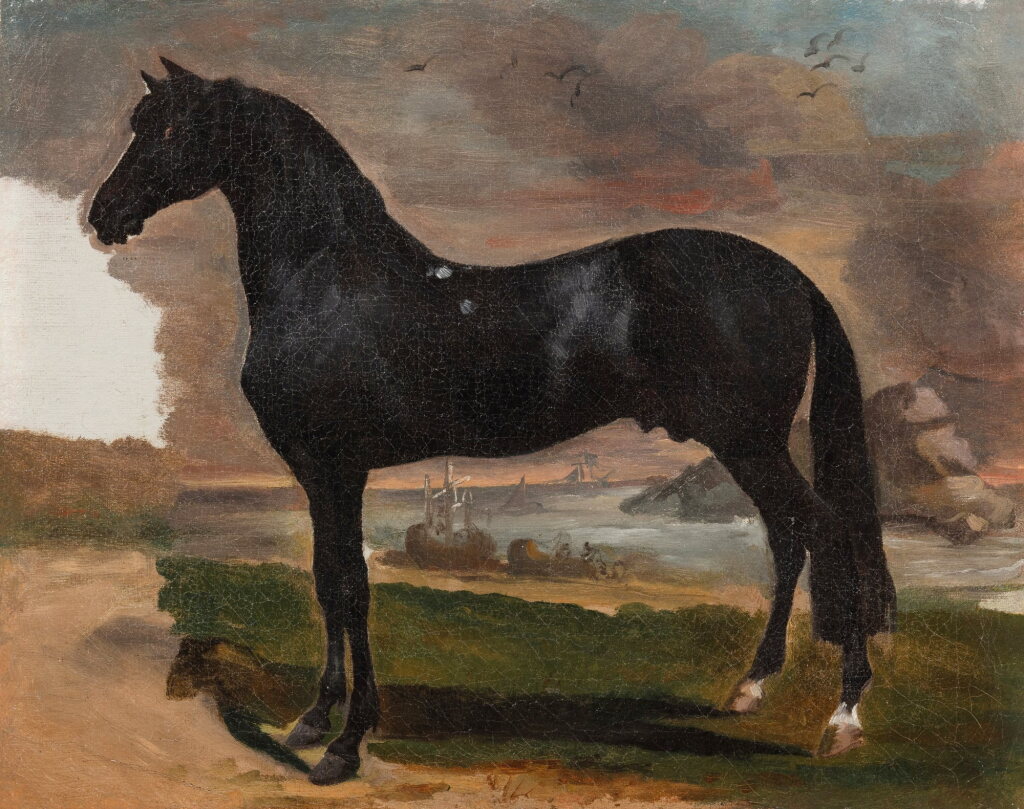
Black Stallion by the Sea
Auction Closed
June 9, 01:57 PM GMT
Estimate
60,000 - 80,000 EUR
Lot Details
Description
A French Private Collection
Théodore Gericault
Rouen 1791 - 1824 Paris
Black Stallion by the Sea
Oil on canvas
34,4 x 44,5 cm ; 13½ by 17½ in.
Charles-François Moulin, called Moulin-Lacrière (1779-1853), Théodore Gericault's cousin, in Vire;
His daughter, Miss Moulin;
Her husband André-Alfred Hardouin;
Miss Simone Hardouin (daughter of André-Alfred Hardouin and Miss Moulin);
From whom, acquired by Jean-Louis Vaneille (called Jean Barbaroux), in the 1960s;
Anonymous sale, Christie, Manson & Woods, London, 27 November 1987, lot 50;
With Jean-Max Tassel, Paris;
Private collection, Paris.
Saint-Lô, Maison du département, Autour de Gericault, November-December 1990, no. 44.
L. Blouet and P. Leberruyer, 'La région et ses peintres', in La Manche, L’Avranchin et le Mortainais, Helio-Cachau 1972, pp. 107 and 109, repr.;
P. Grunchec, Tout l’œuvre peint de Gericault, Paris 1991, pp. 129-130, no. N 8 of the supplément, repr.;
'Exhibitions at Biennale des Antiquaires, Paris, Jean-Max Tassel Fine Paintings', in The Burlington Magazine, volume CXXXIV, no. 1074, September 1992, p. IV, repr.
This painting from the artist’s youthful period depicts a magnificent stallion with a deep black coat, posed in front of a landscape described with a rapid brushstroke. The influence of Gericault’s first master, Carle Vernet, with whom he trained in 1808, can still be sensed in the pose of the motionless horse and in its exquisite thoroughbred elegance. However, the horse gains character from its perceptible energy, the nervous quivering of the coat, gleaming subtly with reflected light, and the lively, curious eye. This differentiates it from Vernet’s horses, with their impeccable, timeless beauty, closer to conventional ideals. The flight of birds, the blue-green and dark brown tones (which would be among Gericault’s favourite colours) and the stormy atmosphere of the sky add a touch of Romanticism entirely foreign to Vernet.
The brushstroke is still fine, but already trembles with the vigour and power that would typify the artist’s future style. The brush is freer and the application of paint thicker in the background landscape especially, anticipating the exceptional series of three landscapes painted in 1818, for example Landscape with fishermen, known as Morning (Neue Pinakothek, Munich, inv. 14561).
Black stallion on the seashore expresses a tangible evolution from Two horses in a landscape (c. 1808–1809), which is still conventional and suggestive of a student study (Washington, Phillips collection, inv. 0763). The comparison could suggest a date of about 1809–1810 for our stallion which, for its vitality and individuality, as well as its light but confident modelling, prefigures one of Gericault’s masterpieces: Grey-white Arab horse, painted in 1812 (Musée des Beaux-Arts, Rouen, inv. 850.3.1). The two animals have a similar stance and both look out at the viewer with an eye whose iris is edged with red. But the Arab horse’s fearful gaze and the tension in its body add a presence and power which is augmented by the bright light that illuminates the subject.
Horses were Gericault’s passion in life and in art; he was an excellent horseman. Everything about them fascinated him, and he was interested in all equine types, from the noble thoroughbred stallion to the sturdy carthorse. His vision of the horse was in sharp contrast to that of his predecessors: no longer an abstract entity, it was a being with a personality and an identity that changed according to its character. It is true to say that Gericault, throughout his too short career, reinvigorated the pictorial representation of the horse (see Philippe Grunchec, Gericault - Dessins et aquarelles de chevaux, Lausanne, 1982, pp. 11–12). His paintbrush gave horses individuality. Supple, sensitive and real, they came alive.
You May Also Like