François Boucher
Allegory of Winter, Two Children Warming Themselves by the Fire
Auction Closed
June 9, 01:57 PM GMT
Estimate
60,000 - 80,000 EUR
Lot Details
Description
François Boucher
Paris 1703 - 1770
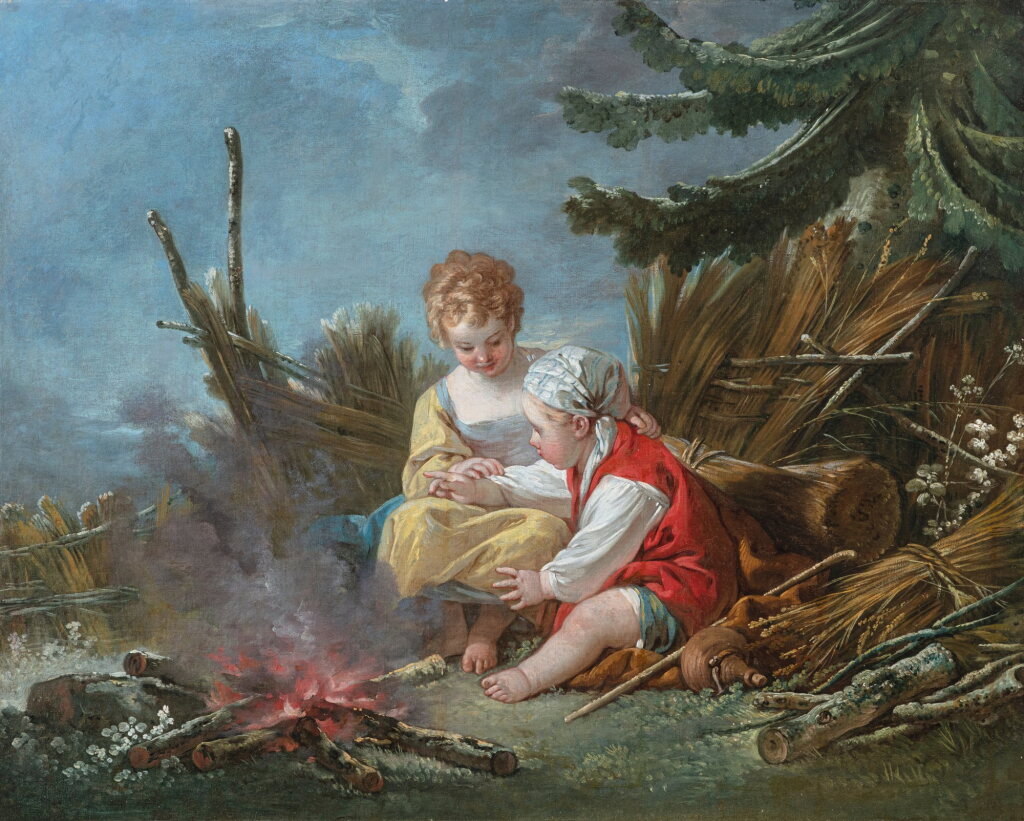
Allegory of Winter, Two Children Warming Themselves by the Fire
Oil on canvas
55,5 x 69 cm ; 21⅞ by 27⅛ in.
Styles Company;
Its liquidation sale, Paris, Galerie Georges Petit, 4 December 1922, lot 11 (sold 18.000 fr);
Where acquired by M. Decour, Paris;
His sale, Paris, Hôtel Drouot, 25 November 1969, lot 32;
Private collection.
A. Ananoff and D. Wildenstein, François Boucher, catalogue des peintures, t. II, Geneva 1976, pp. 72-72, no. 373, fig. 1091.
During the eighteenth century, the theme of children began to assume a greater prominence in French painting. In this ‘gallant century’, the depiction of innocence and childhood was particularly favoured by Boucher’s contemporaries. The artist’s spontaneous, free and fresh approach was especially sought after, notably by King Louis XV, who appointed him First Painter to the King and Director of the Académie de Peinture in 1765.
With these two children sitting beside a fire, Boucher describes a simple and touching scene. Already well known for his pastoral scenes populated with chubby putti, Boucher here revisits the charming motif of a little girl who has tenderly placed her arm around her brother’s shoulder. Her delicately drawn golden curls, brightly coloured clothes and plump cheeks flushed with red are equivalent to Boucher’s signature. White highlights deftly emphasize some elements of the background, helping to shape the scene and enhancing the effect of light that seems to emanate from the central figures. This group had already been the subject of a study drawn by Boucher, now in the Victoria & Albert Museum in London (inv. no. 4908).
The graceful quality of the scene with its gentle illustration of sibling affection were much admired by the artist’s contemporaries: Jean-Baptiste Le Prince made an etching after the drawing, now in the Victoria & Albert Museum, with the title La Chasse (The hunt).
André-Vincent Vieillard borrowed the motif to decorate the tray in his ‘Hébert’ tea service in Vincennes porcelain (Musée du Louvre, Paris, inv. OA 4041 a).
The pair of children also feature on an oval firescreen woven by the Manufacture des Gobelins, Children warming themselves; at least five examples are known to us.
Finally, the young boy reappears in The Little Fisherman, a cartoon for a chairback in the collection of the Manufacture Nationale des Gobelins (inv. GOB 35, G 46 – 64), which has been dated to 1754 by Alexandre Ananoff (op. cit ., p. 126, no. 440), who dates the present painting to 1751. Alastair Laing, on the other hand, suggests a date of about 1768, referring to the date that one of the firescreens was purchased by the Sixth Earl of Coventry for Croome Court.
Boucher made many drawings and tapestry cartoons, which were widely used in the decorative arts. Although he had been accepted into the prestigious category of history painters at the Académie Royale in 1734, Boucher chose to concentrate his efforts on painting for interior decoration, appealing to an aristocratic and bourgeois clientele. His fame grew rapidly and in 1745 he was commissioned to paint a portrait of Madame de Pompadour. A few years later, Boucher completed the decorations for her Château de Bellevue and her boudoir at the Domaine de Crécy.
The childish round forms and pink facial tints that contributed to Boucher’s success are particularly evident here: these elements were popular with the painter’s public, ensuring that he would go down in history for his contribution not only to the graphic arts but also to objets d’art.
You May Also Like