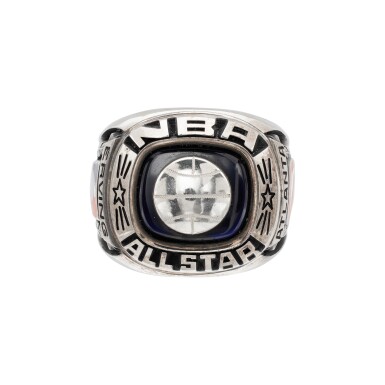
Julius “Dr. J” Erving 1978 NBA All-Star Ring
Lot Closed
July 21, 12:48 AM GMT
Estimate
40,000 - 60,000 USD
We may charge or debit your saved payment method subject to the terms set out in our Conditions of Business for Buyers.
Read more.Lot Details
Description
STEEL, METAL, BLACK STONE
Size 13
Circa 1978
Julius Erving,
Julius Erving III, son of Julius Erving,
Grey Flannel Auctions,
Private Collector
Originally presented to Julius Erving to honor his appearance in the 1978 NBA All-Star Game and later passed on to his son, Julius Erving III, the provenance of this ring is as remarkable as the man it honors. By February of 1978, Erving was already one of the biggest stars in professional basketball. In his first NBA All-Star appearance the year prior, he had put up 30 points and won All-Star Game MVP, announcing himself to the NBA stage in emphatic fashion after years of dominance in the ABA. The 1978 game was only his second NBA All-Star appearance, yet he arrived in Atlanta as the most voted-in player in the Eastern Conference, a reflection of just how quickly he had captured the imagination of a new fan base. That season he would go on to earn All-NBA First Team honors, cementing his status as one of the premier players in the league. He delivered on All-Star night as well, finishing with 16 points, 8 rebounds, 3 assists, and 1 block as the East topped the West 133-125, with Dr. J's performance at the heart of the victory.
The ring is set in classic All-Star fashion, a ball mounted in black stone, and features the Atlanta Hawks logo in tribute to the host city. It is an increasingly rare surviving artifact from Dr. J's playing days, a physical connection to a moment when one of basketball's most electric talents was at the height of his powers and at the center of the sport's growing national spotlight. Kept within the Erving family before making its way to auction in 2009, this is the kind of piece that rarely surfaces, a ring honoring and given directly to the man who wore it and the performance he delivered that night in Atlanta.
The ring is accompanied by a signed letter from Julius Erving III in regards to the provenance.
Going Deeper | Julius Erving
To understand what Julius Erving meant to basketball, it helps to understand what the game looked like before him. The dunk existed, but it belonged to the big men, used for power and proximity. What Erving did was something different entirely. He launched from distance, gathered in the air, and finished with a creativity and grace that the sport had never seen. He did not just dunk. He invented a new language for what a basketball player could be.
Erving built his legend first in the ABA, a league that embraced the kind of above-the-rim play that the NBA had not yet fully welcomed. With the Virginia Squires and then the New York Nets, he won two championships, four MVP awards across both leagues, and three scoring titles, while drawing fans to a league that desperately needed a marquee star. When the ABA merged with the NBA in 1976, Erving came with it, joining the Philadelphia 76ers and immediately becoming one of the faces of the sport at a pivotal moment in its growth.
His highlight reel from those years remains remarkable decades later. The 1976 ABA Slam Dunk Contest, where he soared from the free-throw line and seemed to hang in the air longer than physics should allow. The baseline move against the Lakers in the 1980 NBA Finals, where he went under the backboard and flipped the ball in from the other side in a single fluid motion. The "Rock the Baby" dunk. These were not just athletic feats. They were moments that expanded what people believed was possible on a basketball court.
The hardware followed. He was named NBA MVP in 1981 and two years later led the 76ers to the championship, sweeping the defending champion Los Angeles Lakers in four games. Across his 16 professional seasons, his teams never once missed the postseason. He finished his career with 30,026 combined ABA and NBA points, ninth all-time across both leagues.
Erving was inducted into the Basketball Hall of Fame in 1993 and was named to the NBA's 50th and 75th Anniversary Teams. Sports Illustrated named him one of the 40 most important athletes of all time in 1994. But the numbers and the honors only tell part of the story. The term "posterized," the idea of a dunk so decisive it belongs on a poster, was coined in his image. The slam dunk as art form, as a legitimate and graceful weapon rather than mere spectacle, is his legacy as much as anyone's. He did not just play the game at a high level. He changed what the game was.
You May Also Like