Property from the Fisher Landau Center for Art
Yinka Shonibare CBE
Dorian Gray
Lot Closed
April 16, 05:35 PM GMT
Estimate
30,000 - 50,000 USD
We may charge or debit your saved payment method subject to the terms set out in our Conditions of Business for Buyers.
Read more.Lot Details
Description
Property from the Fisher Landau Center for Art
Yinka Shonibare, CBE
b. 1962
Dorian Gray
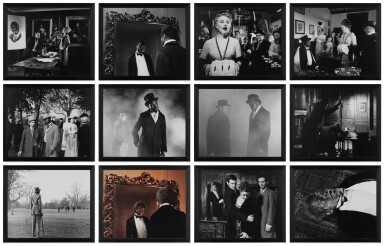
11 gelatin silver prints and one Lambda print, each framed to the artist's specifications, James Cohan Gallery, and Stephen Friedman Gallery, London, labels on the reverse
images: 29 ¼ by 35 ¾ in. (74.3 by 90.8 cm.)
Executed in 2001, this work is number 4 from an edition of 5.
James Cohan Gallery, New York
Acquired from the above in 2004 by the present owner
Yinka Shonibare's Dorian Gray (2001) is a rich and layered series. In this cinematic sequence, Shonibare refashioned the 1945 film The Picture of Dorian Gray, itself a retelling of Oscar Wilde's 1890 novel. In the original narrative, a handsome young white character trades his soul for eternal youth, and his painted portrait, rather than his body, reflects the ravages of age and moral corruption. The tale ends in tragedy when Dorian attempts to destroy the hideous portrait and kills himself instead. In Shonibare’s version, a distinguished figure clad in formal Victorian attire gazes intently at their reflection in an ornately framed mirror, set within an elegantly furnished room. The subject's encounter with their own reflection is laden with deeper meaning, suggesting an introspective examination of identity and self-perception.
Shonibare’s photographs are a potent metaphor for exploring the roots of power and the constructs of social hierarchy. By inserting himself into the role of an 1890s white English dandy, the artist challenges who gets to be the subject of cultural and historical narratives. As a disabled Englishman of Nigerian descent, his presence in that social world would have been unlikely, if not impossible, in Victorian society. The artist, like the author, plays the role of ‘other’ assuming a position denied to the vast majority. Oscar Wilde was famously persecuted and imprisoned for his sexuality, which made him an outsider to the aristocratic world his characters inhabited.
You May Also Like